

Lea nuestras publicaciones de blog en Español
October 8, 2026
What the Texas State Fire Marshal’s Office does, and why it matters
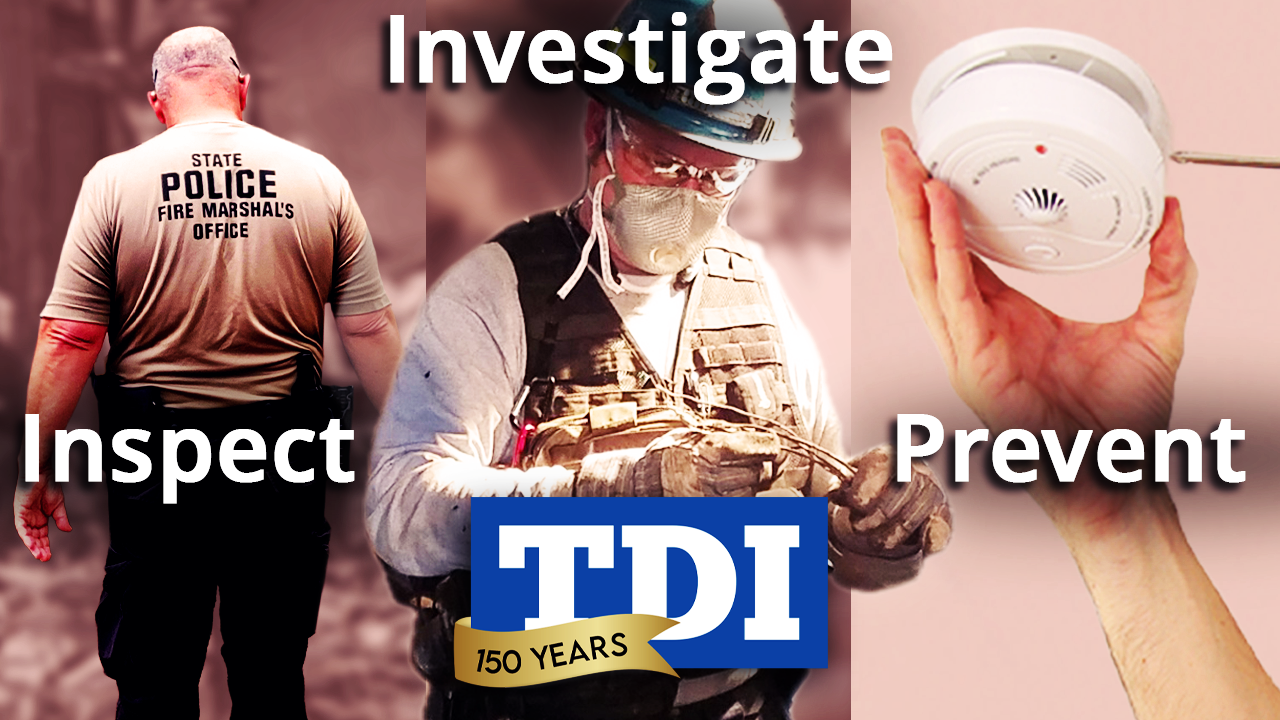
The Texas State Fire Marshal’s Office (SFMO), established in 1910, plays a crucial role in reducing the impact of fire on people and property across the State of Texas.
Learn more in TDI’s Texas Insurance Podcast.
Although the office began independently, it has operated for most of its history as a division of the Texas Department of Insurance. Today, SFMO continues its mission through fire investigation support, building inspections, and licensing key parts of the fire‑protection industry.
Statewide support for fire investigations
SFMO helps with fire investigations in all 254 Texas counties at the request of local jurisdictions or other state agencies.
Requests often come from smaller jurisdictions with limited resources, particularly when a fire involves a loss of life or damage to significant community buildings such as courthouses, grocery stores, or churches.
To support these investigations, SFMO maintains five highly trained fire‑investigation canine teams that can detect the scent of ignitable liquids that may have been used to start or spread a fire. SFMO can also provide drone support when needed.
Fire safety requirements don’t stop at the city limits
A common misconception is that no fire code applies if a local jurisdiction has not adopted one. Texas law provides a statewide safety backstop. Where a local government has not adopted a fire and life safety code, the standards adopted by the State Fire Marshal apply. Local fire officials may enforce those standards, and SFMO also has authority to inspect and enforce them in areas where they apply.
Many requirements in SFMO’s code are simple but critical. Businesses must have visible, lit exit signs and unlocked exit doors, with clear paths leading to them. During a fire, people may have only minutes to escape, and a blocked or locked exit can have deadly consequences..
How SFMO enforces fire and life safety
SFMO organizes its inspections into three main categories:
- State-owned and state-leased buildings:
SFMO inspects more than 21,000 state-owned and state-leased buildings on a regular, ongoing basis according to risk. - Fee-based inspections:
These occur when another state agency requires a fire safety inspection for entities it licenses, such as foster homes or daycare centers in unincorporated areas. - Complaint-based inspections:
These take place when SFMO receives a complaint about a potential fire safety issue. Many of these facilities are in unincorporated areas where residents mistakenly believe no fire code applies.
Community outreach and education
SFMO is also committed to educating Texans. Its education efforts include working with the American Red Cross and local volunteer fire departments to install smoke detectors in underserved communities. SFMO is also collaborating with the Central Texas Special Olympics to create a fire‑safety education program tailored to its participants’ needs.
A key safety tip for every Texan
For Fire Prevention Week this October, SFMO is highlighting safe use and charging practices for the lithium‑ion batteries commonly found in mobile phones, laptops, tablets, and other devices. You should always charge these batteries on a hard, stable surface, never on a bed, couch or other surface that can trap heat or catch fire.
Learn more
- Meet Roxy: The canine helping SFMO uncover evidence at fire scenes
- Top 3 fire safety tips for lithium-ion batteries
- How to safely charge lithium-ion batteries
- Texas State Fire Marshal’s Office 2025 State Building Inspections Annual Report
September 29, 2026
Meet Roxy: The canine helping SFMO uncover evidence at fire scenes


For Sergeant Heath Mahlmann, investigating a fire often means searching through burned debris for evidence that may be difficult for a person to find. Since 2020, he has had a partner with a very different investigative tool: Roxy, his specially trained fire-investigation canine.
Mahlmann joined the State Fire Marshal’s Office (SFMO) in 2015 after 23 years with the City of Brenham, where he worked on a fire truck and in the fire marshal’s office. In 2019, he transitioned to SFMO’s canine division and was paired with Roxy.
Born in the Netherlands in 2017, Roxy received her initial training in Alabama before coming to SFMO. Although she already knew the odors she was trained to detect, Mahlmann and Roxy spent several months developing their partnership.
“She knew the odor she was supposed to find,” Mahlmann said. “We just had to basically dial in her work ... and for us to be able to understand each other.”
Supporting fire investigations across Texas
Since beginning field work in 2020, the pair has worked approximately 550 fire scenes.
Roxy is trained to detect 14 odors associated with ignitable liquids, including gasoline, diesel, kerosene, and charcoal lighter fluid. At a fire scene, she follows an odor to its strongest source and holds her nose over it until Mahlmann gives her the command to return for her reward, a toy that, for Roxy, is essentially her paycheck.
“Her toys are her paycheck,” Mahlmann said. “All she wants to do is work, find the odor and get paid her toy.”
Keeping Roxy’s skills sharp requires regular training. Mahlmann trains with her throughout the year using different amounts of odor on surfaces such as wood, cardboard, clothing, and the ground. The pair also completes annual certification on all 14 odors in different scenarios.
Roxy’s precision has even earned her some bragging rights. At an annual canine conference, teams compete in “Closest to the Pin,” where dogs must locate a tiny amount of ignitable-liquid odor. Roxy won the competition in 2023, locating the source within approximately an eighth inch.
Life at home with an SFMO Canine
While Roxy is all business on a fire scene, Mahlmann says she has a very different personality off duty.
“She has what we call a switch,” he said. “When we put on her vest and get in a truck, she knows it’s work time.”
At home, Roxy is simply part of the family. SFMO’s canine handlers care for their dogs 24 hours a day, seven days a week.
For Mahlmann, Roxy’s value is clearest at a fire scene, where her ability to detect odors can help investigators find evidence they otherwise might miss.
“She provides a valuable service,” he said. “She’s very valuable on just about every scene.”
After hundreds of investigations, Roxy has become more than a canine partner. She’s family.
Learn more
- State fire investigator helps expose the truth behind a child’s murder
- Dogs sniff out fire accelerants for Texas State Fire Marshal’s Office
- Dog burned in fire now helps state investigate fires
September 10, 2026
Celebrating 150 years protecting Texans

The Texas Department of Insurance (TDI) is celebrating our 150‑year anniversary in 2026.
We’re honoring a legacy that began in 1876 when the 15th Legislature created the Department of Insurance, Statistics, and History.
In the 1870s, most Texans bought insurance policies from companies based in other states and foreign countries. Only four of the 61 companies selling insurance in Texas were Texas-based in 1874.
Today, TDI regulates 3,447 companies, including 843 Texas-based insurers.
Our $293.9 billion insurance market is now the second largest in the United States and the fifth largest in the world.
Through all this change, our core mission has remained constant: protecting consumers.
We do this by regulating the insurance industry fairly and diligently, promoting a stable and competitive market, and providing information that makes a difference.
As we celebrate 150 years, we honor our past and look forward to building an even stronger future for Texas.
Learn more
History of the Texas Department of InsuranceSeptember 3, 2026
Power out, food spoiled? Your insurance might help.
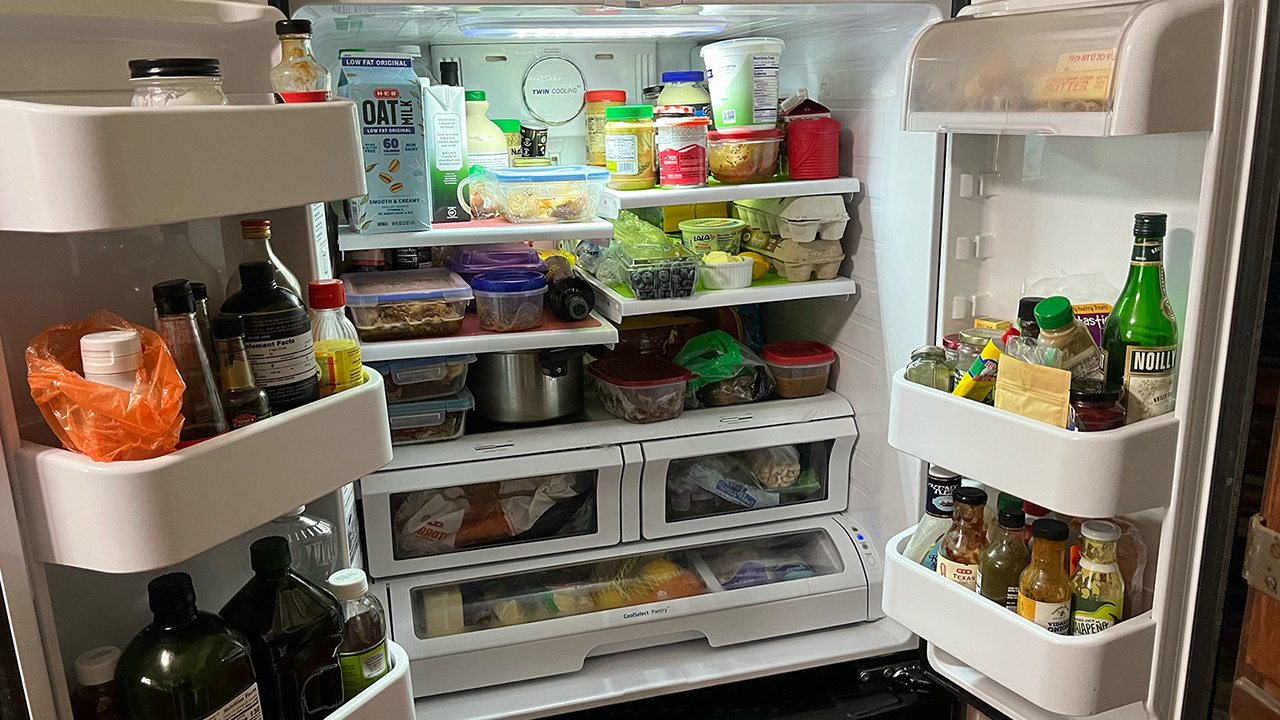
If you lose power and the food in your refrigerator spoils, can your insurance help?
Possibly.
Some homeowners and renters policies will pay up to $500 for spoiled food if the power fails under certain circumstances. Call your agent or company to ask if your policy will pay. Sometimes there is not a deductible.
Take pictures or keep a list of the food that spoiled.
And clean any food spoilage to prevent damage to your refrigerator.
Have other insurance questions? Call the TDI Help Line, 800-252-3439, 8 a.m. to 5 p.m. weekdays.
Learn more
- Does your insurance cover additional living expenses? (video)
- When do policies pay for additional living expenses?
- FAQ: Homeowners insurance and disaster claims
- Creak! Crackle! Pop! Does insurance cover fallen tree branches?
August 25, 2026
Texas wildfires: Insurance can cover home, auto damages.
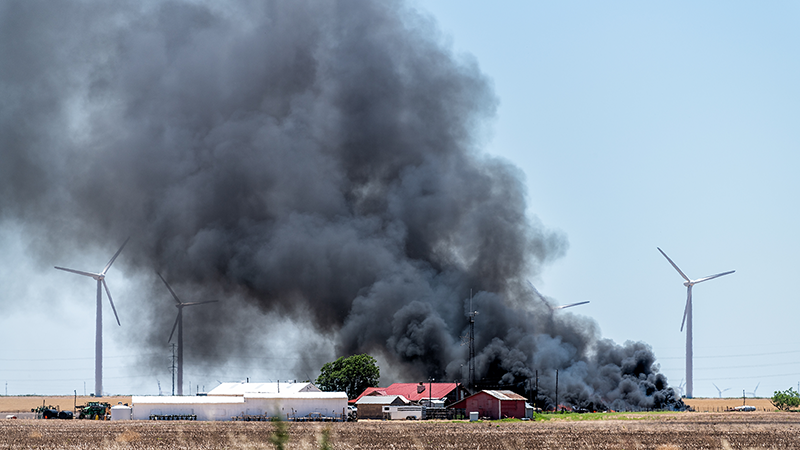
Your insurance can apply if a wildfire damages or destroys your home or car.
Some insurance tips:
- Homeowners insurance will pay to repair or replace your home or property if it is damaged or destroyed in a fire or storm, up to the policy limits. You’ll have to pay your deductible. Damage from an explosion or smoke also is typically covered.
- If you can't stay in your home because of damage covered by your policy, your homeowners or renters policy may pay for a hotel or rental. Check your policy for limits on the coverage.
- Your car is covered if you have comprehensive coverage. Some policies will pay for a rental car if yours is damaged.
- Call your agent or read your policy to check details.
Questions? Call the Texas Department of Insurance’s Help Line at 800-252-3439, 8 a.m. to 5 p.m. Monday to Friday.
Learn more
- Steps to getting your home or car insurance claim paid
- Recovery tips
- Working with an insurance adjuster
- How to avoid contracting scams
August 19, 2026
TDI law clerks gain hands-on experience in public service

For law clerks Evan Hancock and Edwin Griffis, working at the Texas Department of Insurance has been more than a traditional internship. It has given them a chance to explore public service, contribute to meaningful legal work, and experience the open, collaborative culture at TDI.
Both serve in TDI’s General Counsel Division, assisting attorneys with legal research, rule review, litigation support, and other projects across the agency.
Evan, a graduate of the University of Texas School of Law, first joined TDI as a full-time summer intern after his second year of law school. He enjoyed the experience so much that he stayed on part time throughout his final year and continues with the agency as he prepares for the bar exam.
“I came into law school with a pre-existing interest in administrative law, public law, and highly regulated industries,” Evan said.
For Evan, insurance regulation connects government, business, and consumer protection.
“Insurance aligns really well with that because it is highly regulated,” he said. “It’s something we all interact with at some point in our lives, especially when we’re facing challenging circumstances.”
Edwin, a second-year law student at the University of Texas School of Law, came to TDI after working for a state court in Mississippi. That experience sparked his interest in state government and what life as a government attorney could look like.
“TDI interested me because it tapped into a few of my areas of law that I was interested in learning more about,” Edwin said. “Insurance touches so many different things.”
Once at TDI, both law clerks quickly saw how broad the agency’s work really is. Evan was surprised by the range of functions housed under one roof, including the State Fire Marshal’s Office.
Edwin also didn’t realize the full scope of the agency before starting.
“I wasn’t even aware that the State Fire Marshal’s Office was under the same umbrella at TDI,” Edwin said. “It’s just a very large department, which makes sense.”
That variety has created opportunities for both law clerks to work on substantial projects early. Evan has assisted with litigation and settlement negotiations, public law research, insurance business matters, financial oversight work, and a memo involving constitutional law.
“One of the things I like most about being in General Counsel is the diversity of matters I have been able to pitch in on,” Evan said.
Edwin’s assignments have included answering legal questions, conducting legal research, reviewing outdated TDI rules, recommending changes as part of government efficiency efforts, and helping draft proposed statutory changes.
“It’s kind of like a grab bag of different projects,” Edwin said. “It’s mostly been legal research for me, which is fine given what I liked in law school.”
Both said TDI’s welcoming environment has made the experience even more valuable.
“Nobody here makes it hard to do your job,” Evan said. “Everybody has been very welcoming. It’s a friendly culture.”
Edwin agreed, saying, “Whenever I have questions, there’s always someone that’s willing to talk me through it.”
Their experiences show how TDI internships can help students build practical skills, explore dynamic career paths, and grow in an agency committed to serving Texans.
August 11, 2026
Make sure your renters insurance covers your personal belongings
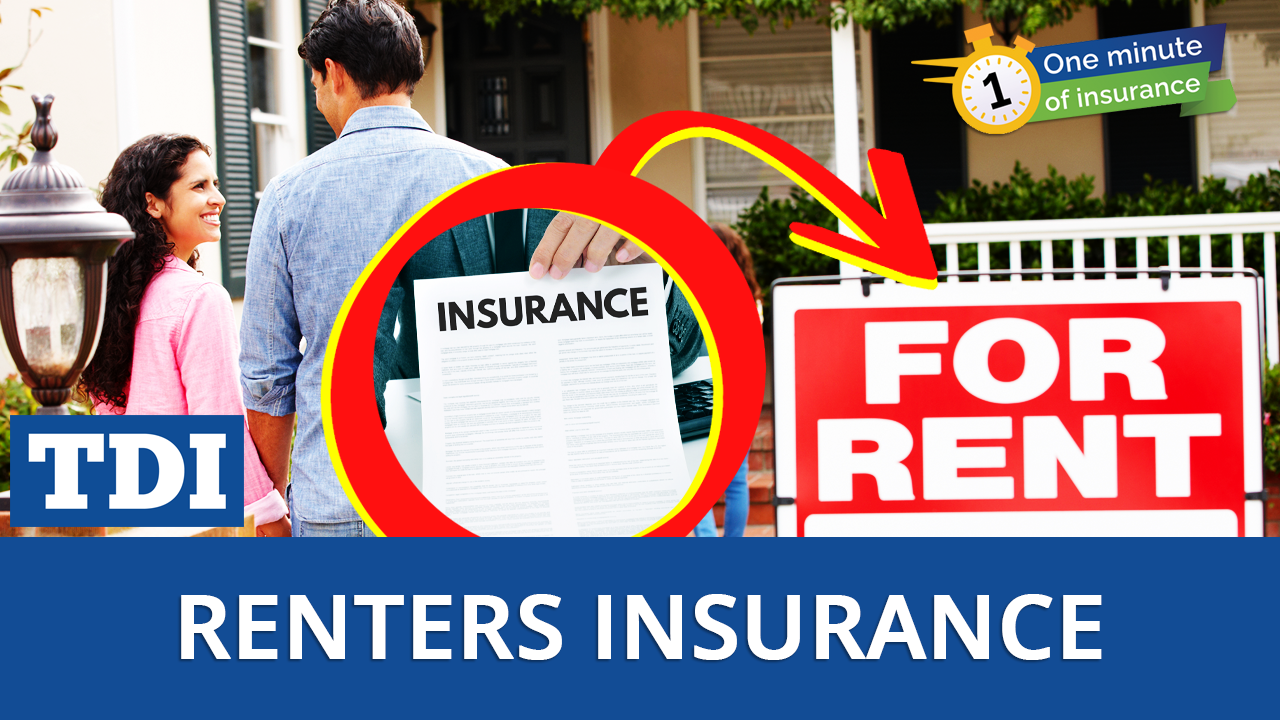
When you buy renters insurance, make sure you understand exactly what your policy covers. Some liability-only renters insurance policies don’t pay for your personal property.
Ask your agent or insurance company to explain what the policy covers—and what it doesn’t. This helps you avoid surprises if you file a claim.
Most policies also limit what they’ll pay for expensive art, jewelry, and firearms.
Also, renters insurance doesn’t cover flood damage. You’ll need a separate flood insurance policy for that.
Take time to compare options, shop around, and make sure your coverage fits your needs.
Learn more
- Renters insurance: What does it cover and how much does it cost?
- Do you need flood insurance as a renter?
- Does my roommate’s renters insurance cover my stuff?
August 10, 2026
Metal roofs and home insurance: 4 key facts for homeowners

Metal roofs are fire resistant, energy efficient, and can last longer than standard shingled roofs. If you’re thinking about switching to one, here are four things to know about how it could affect your home insurance.
1. A metal roof could lower your home insurance premium.
A metal roof could lower your premium, but not all insurers offer discounts and savings vary. Talk to your insurance agent and compare rates. Also keep in mind that metal roofs might cost more to install.
2. Metal roofs are tough, but not invincible.
Even though metal roofs are strong, they can still dent or scratch from hail, debris from high winds, and falling tree branches. While these might not affect the roof’s performance, they can hurt its curb appeal. Durability varies by metal type, panel thickness, and coating. Proper installation is also very important, so do your research when hiring a professional and choose materials wisely for your climate.
3. Your policy might not cover cosmetic damage.
If your insurance offers a discount for a metal roof, it might come with conditions like an exclusion for cosmetic damage. This means if something damages the way the roof looks, but it still functions, your insurance won’t pay to fix it. Review your policy and talk to your agent.
4. Watch for policy changes at renewal.
Even if your insurance policy covers cosmetic damage for your metal roof now, that could change at renewal time when companies can update their terms and add new exclusions.
Many policies reduce coverage as your roof ages, though this reduction is usually slower for metal roofs than it is for shingled roofs. Review your policy every year and ask your agent about updates.
If you have other questions about your insurance policy, call us at 800-252-3439.
Learn more
Insurance and your roof: What to know when buying policy or filing a claimAugust 6, 2026
Does my roommate’s renters insurance cover my stuff?
If you lease your apartment or home with a roomie, you should each buy your own renters insurance.
Big yikes: Your roommate’s policy won’t pay for your stuff if it’s lost in a robbery or fire. Their policy covers only their belongings.
Renters insurance costs less than $20 a month.
Reasons to buy a policy:
- It pays for your belongings – clothes, electronics, home décor, furniture – if they’re damaged or stolen from your rental home or car and while you’re traveling.
- If you need to move out of your rental home while it’s being repaired, it might pay for rent somewhere else and food.
- It also covers medical expenses and your legal fees if someone is hurt at your place.
If your parents have homeowners insurance, their policy will pay a certain amount to replace your belongings. But it’s likely that renters insurance would probably cover more than the limits of your parents’ homeowners policy. Check with their insurance company to get coverage amounts.
Watch our video featuring tips about college students and insurance.
Learn more
- Insurance tips – college edition
- Renters insurance: What does it cover and how much does it cost?
- Do I need insurance for my self-storage unit?
- Texas law encourages renters to buy flood coverage
August 4, 2026
Student housing fire safety

September and October are peak months for fires in student-housing—especially between 4 p.m. and midnight. Most of these are cooking fires.
From 2019 to 2023, U.S. fire departments responded to an annual average of 3,231 structure fires in dorms, fraternity and sorority houses, and other related properties.
Use these tips to stay safe:
- Make sure bedroom and other living areas have working smoke alarms.
- Practice a fire escape plan. Find two ways out of your room, apartment, or home.
- Don’t cook when you’re distracted. It could lead to a mistake and fire.
- Don’t use candles or incense.
- Keep exits, hallways, and stairwells clear of furniture or any obstructions.
- Clean the dryer lint trap before and after each use. Clogged vents are a fire hazard.
- Make sure you and your roommates know your dorm or housing’s safe meeting place.
- Leave quickly if an alarm sounds. Even a short delay can be dangerous. Leave everything and get out.
Learn more
August 3, 2026
What to do with insurance when you’re selling a vehicle

Thinking about selling your car, truck or SUV? Don’t cancel your auto insurance just yet. Find out the right time to end your vehicle’s coverage so that you’re financially protected.
Can I cancel my auto insurance before I sell my car?
No. If you cancel your auto insurance coverage, you’ll have to pay for damage that happens while it’s still in your name and any accidents that may happen during test drives.
Texas law requires drivers to prove they can pay for any accidents they cause regardless of whether the car they’re driving is for sale.
Should I cancel my auto insurance after I transfer the title to the buyer?
Contact your insurance company to remove the vehicle from your policy when the sale is final, the title has been transferred, and you’ve filed a vehicle transfer notification with the Texas Department of Motor Vehicles (TxDMV). After you file the notification, you won’t be responsible for the buyer’s parking tickets or toll violations.
What else should I know when selling my vehicle?
- You need insurance while you’re trying to sell your vehicle even if you aren’t using it.
- Comprehensive and collision coverage protects you from theft or damage before the sale is final, as well as damage if an accident happens during a test drive.
- Liability coverage protects you from damage caused to others during test drives.
- Keep all sale documents so you can confirm the insurance cancellation date.
Learn more
July 16, 2026
Insurance claim tips for Texas flood victims
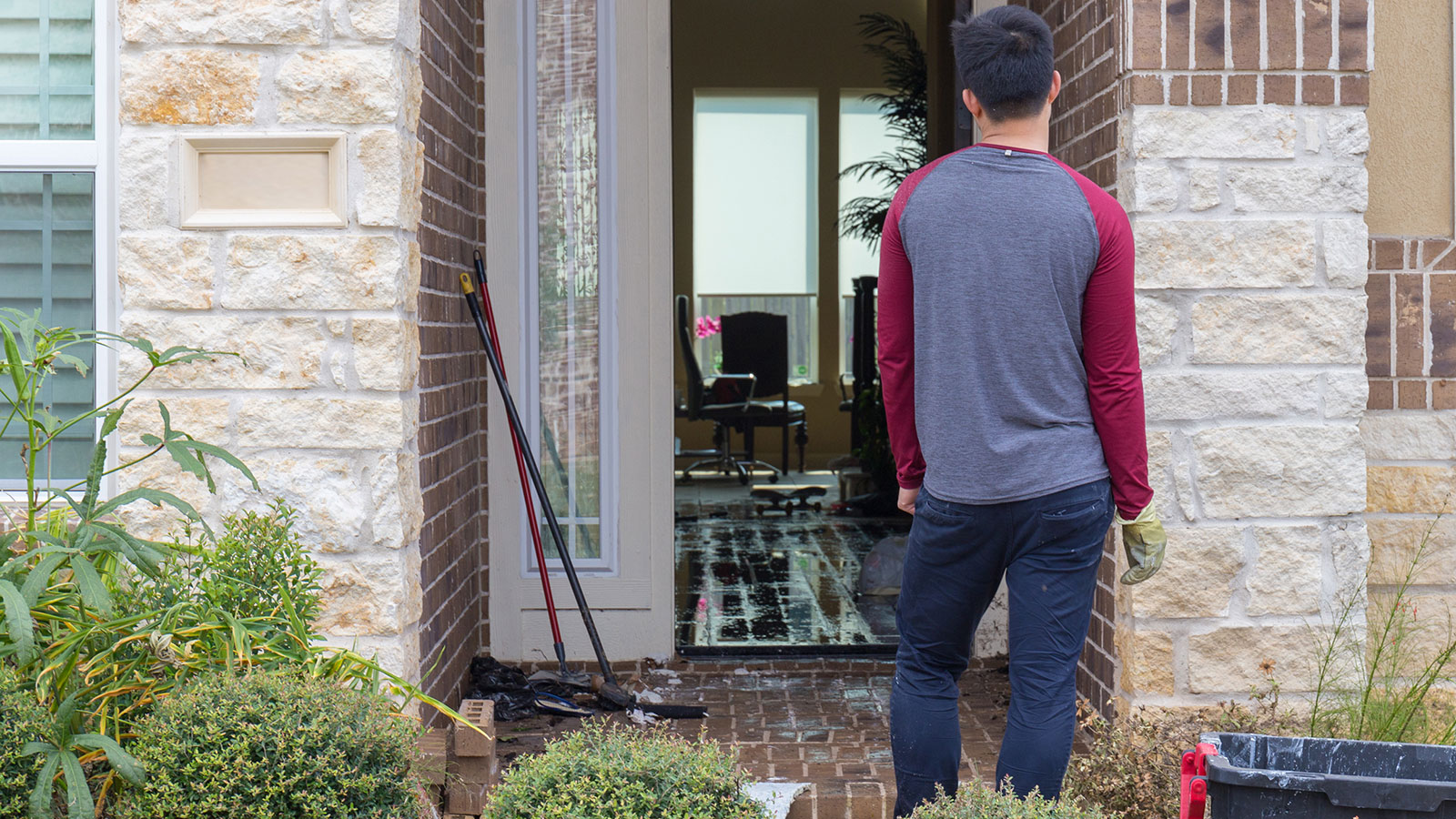
The Texas Department of Insurance (TDI) reminds flood victims to document damages and file insurance claims quickly.
For home damage
- If you have flood insurance and your home flooded, call your company to file a claim as soon as possible. If you have a policy through the National Flood Insurance Program (NFIP), call 877-336-2627. NFIP policies require you to file a claim within 60 days.
If you have a flood policy through your insurance company but can’t find their phone number, we can help. Call us at 800-252-3439.
- Not sure if you have flood insurance? Most home and renters policies don’t cover flood damage, but a few do. Even if you don’t have flood coverage, you might need a denial from your insurance company to apply for federal disaster assistance if it becomes available.
- File a home insurance claim if you have other damage. Most home policies cover damage from wind or falling tree limbs. They’ll also cover damage to fences.
- Take photos or video of the damage as soon as it’s safe. Don’t throw away damaged items until you talk to your insurance adjuster.
For auto damage
- File an auto claim if your car flooded. Your auto policy covers flood damage if you have comprehensive coverage.
- Take photos or video of the damage. If it’s safe to do so, also take pictures of your car in the water.
- Talk to a mechanic before trying to dry out a car that got water inside.
For FEMA assistance
Homeowners and renters with damage or other storm-related costs not covered by insurance policies may be able to apply for federal disaster assistance.
If you have insurance questions, call our Help Line at 800-252-3439 from 8 a.m. to 5 p.m. Central time, Monday through Friday.
Learn more
- Help after a disaster
- Workers’ compensation resources for Central Texas flooding
- Storm damage? Here are 10 tips you need to know (video)
- FAQ: Homeowners insurance and disaster claims
- Flooded cars: What to know about insurance claims and repairs
- Insurance for RVs: Know your coverages
- When are water damage and mold covered by insurance?
- What if my insurance isn't paying enough?
- How to avoid contracting scams
July 14, 2026
Why you might get a doctor’s bill after your free annual physical

Most U.S. health insurance plans pay for an annual wellness check or physical.
By law, a wellness check can include routine immunizations, cancer and depression screenings, and other basic services—at no cost to you. These free visits encourage detection of life-threatening conditions or illnesses.
Still, some patients report getting billed after a wellness check.
What gives?
You can be charged if:
- You’re visiting to treat a chronic condition such as asthma or diabetes. You can be charged a copayment for the office visit. But if you get a flu shot or other routine immunization, the shot is free.
- Your wellness check is provided by a doctor not in your insurance plan’s network. However, if an out-of-network provider is used because there is no in-network provider available, you shouldn’t be charged.
- You get treatment after a screening at your wellness check. For instance, if a CT scan at your wellness appointment detects lung cancer, you’ll have to share the costs of related surgery or medication.
If you get an unexpected bill after a wellness appointment, ask for an itemized bill with billing codes. If something seems off, ask the physician’s office. You can also follow up with your insurance company.
Have an insurance question? Call TDI’s Help Line at 800-252-3439. It’s open weekdays from 8 a.m. to 5 p.m. Central time.
Learn more
- What is an explanation of benefits? (video)
- How to save money at the doctor
- You might have gotten the bill by mistake
- How to get help with a surprise medical bill
July 10, 2026
Biking and insurance pedal together

When you ride your bike, insurance rides with you. For instance, if your bike is stolen, your homeowners or renters policy might cover replacement, though your coverage might have a dollar limit.
Read your policy or contact your agent to be sure.
If you bike often, you may want to ask your agent about liability coverage. If you cause an accident that results in property damage or injures someone, liability insurance could help cover costs you’re responsible for. If you have home or renters insurance, it likely includes liability coverage.
July 9, 2026
How to read your explanation of benefits

Understanding your explanation of benefits (EOB) is an important part of managing your health care costs. An EOB shows what your doctor billed, what your health plan covered, and what you might have to pay. Knowing how to read this document can help you avoid surprise charges and catch potential errors early.
You can learn more in TDI’s Texas Insurance Podcast.
An EOB is a document that your health plan sends you after it receives a claim for care you received. This claim could be a visit to a doctor, lab, hospital, or any other health care facility.
Each time a provider submits a claim for you, your health plan creates an EOB. It lists all the services and procedures performed during your visit, such as exams, vaccinations, surgeries, or anesthesiology.
When you receive an EOB, review it carefully. First, confirm your personal information, like your name and address. Then, check that the services listed match the services you received during your visit. Mistakes in this information can affect how much you and your health plan will pay.
Next, look at how the costs were applied to your copayment, deductible, or coinsurance. These are the amounts you’re responsible for under your health plan. If something looks wrong, contact your health plan to review the charges. If you still believe the amount is different from what your provider told you, reach out to the provider for clarification.
Learn more
- Understanding an explanation of benefits
- How to avoid costly mistakes with your health plan
- How to save money at the doctor
July 8, 2026
TDI’s new Chief Prosecutor Patrick Cryer aims to strengthen fraud enforcement across Texas
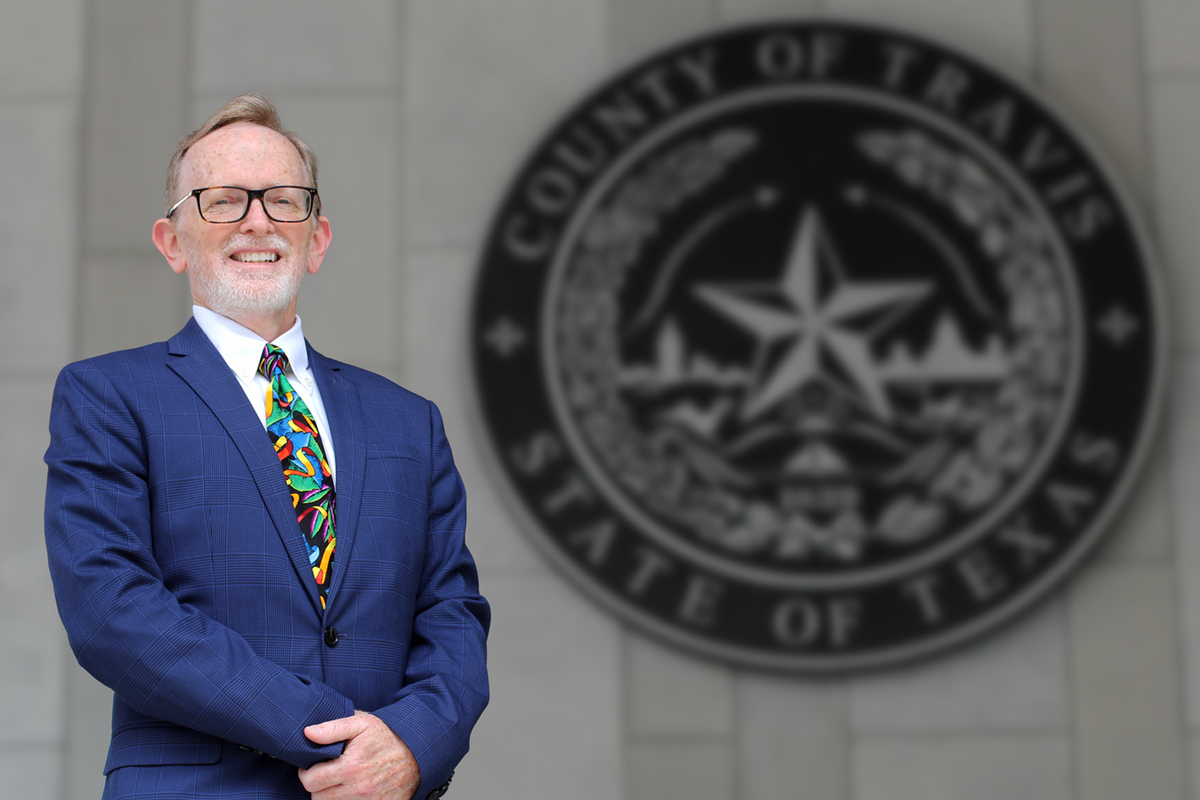
After years serving as an embedded insurance fraud prosecutor for the Texas Department of Insurance in Dallas County, Patrick Cryer is beginning a new chapter in Austin as TDI’s Chief Prosecutor and Fraud Counsel.
The transition is more than a new title, it’s an opportunity to continue learning while helping strengthen fraud prosecution efforts across Texas.
“It’s exciting to do something that’s a little outside my comfort zone and learn something new,” Cryer said.
Although he originally found himself prosecuting fraud through a routine assignment in the Dallas County District Attorney's Office, the work quickly became a passion. He believes insurance fraud is different from other crimes because its impact reaches every Texan.
“We're all affected by fraud,” Cryer said. “We see it every time we pay our insurance bill.”
Insurance fraud drives up premiums, strains resources, and ultimately increases costs for policyholders. By holding offenders accountable, Cryer says prosecutors help protect both consumers and the integrity of Texas' insurance system.
In his new leadership role, Cryer hopes to expand those efforts beyond Texas’ largest counties. One idea he is eager to explore is developing regional prosecution resources for rural areas where insurance fraud cases may otherwise sit untouched.
“I'd like to see if there are cases sitting in boxes gathering dust,” he said. “If we can move those forward, I'd like to see that happen.”
He also hopes to continue building awareness around the importance of prosecuting insurance fraud. As fraud has become a more visible topic in the national conversation, Cryer sees an opportunity to remind Texans that insurance fraud affects everyone, not only through government spending, but also through the premiums consumers pay every day.
“I think that's an opportunity,” he said. “People are realizing fraud affects them—not just through tax dollars, but through their insurance premiums as well.”
For Cryer, TDI’s embedded prosecutor model has been an important part of that mission. Working within a district attorney's office while remaining dedicated exclusively to insurance fraud allows prosecutors to focus on complex financial investigations that might otherwise compete with higher-profile criminal cases. That dedicated focus helps ensure insurance fraud cases continue moving forward and that those who commit fraud are held accountable.
Colleagues who know Cryer professionally may be surprised to learn that outside the courtroom, he spends his evenings performing stand-up comedy throughout Texas, Oklahoma, and Arkansas.
“My second job is doing stand-up,” he joked.
Comedy, he says, provides a welcome balance to the serious nature of criminal prosecution and offers an outlet after spending his days handling complex fraud cases.
As Cryer relocates to Austin and begins working with the Travis County District Attorney's Office, he's looking forward to building new relationships while continuing TDI's mission of protecting Texas consumers through effective fraud prosecution.
For Cryer, the work ultimately comes back to one simple goal: “Getting people to care about these cases.”
Learn more
- TDI prosecutors embed in Texas district attorney offices
- How TDI’s prosecutors work with Texas district attorney offices (video)
June 23, 2026
Financial examiners protect Texas insurance consumers

For nearly two decades, TDI Financial Regulation Division examiners Jacqueline Yarbrough-Whelpley and Claudia Martinez have dedicated their careers to one mission: protecting Texans by making sure insurance companies are financially sound and following state laws.
“It’s rewarding to know that you’re playing a vital role in protecting consumers by making sure insurance companies are financially stable,” said Senior Financial Solvency Examiner Claudia, who recently celebrated her 18-year anniversary with TDI.
Jacqueline, the assistant chief examiner and field manager for the Austin region, has been with TDI for 20 years. Together, they take deep pride in knowing their work safeguards Texans when they need it most.
A statewide effort with a far-reaching impact
The Financial Regulation Division has teams in Austin, Dallas–Fort Worth, Houston, and San Antonio. Each year, the teams conduct financial examinations of Texas-based insurance companies to make sure they’re complying with state laws and honoring their policy commitments. They review all types of insurers — auto, health, home, life, and more.
These examinations are detailed and rigorous. Part of the work involves analyzing balance sheets and financial records to confirm companies have the resources to pay claims. But the review goes far beyond the numbers. Examiners interview management, evaluate cybersecurity practices, and assess internal controls and compliance systems.
This level of scrutiny calls for a cross functional team of experts — analysts, actuaries, financial examiners, and support staff all play a role.
“One of the highlights of my job is the opportunity to work alongside and be mentored by exceptional people every day,” Jacqueline said. “You can sense their dedication.”
A career built on curiosity and service
Jacqueline first became interested in financial examination after an auditing professor at the University of Texas at San Antonio shared stories from the field. When she later saw a TDI job posting that called for auditing and aligned with her interest in public service, she applied — and never looked back.
Established insurance companies are generally examined once every five years, and newly licensed companies undergo more frequent reviews – typically getting three reviews in the first years.
And while a company may be domiciled, or officially based in Texas, its records can be located anywhere in the country. That means travel is often part of the job. Claudia has completed assignments in Boston, New York, Miami, Phoenix, and even Nashville.
Representing TDI with pride
One of Jacqueline’s favorite parts of the job is meeting company staff in person at the start of a new financial examination. She knows that sometimes her team is the only face of TDI they will ever meet in person.
“They’ll often use that opportunity to ask lots of questions about TDI,” she said, adding “most insurance companies really want to do the right thing.”
When issues do arise, they’re usually unintentional — compliance gaps or internal controls that need strengthening. The goal is always the same: help companies meet the standards that protect Texans.
A culture of learning and purpose
The Financial Regulation Division sets high expectations and fosters a culture of continuous learning. The work can be challenging, but the support of a talented team keeps Jacqueline and Claudia motivated and growing.
At the end of the day, both women take pride in knowing their efforts uphold TDI’s mission of protecting Texans by fairly and diligently regulating the insurance industry.
Learn more
- TDI tracks insurance companies’ finances to make sure they can pay claims
- Our mission, vision, and values
June 11, 2026
Behind the scenes with TDI’s Enforcement Section
The Texas Department of Insurance (TDI) works every day to protect Texas consumers. One way it does this is through its Enforcement Section, which makes sure insurance companies, agents, and adjusters follow state laws and treat people fairly.
You can learn more in TDI’s Texas Insurance Podcast.
What TDI’s Enforcement Section investigates
TDI looks into many kinds of insurance issues, including:
- Selling insurance without a license.
- Not paying claims on time.
- Delays or mistakes in handling claims.
- Steering drivers to specific auto repair shops, which is illegal in Texas.
Once an insurance company accepts responsibility for a claim, Texas law requires them to pay within a set timeline. If it misses that deadline, it must pay interest or penalties to the consumer.
How an investigation works
TDI’s Enforcement Section has 34 investigators and attorneys. They review complaints, look into possible violations, and take action when needed.
Here’s what happens when a case comes in:
- Investigators gather the facts.
- Attorneys review the information and decide if a violation happened.
- TDI decides the next step, which could be a warning, a consent order, or a formal hearing.
What happens at a hearing
If a case goes to the State Office of Administrative Hearings, both sides get to tell their story and present their evidence and witnesses.
- Applicants for insurance licenses can explain why they should be approved.
- Licensed agents or companies accused of misconduct can respond to the complaint.
After the hearing, an administrative law judge recommends a penalty or solution to the Texas insurance commissioner, who makes the final decision.
Learn more
- TDI analysts work behind the scenes to stop insurance fraud
- Insurance fraud investigations recover millions for Texans
- Report insurance fraud online
June 3, 2026
Experts predict an active hurricane season. Use our tips to prepare.
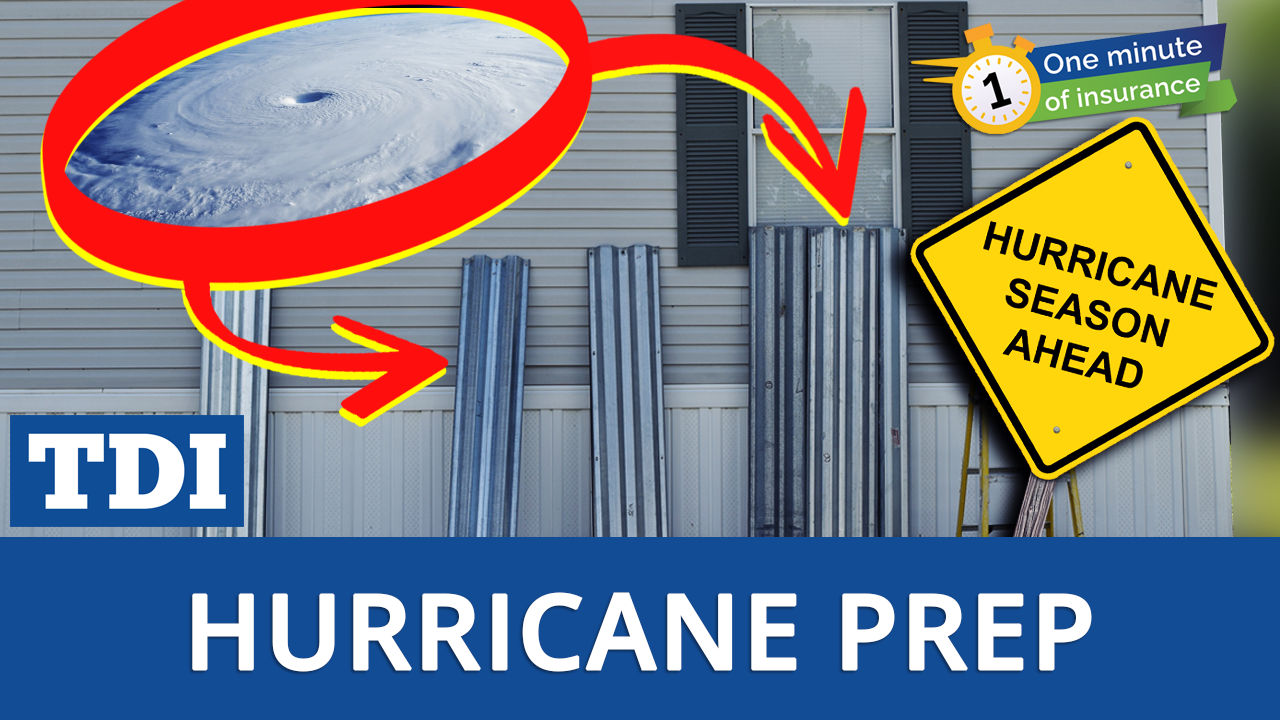
Texas and the U.S. could be in for a busy hurricane season.
The National Oceanic and Atmospheric Administration (NOAA) predicts that eight to 14 named storms could develop over the Atlantic Ocean during hurricane season, which runs from June to November. Three to six of the storms could develop into hurricanes, NOAA says, one to three of them major storms.
Colorado State University experts expect 13 named storms, including six hurricanes, two of them major storms. They warn there’s an 48% chance that a named storm hits Texas this hurricane season.
The good news is that Texans have time now to prepare.
Some tips:
- Consider buying flood insurance. Flood damage isn’t usually covered by your home insurance. Don’t wait long: It typically takes 30 days for flood policies to take effect.
- Write a family disaster plan. Start on the TexasReady.gov website
- Decide where and how far you’ll go if you evacuate.
- Build a “go kit” with food, medicine, clothes, pet food, and other vital supplies.
- Make a room-by-room home inventory. This could help later if you file a claim.
Learn more
Plan to be safe before a hurricane hits Texas
Hurricane season: How to prepare your home and property
Flood insurance: Why you need a policy
June 2, 2026
TDI analysts work behind the scenes to stop insurance fraud

TDI Fraud Unit analysts Anita Todd and Vivian Cervantez play a key role in unraveling insurance scams across Texas. Their job is to follow the financial paper trail—claims, receipts, bank records, and personal information—to reveal the full scope of a fraud scheme, identify victims, and support investigators building criminal cases.
“Some people don’t even know they’ve been scammed until we contact them,” said Vivian, the financial analyst team lead.
TDI investigators gather statements, interview suspects and victims, and collect documents. They then bring that evidence to analysts like Anita and Vivian, who search for financial links that can expose more victims and co‑conspirators.
“I look up names and dates of birth to make sure they’re real people,” criminal analyst Anita said. “Then, the investigator contacts them to see if they know a policy was created in their name.”
Their cases span every type of insurance fraud—fake medical claims, staged car crashes, fraudulent insurance sales, and even licensed agents using stolen identities to create fake policies and collect commissions.
In 2025, the Fraud Unit helped secure $50.9 million in court‑ordered restitution for victims. Twenty investigators across the state investigated 401 fraud cases, focusing on the ones with the biggest possible impact.
This work helps protect Texans and potentially saves money for all consumers.
Fake insurance agent scam
One of the most common schemes the analysts see involves scammers posing as insurance agents and insisting on direct payment in cash or through apps—methods that are harder to trace.
“Don’t sign up for car insurance on Facebook. Check out the agent and make sure they’re real,” Anita said. She also warns consumers to be cautious of anyone who shows up at your door asking for personal information.
“Don’t rely on an agent’s word alone,” Vivian added. “Contact the insurance company directly to verify your coverage and make sure you receive policy documents.”
Saving policy documents and receipts is essential to creating a paper trail that investigators can follow later.
“It gives us the evidence we need to pin the fraud on the insurance agent,” Vivian said.
Texans can verify an agent’s license on the TDI website.
Exposing a Dallas opioid scam
One of the most memorable cases for Vivian involved Dallas doctors Desi Barroga and Deno Barroga. The twin brothers overprescribed opioids and used patient insurance information to bill multiple insurers for injections they never performed at their pain management clinic.
Vivian assisted during the execution of a search warrant at the clinic alongside the U.S. Department of Labor and the U.S. Drug Enforcement Administration.
The scheme resulted in more than $45 million in false claims billed to health plans.
“In one case, they billed an insurance provider for 80 injections on the same patient in a single day,” Vivian said.
The brothers pleaded guilty, received 78-month federal prison sentences, were ordered to pay $9 million in restitution, and lost their medical licenses.
A busy mission: protecting Texans from fraud
For Vivian and Anita, helping investigators unravel complex insurance schemes is all in a day’s work.
“We stay very busy,” Anita said.
Learn more
- Look up an insurance company or agent
- Report insurance fraud online
- Insurance fraud investigations recover millions for Texans
May 14, 2026
How TDI helps Texans before and after disasters

Texas storms can move fast, but the Texas Department of Insurance (TDI) works just as quickly to keep Texans informed and supported. From helping consumers understand their coverage to hands‑on help after a disaster, TDI is here for communities across the state.
Learn more from TDI’s Texas Insurance Podcast.
How TDI prepares before severe weather
TDI stays plugged into statewide emergency operations long before a storm hits. When dangerous weather is expected, TDI joins situational awareness calls with the Texas Division of Emergency Management (TDEM) and the National Weather Service. These briefings help state agencies track threats and coordinate early action.
If the State Operations Center (SOC) activates — whether for hurricanes, tornadoes, wildfires, or flash floods — TDI sends its disaster response coordinator to the 24‑hour command center in Austin. From there, TDI shares real‑time insurance information with state and federal partners and helps coordinate support for local communities.
Working with insurance companies during a disaster
TDI leads the Texas State Disaster Coalition, a coalition of major insurance companies and state agency personnel. The coalition meets daily or weekly to share updates during and after a disaster. On these calls, TDI provides statewide updates on the disaster response and insurance companies report what their adjusters are seeing on the ground in affected areas.
Helping Texans after a disaster
After a disaster hits, TDI deploys its Disaster Assistance Response Team (DART) volunteers to local Disaster Recovery Centers (DRCs) run by FEMA and TDEM. These trained volunteers answer insurance questions face-to-face and help guide Texans through the insurance claim process.
If you’ve been affected by a natural disaster and can’t go to a DRC in person, call TDI’s Help Line at 800‑252‑3439.
Learn more
- Disaster response coordinator leads TDI response to July 4 Central Texas floods
- Before the storm
- What to do after a storm
- Disasters: how to prepare and recover
- TDI’s Role in a Disaster
May 6, 2026
Hurricane season starts in May? Prepare now.

Hurricane season starts June 1, right?
Maybe officially, but not anymore, according to Dan Reilly, a Texas-based National Weather Service meteorologist. “In most of the recent years, we’ve had many storms, before June” Reilly said. “So, in reality, I would say hurricane season probably starts in May.”
Protect your family and property by preparing now.
A few tips:
- Make or update your home inventory. Take pictures or videos of each room in your home. For major items, write down the serial number, what you paid, and date you bought it. Don’t forget to get a video of items inside closets and drawers. Having a home inventory is one of the best things you can do to make sure you get the value of your claim.
- Have an emergency kit packed and . ready to go Set aside 3 gallons of water per person, enough to last three days. Also pack non-perishable food, a can opener and utensils, a battery-powered radio, a flashlight and extra batteries. See a full kit list at ready.gov. Put some water and food supplies in your car too, just in case.
- Check your roof. Damaged shingles or leaks around chimneys or skylights will get worse in a storm. Have a professional secure loose shingles and check the metal flashing around openings or on roof valleys for leaks.
- Get your yard ready. Remove dead tree limbs and branches that hang over your house. Check for loose items that can become windborne such as yard furniture or trampolines. Tie them down.
For more tips, watch the Texas Insurance podcast.
Learn more
- How to prepare for a hurricane (video)
- Hurricane season: How to prepare your home and property
- Plan to be safe before a hurricane hits Texas
- Flood insurance: Why you need a policy
- Before the storm
May 4, 2026
How to evacuate your pets safely during an emergency

Our pets are family members. When creating an evacuation plan for your home, include your furry, feathery, and scaly friends in your plans. Whether you’re evacuating ahead of extreme weather or escaping from a fire, make sure you have an emergency plan in place.
Practice your plan
- Create and practice a Home Escape Plan to evacuate your family and pets.
- Get your pet used to the sound of your smoke alarms and being leashed or crated quickly.
- Practice evacuating everyone in two minutes or less. Fires get out of control fast, and you want everyone to know what to do and where to go.
- If you can’t evacuate with your pet during a real fire – get out and stay out. Tell first responders about any pets or family members still inside and where they might be.
Make plans if you’re gone
- Place a “Pet Alert” sticker in a front-facing window so responders will know how many pets are in the house.
- Keep your pets on the main level of your home while you’re gone. This makes it easier for them to be rescued.
- Tell a neighbor where your pet’s favorite hiding spots are. They can tell first responders when they arrive.
Prepare to evacuate
- Make an emergency kit for your pet. Collect supplies and documents and put them in a “go bag” or kennel. Place your kit by the front door where you can grab it as you leave.
- If you can’t stay with family or friends, look for pet-friendly hotels or emergency shelters along your evacuation route. Some hotels waive their no-pet policies during an emergency, so call ahead.
- Make sure your pet’s microchip is updated with your current contact information. If your pet isn’t microchipped, contact your vet.
- If you’re away from home or can’t get to your pet, call relatives and neighbors nearby and ask if they can take in your pet. Local animal shelters or animal services might also help.
Learn more
For more information, visit Prepare Your Pets for Disasters | Ready.gov.
May 4, 2026
How to stay safe with candles

Candles fill our homes with scents and light, but they’re also one of the leading causes of residential fires. Practicing candle safety is key to protecting your home and family.
Prepare candles
- Trim wicks to a half inch. This prevents high flames which can cause a fire.
- Make sure your candle holder is sturdy and doesn’t tip over easily.
- Buy candles that have fire safety labeling and follow fire safety standards.
Choose the safest place for candles
- Place candles on a sturdy, heat resistant surface that prevents them from being knocked over.
- Keep candles away from open windows, fans, vents, and drafts.
- Burn candles in a well-ventilated room.
Burn candles safely
- Don’t leave a burning candle unattended.
- Keep multiple candles at least 3 inches apart.
- Never put a lit candle within 12 inches of something flammable.
- Keep candles out of reach from children and pets. Create a three-foot safety zone.
- Don’t move a candle while it’s lit.
Extinguish a candle safely
- Don’t let candles burn all the way down. Put them out when a half inch of wax remains.
- Use a candle snuffer or gently blow out the flame.
- Don’t splash the flame with water. It can cause the candle to fall over or splatter hot wax.
- Don’t move the candle until the wax has cooled and hardened.
Safe alternatives to traditional candles
- Battery operated candles are the safest option.
- An electric candle warmer is a great way to enjoy scented candles without an open flame.
April 30, 2026
An emergency go kit helps you survive a disaster

Texas gets walloped by hail, tornadoes, hurricanes—even freezing blizzards.
Before disaster looms, put together an emergency go kit so you and your family can scoot in a hurry.
Some emergency kit tips:
- Set aside three gallons of water per person, enough to last three days.
- Also pack non-perishable food, a can opener, utensils, battery-powered radio, flashlight, and extra batteries. Remember to have chargers for your gizmos and cell phone too.
- Put water and food supplies in your car, just in case.
An expert talks about how to build your kit in this Texas Insurance Podcast.
Learn more
- Storm season: TDI's Disaster Assistance Response Team (video)
- Build a kit (Texas Division of Emergency Management)
- TexasReady.gov
April 28, 2026
Danger, danger! Don’t mix up tornado watches and warnings
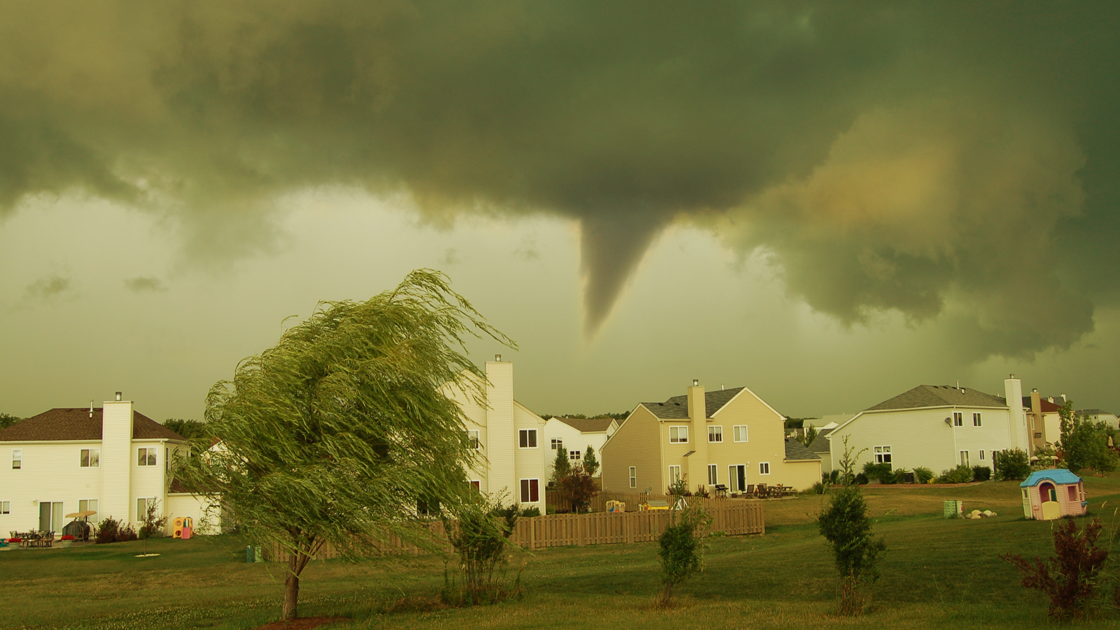
Ever mix up a tornado watch with a tornado warning?
Big difference!
- A tornado watch means keep an eye out for a possible tornado.
- A tornado warning means a tornado’s been spotted in your city or county.
Tornado warning in your area? Take cover.
People in a warning zone need to take cover immediately. If you’re in a vehicle, trailer, or mobile home, leave and head to the closest building if you have time.
If you’re in a house or building, go to an interior room, bathroom, or closet on the lowest level. Cover yourself with blankets, towels, or a mattress to stay safe from falling debris. Never open windows; it doesn’t help equalize pressure. But you should shut all your doors because that will help reduce the chance that your roof will blow off.
If you’re driving, don’t stop under bridges or overpasses. They don’t offer protection from tornadic winds or flying debris. If you can’t get to a building, lie flat and face down in the nearest ditch or depression. Cover your head with your hands.
Tornado watch in your area? Get ready.
Tune in to your local weather report to keep track of the tornado watch. Get ready to move to a safe space.
A tornado watch area is often large, covering counties, even states.
If you are under a tornado watch:
- Review your emergency plans.
- Bring in or secure outdoor objects that might blow around.
- Check supplies, such as batteries, flashlights, water, non-perishable food, and medicines.
- Identify your safe room.
Summing up: A tornado watch means get ready. A tornado warning means move quickly to safety.
Learn more
- Are you prepared for a tornado? Here’s how to protect your home
- What are some common facts about tornadoes? (video)
- For more insurance tips, visit our before the storm page.
- Division of Workers' Compensation tips: Tornado Safety (PDF) | Seguridad en caso de tornados (PDF)
April 17, 2026
State fire investigator helps expose the truth behind a child’s murder
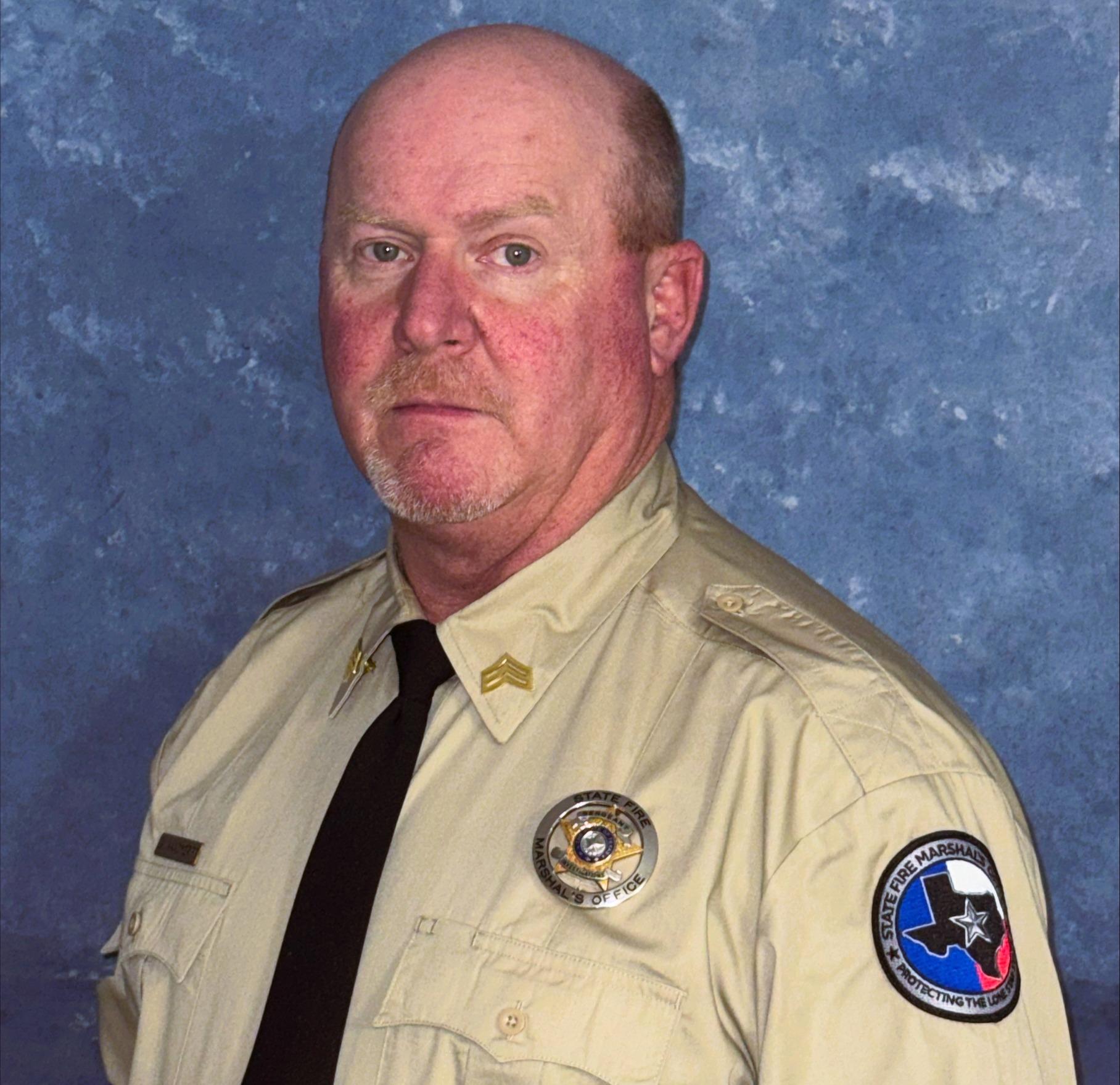
The killer of a 4-year-old girl tried to hide evidence of his crime by setting a house on fire. An investigation by a State Fire Marshal’s Office (SFMO) employee helped lead to his conviction.
Sergeant Kelly Vandygriff sensed this was no ordinary fire the moment he arrived at the smoldering home in the Texas Panhandle. A veteran fire investigator with SFMO, Vandygriff had driven three hours from Lubbock to assist in the investigation at the request of Perryton police.
“Almost immediately there was evidence of a crime,” Vandygriff said.
Suspicions arose when firefighters extinguishing the blaze found the body of 4-year-old Hope Raley in the master bedroom and located an occupant of the home, Humberto Martinez, hiding in a crawl space beneath it.
Lending expertise to local law enforcement
SFMO conducts fire investigations across all 254 counties in Texas at the request of local authorities and other state agencies, including the Texas Rangers, Texas Department of Public Safety, Texas Forest Service, and Texas Parks & Wildlife.
Each SFMO investigator, including Vandygriff, handles an average of more than 30 fire cases per year, providing specialized support to agencies in need of additional expertise.
“Any time there’s a loss of life, we make it a priority to be on the scene as quickly as possible,” Vandygriff said. “We’re there to carefully process the scene, follow the evidence, and help bring clarity to what happened.”
SFMO has 17 commissioned fire investigators and five ignitable liquid detection canine teams ready to respond wherever they’re needed. All are trained to uncover the truth behind suspicious fires. In 2025, SFMO investigators collectively responded to 80 fatality fires involving 89 victims statewide.
Vandygriff brings a wealth of experience to his work, with 37 years in the Abernathy Volunteer Fire Department, where he now serves as fire chief, and 19 years with SFMO.
A recognized leader in the field, he served six years as a commissioner on the Texas Commission on Fire Protection board, appointed by the governor. He is also a past president of the West Texas Fire and Arson Investigators Association and a member of the International Association of Arson Investigators.
At the Perryton scene, Vandygriff met up with a Texas Ranger and they were later joined by fellow SFMO investigator Sgt. Billy Lang — who worked alongside his canine partner, Kira. Together, they combed through the charred remains of the home, collecting evidence, and evaluating all possible causes.
After ruling out accidental ignition sources, Vandygriff determined the fire was intentionally set, with a lighter and nearby combustibles used to ignite the mattress where Hope’s body was found.
An autopsy witnessed by Vandygriff later determined young Hope had been strangled to death before the fire was set.
Finding justice for Hope
Though Vandygriff has spent 32 years in law enforcement, cases involving children still weigh heavily on him. “You never get used to scenes like this,” he said. He takes some solace in knowing that careful investigative work can help families find answers.
That work proved crucial in this case when the combined efforts of local law enforcement, Texas Rangers, and SFMO investigators helped secure the March 2026 conviction of Martinez. The Panhandle man pleaded guilty to capital murder and received a life sentence without the possibility of parole.
“Our team’s work helped reveal the truth in a complex and tragic case, bringing justice and closure to the victim’s family,” said State Fire Marshal Debra Knight. “Investigations like this demonstrate the critical role the SFMO plays in uncovering the facts behind suspicious fires.”
Learn more
Texas man gets life after State Fire Marshal’s Office finds arson used to hide murder
April 15, 2026
Andrew Norton joins TDI as captive insurance specialist

The Texas Department of Insurance (TDI) has hired Andrew Norton as captive insurance specialist to support the regulatory oversight of the state’s growing captive insurance market.
Andrew plays a central role in managing a sector that grew 8.6% to 101 state-domiciled captives in the six months leading up to April 2026.
“Texas is seeing continued growth – and we only have one type of captive,” Andrew said.
A captive is a wholly owned insurance company created to provide insurance coverage to its owner and affiliated companies. Captives are a form of self-insurance that are typically established to meet the unique insurance needs of the owners.
Andrew’s work makes sure that as the number of self-insurance entities grows, they remain subject to consistent and thorough evaluation.
A wealth of experience
Andrew brings more than 15 years of insurance experience to TDI, with a background in operations, Insurtech, and large-scale business improvements. This experience helps him understand how insurance structures work in real-world conditions.
“Coming from an operational background, you see the other side of risk — how it performs in real-world conditions, both expected and unexpected,” Andrew said.
His technical experience is backed by several professional designations, including Chartered Property Casualty Underwriter (CPCU), Associate in Reinsurance (ARe), and Senior Claims Law Associate (SCLA) Gold.
He has a genuine interest in learning about the insurance field and sharing what he learns with colleagues. He even displays a vanity license plate at his workstation — INSNERD — which served as his actual plate during his early career in Oklahoma.
Prioritizing transparency and efficiency
At TDI, Andrew’s main focus is maintaining a regulatory framework that’s transparent and predictable.
“The more efficiently we process an application, the better it is for everyone,” he said.
As Texas continues to see strong growth in captive formations, Andrew will help strengthen collaboration across the captive insurance ecosystem, improve regulatory processes, and support the next phase of captive market development.
Learn more
April 13, 2026
Don’t use third-party mobile payment apps to buy insurance

Protect your money when you buy insurance by paying the insurance company directly.
Some insurance companies offer their own mobile payment apps. Unless your bank approves, you should avoid using other mobile apps to pay for coverage.
Texas consumers have filed complaints about using non-company, or third-party, mobile apps to pay for insurance they never got. They’ve also complained about not being able to get their money back.
"Anyone who tells you to send money for insurance using a third-party mobile app might be involved in a scam," said Cindy Wright, a TDI consumer assistance expert. "Be cautious."
Have an insurance question? Call TDI’s Help Line at 800-252-3439 weekdays from 8 a.m. to 5 p.m. Central time.
Learn more
- 5 ways to stop insurance agent fraud (video)
- How to avoid fraudulent insurance scams
- How to avoid scams aimed at older adults
- How to avoid Medicare scams
April 9, 2026
Why every Texas family needs a fire escape plan
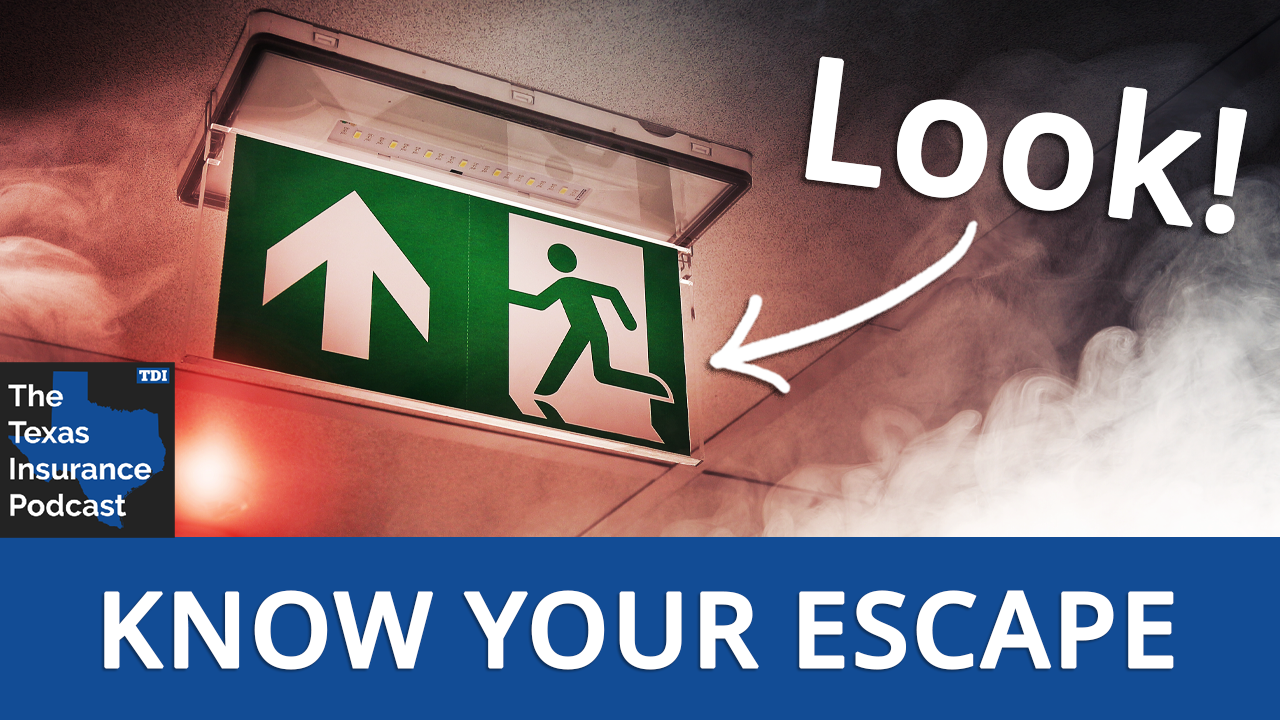
Every second counts when a fire breaks out. That’s why creating and practicing a fire escape plan is important for your family’s safety.
Learn more from TDI’s Texas Insurance Podcast.
To plan your family’s exit, draw a map of your home and find two ways out of every room. Then, walk everyone through how to use them.
You won’t always be in the living room when a fire alarm sounds. Practice escaping from bedrooms, hallways, and common areas, too. Teach everyone how to stay low to the ground to avoid smoke.
Choose a safe meeting spot
No one should go back inside a burning home. Pick a meeting place like a mailbox, a neighbor’s driveway, or a large tree. This will make sure firefighters don’t risk their lives searching for someone who’s already safe.
Prepare for second‑floor escapes
If your home has a second level, keep a fire escape ladder near a window that your family can use. Make sure the ladder fits the windowsill and that the window opens easily.
For families with young children, check the ladder’s age recommendations and practice using it safely from the first floor. Turn practicing into a game to help kids feel confident.
Learn more
- How to keep your dogs, cats, and other pets safe from fire
- How to protect your family from a home fire
- Fire safety tips for older adults (video)
- Have an exit strategy campaign
April 3, 2026
Do you know your home’s wildfire risk?

In 2011, the most destructive wildfire in Texas history destroyed more than 1,600 homes in Bastrop County. A decade later, wildfires continue to pose a risk to much of Texas – and the risk increases as population expands into wilderness areas.
You can use the Texas Wildfire Risk Assessment Portal to check the wildfire risk for your home. Just enter your address, and you’ll get a look at the risk for your property and the surrounding area. Then listen to our interview with the Texas A&M Forest Service about what you can do to reduce those risks and protect your home.
Learn more
- Wildfire risks: Projects to help you protect your home
- Texas wildfires: Insurance can cover home, auto damages.
March 9, 2026
Spring showers? Shop for flood insurance

With hurricane season starting June 1, it’s a good time to shop for flood insurance. Act soon because a flood policy typically takes effect 30 days after purchase.
Reasons to shop:
- Since 1996, 99% of U.S. counties have been affected by flooding.
- One inch of water in a home or apartment can cause over $26,000 in damage.
- People who have flood insurance receive an average claim payment of $68,000.
To shop, talk to your home or renters insurance agent or company. If they don’t offer a flood policy, go online to floodsmart.gov to find a company. You can use the National Flood Insurance Program’s (NFIP) quoting tool to get policy and premium costs.
Get expert advice on flood insurance in this Texas Insurance Podcast.
Learn more
Flood insurance: Why you need a policyMarch 2, 2026
Traveling? Remember to check for smoke, carbon monoxide detectors.

Your bags are packed, you’re ready to travel. But do you plan to check your getaway spot for smoke and carbon monoxide (CO) detectors? That would be wise.
CO is a colorless, odorless gas that replaces oxygen in your blood when you breathe it in. It can make you short of breath or cause headaches, dizziness, nausea, weakness—even death.
Each year, at least 420 people in the U.S. die from accidental CO poisoning, with more than 100,000 people going to an emergency room. And a 2019 study tallied over 100 CO poisoning incidents in U.S. hotels, motels and resorts—mostly caused by natural gas-fueled appliances.
Before or when you arrive at your vacation spot, check for:
- Working CO and smoke alarms.
- Portable fire extinguishers in easy reach.
- Directions on how to exit the building.
If you own or rent an RV, make sure it has working alarms.
For less than $50, a small portable CO detector might be worth packing. Use it at your destination and help protect your family.
Learn more
- Do you need travel insurance? (video)
- How to avoid carbon monoxide poisoning (podcast)
- What should you check out when checking into a hotel? (video)
- How to avoid carbon monoxide poisoning at home
February 19, 2026
Meet the Texas Capitol’s everyday guardian
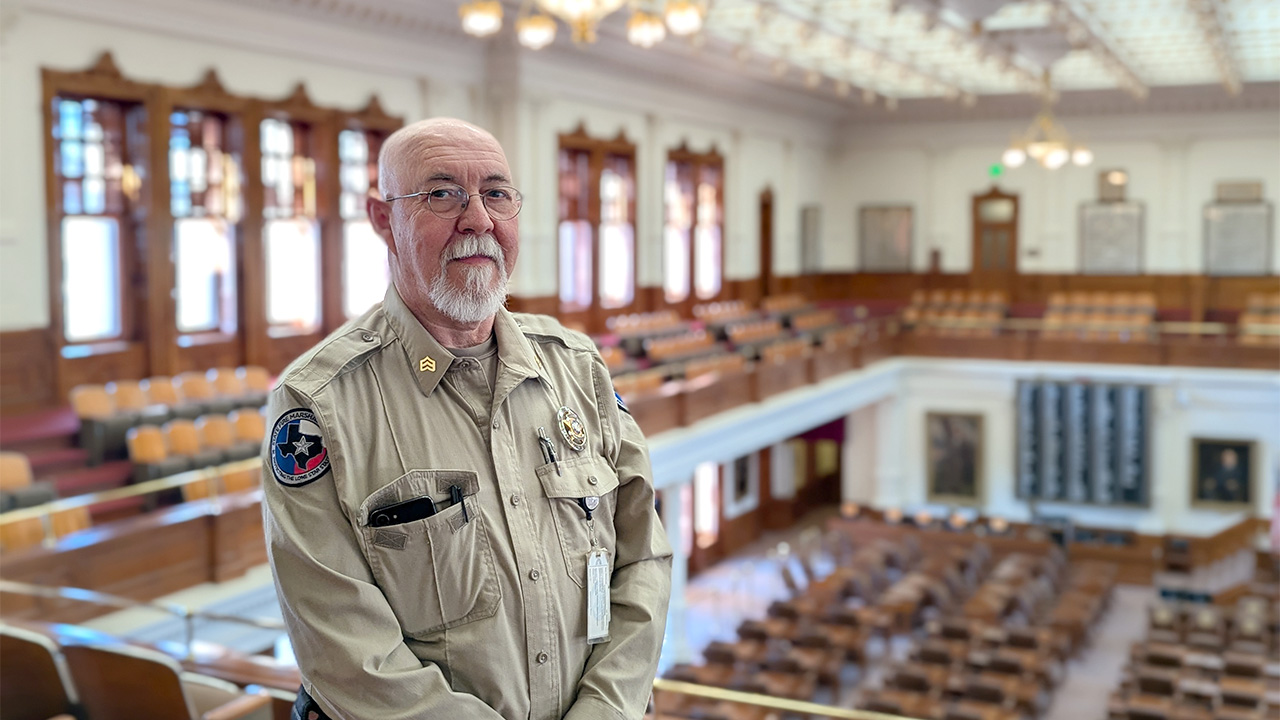
Sergeant Warren Lay in the observation gallery of the House Chamber.
Capitol Fire Marshal Sergeant Warren Lay is a familiar presence at the Capitol Complex. If you ever visit, you might see him walking through the Texas Capitol building or the Bullock Texas State History Museum on his daily fire-safety inspections.
He oversees fire protection systems for the Capitol and 15 other buildings in the Capitol Complex. “I’ve always enjoyed the fire prevention side of the service,” he said.
During events and legislative sessions, Sgt. Lay works alongside Texas Department for Public Safety (DPS) officers to manage crowds. That includes setting up movable barriers to keep visitor lines organized and making sure exits and entrances remain clear.
The pace picks up when the Legislature is in session. The Senate and House of Representatives public observation galleries each hold about 500 people, but high-interest bills can draw crowds of 2,000 or more. Fortunately, Sgt. Lay thrives on interacting with visitors.
“I get to meet a lot of interesting people from all over the world,” he said.
His workload is never static. A walkie talkie on his desk broadcasts DPS radio traffic, keeping him tuned into what’s happening around the complex at all times.
Seasonal tasks add to the variety. During the holidays, he monitors water levels for the Capitol’s Christmas trees and, for the January 2026 freeze, he oversaw the draining of drum drip pipes for the parking garage fire sprinklers, ensuring there was no water in the pressurized pipes that could freeze.
“I get to spend a lot of time in basements and attics,” he says.
The role also demands flexibility. Late-night fire alarm calls are part of the job, and they’re something he got used to during his time as a firefighter.
A new chapter in service
A Lockhart, Texas, native, Sgt. Lay spent 23 years with the Lockhart Fire Department, rising from firefighter to captain and eventually fire marshal. After retiring from that role, he joined the State Fire Marshal’s Office (SFMO) in Austin.
“After 20 years on the big, red truck, I figured I ought to get off and try something new,” he said.
He has served with SFMO for seven years and became Capitol fire marshal in 2023 following the retirement of Sgt. John Nichols.
The position itself has historic roots. It was created after a devastating 1983 fire nearly destroyed the Capitol. In response, the 68th Legislature established the State Preservation Board (SPB) to preserve and maintain the historic building and other facilities in the Capitol Complex. SPB contracts the Capitol fire marshal role through SFMO.
The role is perfect for Sgt. Lay not only because of his fire service background but also his love of history. During recent work on the Capitol roof, he salvaged two pieces of wood from the original 1888 structure still held together by hand‑forged square nails.
For him, the Capitol Complex is more than a workplace — it’s a place he feels privileged to protect. Every inspection, late-night alarm, or conversation with a visitor reminds him why he chose this path.
Learn more
February 12, 2026
What you need to know about getting an insurance license
TDI offers more than 34 license types, including both agent and adjuster licenses. Some licenses are product-specific, while others cover broader categories. Choosing the right one depends on the type of insurance products you plan to sell or service.
You can learn more in TDI’s Texas Insurance Podcast.
For most TDI license types, you’ll need to be at least 18 years old, submit to a fingerprint background check review, and pass a licensing exam. Some license types have more requirements, so check the details for the license you want on TDI’s Agent/Adjusters page before applying.
Common license types are:
- Life insurance only.
- Life, accident, and health.
- Property and casualty.
- Adjuster.
If you’re moving to Texas
If you’re moving to Texas and you already have a similar license in another state, you usually won’t have to retake the licensing exam, as long as you notify TDI within 90 days of moving. You will need to submit a new application and TDI will verify your licensing history through a national database.
Learn more
- Careers in insurance: How to become an insurance agent or adjuster
- Individual license online renewal or reinstatement guide
- Continuing education information for agents and adjusters
- What you need to know about continuing ed
- Have a question about your agent or adjuster license?
February 11, 2026
Buying a house? Beware of seller impersonation fraud.

One of the fastest-growing real estate scams targets vacant or unoccupied houses for sale.
It starts with someone forging documents to sell a house they don’t own. They list a house below market value and accept a quick offer – with a preference towards cash buyers – to steal the money from the sale.
Put your guard up if a seller:
- Tells your agent they only want a cash buyer.
- Doesn’t show up for closing or asks to sign documents electronically.
- Asks for a remote notary at signing and wants to use their own notary.
- Asks that the money from the sale go directly to them.
Some tips:
- Visit the house you want in person. Only the real homeowner can give your agent the key.
- Ask your agent to use a trusted in-person notary at closing.
- Buy title insurance. Your real estate agent will likely recommend it and your mortgage company will probably require it. Title insurance protects you from problems with an ownership title.
Report fraud to the Texas Attorney General, the Federal Trade Commission, and your local police.
Learn more
- What is title insurance? Why do I need it for my new house?
- Red Flags and Best Practices (PDF) from the Texas Land Title Association
- FAQ: Title insurance
February 10, 2026
Do you need insurance experience to work for TDI? No.

True or false? You must have an insurance background to work for the Texas Department of Insurance.
False!
TDI has wide-ranging job opportunities. Recent job openings include those for attorney, investigator, actuary, auditor, programming, and accounting positions.
Sign up to get emails of TDI job postings
Learn more
Thinking about a new job? Don’t forget the insurance.
February 9, 2026
Do you need flood insurance as a renter?
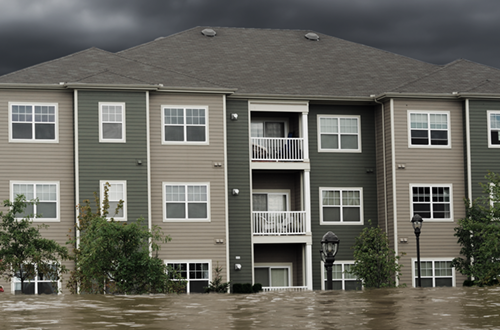
If you rent your home or apartment, you may have bought renters insurance to protect your belongings from theft, fire, or damage from a burst pipe.
But there’s more to consider. Renters policies typically don’t pay for losses due to floods. But a flood insurance policy could.
If a flood causes damage or loss, your flood policy covers personal belongings such as clothing, furniture, electronics, kitchenware, and curtains.
A flood policy doesn’t cover cash, precious metals, stock certificates, and other valuable papers. A policy also doesn’t cover cars, trucks, or personal property kept in a basement.
Shop before storm season. It typically takes 30 days for a flood policy to take effect.
Ask your insurance agent if they sell flood insurance. If not, you can buy a policy from the National Flood Insurance Program. You can also call them at 877-336-2627.
Learn more
- Renters insurance: What does it cover and how much does it cost?
- Texas law encourages renters to buy flood coverage
- Flood insurance: Why you need a policy
January 29, 2026
Unexpected indoor waterfall? Home or renters insurance might help.
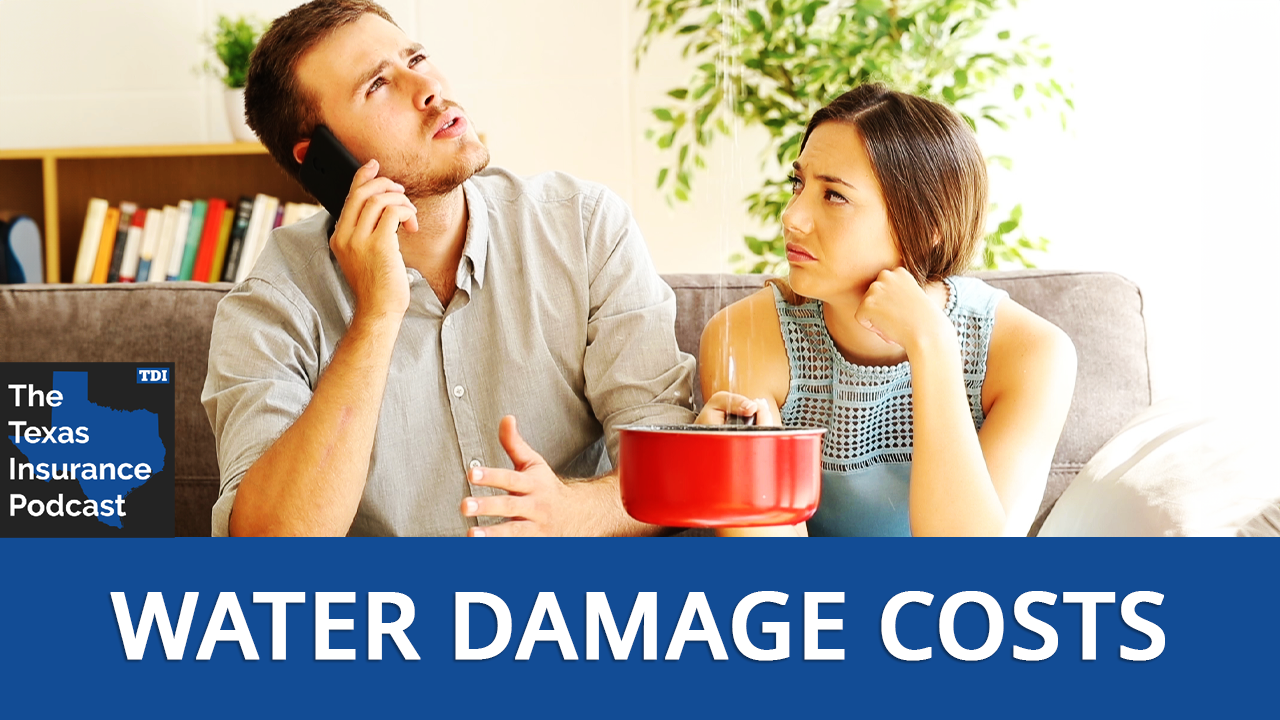
A pipe bursts—or a toilet overflows or a washer hose breaks.
Good news: Your home or renters insurance policy covers sudden and accidental water damage. Your personal belongings are covered too.
Also, if mold develops on a damaged item, it would be covered.
Still, policies usually won’t cover damage from gradual leaks or seepage—and that includes damage from mold.
Mold from a flood wouldn’t be covered because home policies don’t cover floods. You would need a separate flood policy.
If you have a sudden leak, shut your water off at the main. Move expensive items off the floor. Your insurer may deny your claim if you don’t protect your property.
One more tip: You can always check what’s covered by reading your policy or calling your agent.
Listen to this Texas Insurance Podcast to hear expert advice on insurance and water damage.
Learn more
- When are water damage and mold covered by insurance?
- Winter storms: Tips for preparing your house and pipes
January 26, 2026
A home warranty is not home insurance

When buying a home, you might be asked if you want a home warranty or residential service contract. A home warranty is different than home insurance.
- Insurance pays for damages from events your policy covers like fire or theft but not wear and tear.
- Warranties cover certain items in your home when they break down from normal wear and tear. Depending on your warranty, you may get coverage for appliances, such as stoves and refrigerators, water heaters, electrical and plumbing systems, and even swimming pools.
Home warranties can bring peace of mind about the equipment and systems that keep your home comfortable but carefully read the fine print before signing up. Not all home warranties are the same.
Under Texas law, companies that sell home warranties must be licensed by the Texas Department of Licensing and Regulation (TDLR).
Learn more
- List of TDLR-licensed residential service companies
- Residential service contract (video)
- Five things your home policy won’t cover
January 24, 2026
Does insurance cover fallen tree branches?
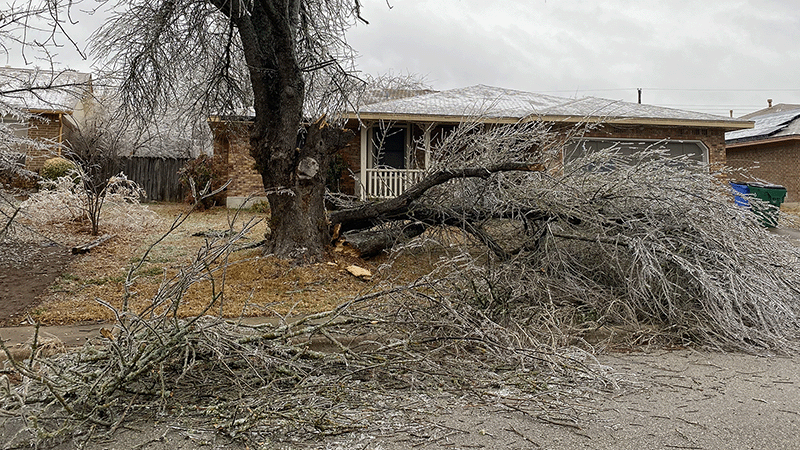
Will insurance pay when a tree crashes down on your car or house?
Sometimes.
If a tree or branch falls on your house or car, use these tips:
- Take photos of the damage before you move the tree, make repairs, or take other steps to prevent more damage.
- Make temporary repairs to prevent more damage, and contact your agent or insurance company as soon as possible.
- Save your receipts for reimbursement. Your homeowner policy should cover materials and labor used to make repairs.
FAQ about trees that fell in your yard
A tree fell on my house and damaged my roof. Will my homeowners pay for repairs?
Many policies pay for damages from falling objects, like trees. Call your agent or company to ask if your policy will pay.
A tree fell in my yard. Will my homeowners policy pay for tree removal?
Many policies provide some coverage to remove trees or limbs that fell due to storm damage and damage your house or block your driveway. Trees and limbs falling in your yard usually aren’t covered. Call your agent or company to ask if your policy will pay.
My neighbor's tree fell on my house. Will my neighbor´s homeowners policy pay for the damage and tree removal?
Probably not, unless your neighbor was at fault. Your neighbor isn’t responsible for acts of nature. If your neighbor's policy doesn’t pay, you can file a claim under your own policy.
A tree fell on my car. Will my auto insurance pay for the damage to my car?
Your auto policy will pay for damages if you have comprehensive coverage.
If the tree was your neighbor’s, their homeowners insurance might pay if your neighbor is somehow at fault. If not, their policy likely won’t pay because your neighbor isn’t responsible for an act of nature.
Other questions? Call our Help Line at 800-252-3439.
Learn more
January 23, 2026
Avoid frozen pipes and costly water damage by taking steps now
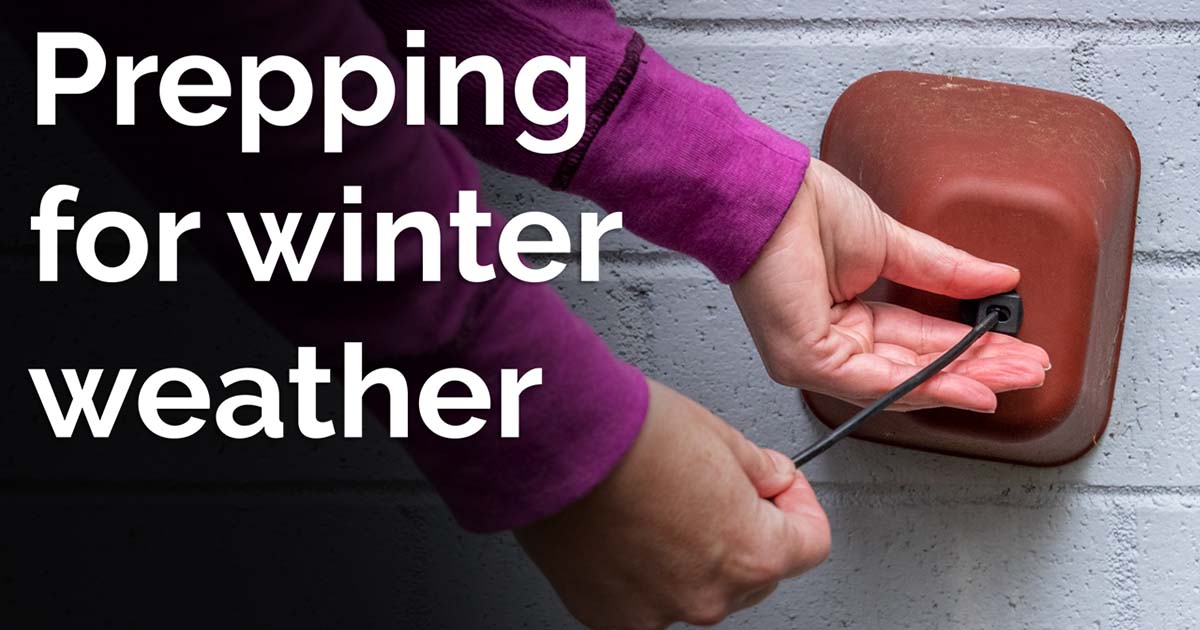
Freezing temperatures can cause frozen pipes.
But by taking simple steps now, you could head off thousands of dollars of water damage to your walls, ceilings, carpets, and furniture.
Key tips
- Install inexpensive wraps on exposed pipes. Start in the attic, where many Texas homeowners saw pipes freeze last winter.
- Wrap your outdoor faucets.
- Whether you own your home or live in an apartment or condo, identify water shutoff valves indoors and out. This will ready you for cutting off the water if a freeze poses risks.
- Don’t delay preparations until a freeze looms. Act now to ease your worries.
In this TDI video, How to prevent pipes from freezing, an expert with the Texas State Board of Plumbing Examiners shows several preventive steps you can take (plus, he spots a toad).
Learn more
- How to prepare your home for a winter storm (video)
- When are water damage and mold covered by insurance?
January 23, 2026
Preventive health screenings covered by your health plan

Did you know many preventive screenings and services are covered by your health plan —at no cost to you? Federal law requires most health plans to cover a range of preventive services. In many cases, you won’t pay a copayment or coinsurance even if you haven’t met your deductible, as long as you visit an in-network provider.
These preventive health benefits are designed to help you stay healthy and catch problems early, before they become more serious and costly to treat.
Common preventive health services
Most plans cover these screenings and services:
- Cancer screenings. Prostate, colorectal, breast, and cervical cancer screenings.
- Mental health screenings. Anxiety and depression screenings, including perinatal depression screenings during and after pregnancy.
- Chronic condition checks. Blood pressure and prediabetes testing.
- Flu shots and other recommended vaccines.
- Lifestyle screening and counseling. Alcohol, drug, and tobacco use. Obesity, sexually transmitted infections, and domestic violence.
Preventive services for women and children
- Children. Autism, developmental, and behavioral screenings. Hearing and vision checks, and well-child exams.
- Women. Contraception, breastfeeding support, folic acid supplements, and well-woman and prenatal visits.
How to access preventive benefits
Since recommended preventive services vary based on your age and risk factors, talk with your primary care doctor about which preventive services are right for you. To make sure your preventive services are covered, always confirm that your health care provider is in your insurance network, and check coverage details with your health plan’s customer service. Remember that your normal cost-sharing will apply if your visit involves more than just the preventive services.
You can find the full list of preventive services covered by Affordable Care Act health plans on the HealthCare.gov preventive health services page.
Learn more
- How to save on healthcare, from doctors to pharmacies (video)
- Health care coverage guide
- 2026 Texas Health Coverage Guide (PDF)
- Don’t overlook these unexpected health plan benefits
January 22, 2026
Auto and home insurance rate changes
Your premiums for auto and home insurance are likely different every year. This shows how much insurance companies have changed their rates on average across the state.
Private passenger auto average rate change

Source: TDI rate filing data
Homeowners average rate change

Source: TDI rate filing data
Note: includes rate changes for owner-occupied homeowners, tenants, condos, and mobile homeowners policies.
What’s the difference between a premium and a rate?
Premium – The amount you pay to an insurance company for an insurance policy.
Rate – The cost of insurance per exposure unit ($1,000 of home coverage or one year of auto coverage).
Example – A gallon of gas costs $3.50. I pay $49 to fill up my car’s 14-gallon gas tank. The premium is $49. It’s the rate ($3.50) times the unit (14 gallons).
Learn more
How are your auto and homeowners insurance costs calculated?
January 21, 2026
Ways to stay safe during cold weather

Wintry conditions could lead more Texans to rely on space heaters and other ways to stay warm. The Texas State Fire Marshal’s Office shares these tips to stay safe.
Caution with space heaters
In the last few years, several fatal fires in Texas were started by space heaters. Here are tips for keeping your family safe.
- Inspect a heater before you use it. Make sure there are no cracked or broken plugs or loose connections.
- Always plug space heaters directly into a wall outlet. Don’t use extension cords or power strips.
- Keep your space heater at least three feet from anything that can burn.
- Turn off your space heaters before you leave the room or go to bed. Look for models that shut off automatically when tipped over.
Avoid carbon monoxide poisoning
Cars, trucks, stoves, grills, fireplaces, and many appliances that burn fuel can generate carbon monoxide. You can’t see or smell it, but if enough builds up, it can be deadly.
If there’s too much carbon monoxide nearby, you may feel short of breath, have a headache, or feel dizziness, nausea, or weakness.
Use these tips to protect your family from carbon monoxide poisoning:
- Test carbon monoxide and smoke alarms.
- Never leave a car or truck running in a garage.
- Never use a charcoal grill or portable camping stove inside.
- Never use a portable generator in your home or garage, even if doors and windows are open. Only use these devices outdoors, and more than 20 feet away from open doors or windows.
- Never use a stove to heat your home.
- When using a fireplace, make sure first that the flue is open.
- If your carbon monoxide or smoke alarm go off, do not ignore it. When the alarm sounds, make sure everyone goes outdoors. Call 9-1-1 and stay outdoors until emergency responders say it’s safe to go back in.
Resources
- Space heater safety: Tips to prevent fires
- How to avoid carbon monoxide poisoning at home
- Know the dangers of carbon monoxide poisoning
- Using a generator? Stay safe from carbon monoxide
January 21, 2026
How to safely set up and run your portable generator

If you own a portable generator, remember to place it outdoors at least 20 feet from your home’s doors, windows, or vents.
Keeping a distance helps protect you from carbon monoxide gas, which is colorless, odorless, and potentially deadly.
More generator safety tips:
- Don’t put fuel in a hot generator. Turn it off and let it cool before refueling. Only put fuel in containers made for fuel. Never store fuel inside your home.
- Take care of cords. Plug appliances into your generator directly or use a heavy-duty, outdoor-rated extension cord. Check the cord for cuts, tears, or missing prongs.
- If you want to connect your generator to your house’s wiring, have a qualified electrician do it. Make sure the electrician uses a properly rated switch that meets electrical codes.
Watch our video for help using portable generators from Kelley Stalder, chief engineer of the Texas State Fire Marshal’s Office.
View podcast Q&A: How to safely use a portable generator
Learn more
- Generator safety: Knowing these tips can save your life (video)
- Using a generator? Stay safe from carbon monoxide
January 15, 2026
Don’t overlook these unexpected health plan benefits

Your health plan may provide some surprising wellness benefits. Learn about commonly covered things that you may have missed.
Telehealth
Can’t make it to a doctor’s office? Many health plans cover online appointments, often called telemedicine or telehealth, that let you meet a health care professional on your computer or phone.
Immunizations
Health plans often cover vaccinations. Be sure the ones you need are included in your plan and get them at a covered health care provider.
Other services your plan might offer:
- Gym membership discounts.
- Programs to quit smoking.
- Certain diabetes equipment.
- Other medical equipment.
Find out what your plan provides
Every health plan lists certain mandated benefits it must cover in your policy and evidence of coverage documents. Check your plan’s website and get familiar with those documents to find out what your plan pays for.
If you still have questions or aren’t sure, contact your health plan’s customer service or the insurance agent who signed you up.
Learn about health plan benefits in TDI's Texas Insurance Podcast.
Learn more
- How to save on healthcare, from doctors to pharmacies (video)
- Your health plan can help you quit smoking or lose weight.
January 8, 2026
Home insurance might cover dog bite costs

A dog bite bites—with about one in five dog bites requiring medical attention.
If your dog bites someone on your property, your homeowners insurance might help.
Tips:
- Some policies exclude certain breeds. To be sure, check your policy or call your insurance company.
- Medical payments coverage in your policy pays the medical bills of people hurt on your property. It also pays for some injuries that happen away from home, like at a park.
- You might want to buy more liability coverage through an umbrella policy. A personal liability umbrella policy helps if your home insurance doesn’t cover dog bite injuries or doesn’t pay enough. Umbrella coverage pays up to a certain amount (usually $1 million or more) for medical bills, lost wages, and lawsuits if someone sues you.
Learn more
December 19, 2025
Older Texans face greater fire risks. Learn how to make a safe exit.
Older adults have a higher risk of dying in a house fire. But taking precautions can save lives.
Some tips to prevent fires and to make a safe exit:
- Install smoke alarms on every level of your home, inside and outside the bedrooms. The best alarm system is interconnected so that when an alarm sounds in one room, alarms in the other rooms also go off.
- Keep your glasses, cane, wheelchair, or other helping devices close in case you need to leave your home quickly.
- Test your alarms monthly.
- Replace alarm units every 10 years.
Make and practice a home escape plan with everyone in your house. In a fire, you might have just two minutes to get out.
Watch our “This Is TDI” video featuring Teresa Neal of the U.S. Fire Administration who shares fire safety tips, including cooking safety tips for older adults.
Learn more
- Smoke alarms: Where to put them, how often to replace batteries
- How to protect your family from a home fire
- How to escape from a house fire
- How to prevent kitchen fires with our cooking safety tips
December 18, 2025
Keep batteries out of trash and recycling bins. You have better options.
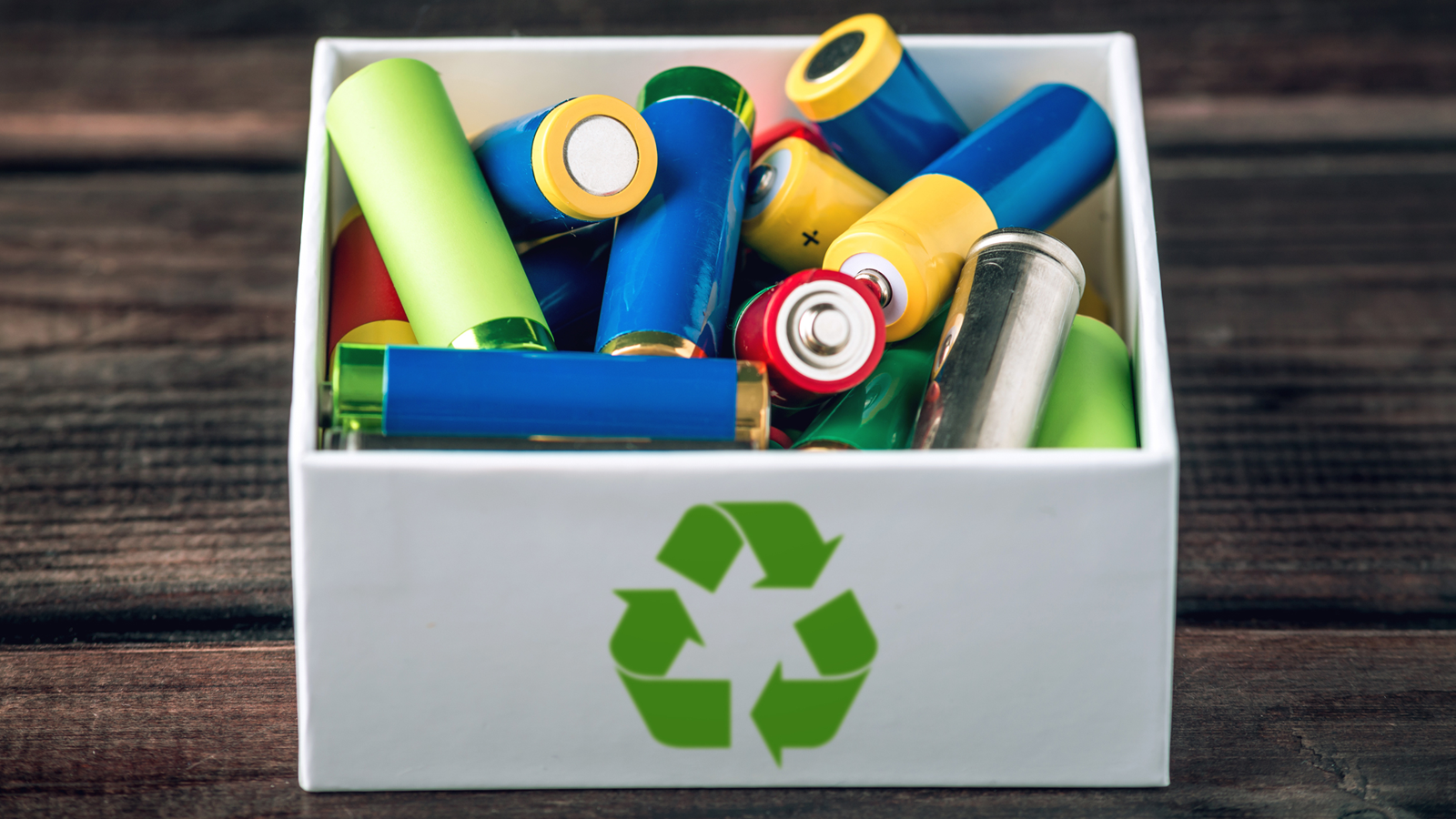
Batteries are a part of our daily lives; they power cars, phones, household devices, and much more! But improper disposal of batteries can be a possible fire hazard. Avoid putting batteries into dumpsters, trash cans, recycling bins, or compost bins.
Instead, use these safe disposal tips:
- It’s best for the environment to take batteries to a retail recycler or a community household hazardous waste collection site. Home improvement and other retail stores sometimes recycle batteries.
If you’re unable to remove a battery from the device it powers, take the whole device to an electronics store or a household hazardous waste collection site for disposal.
- It’s against Texas law to put lead-acid car or truck batteries in your trash. Take your used battery to an automotive parts store or a hazardous household waste recycling facility. Plan to pay a small fee.
- Lithium-ion batteries can cause fires and explosions if they are punctured. Do not place these batteries in your regular household trash or recycling. Instead, seal each battery’s electrical contacts – or terminals – with electrical tape. Or, put each battery in a separate container before taking them to a hazardous waste collection site.
December 11, 2025
Prepare now for winter driving hazards
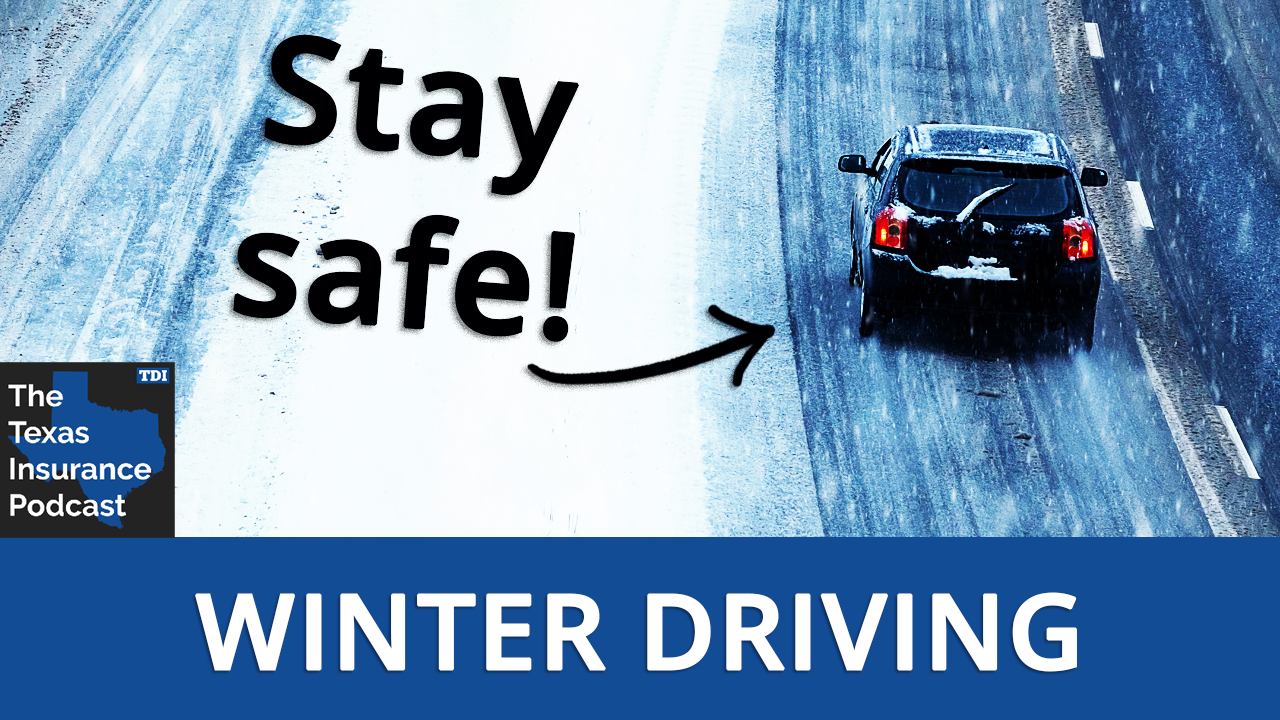
Now’s the time to get ready for winter driving hazards. Don’t wait until freezing temperatures arrive to shop for de-icer and an ice scraper – get them now so they’re ready when you need them.
Maintaining your tires is also an important part of preparing. Tires affect how your vehicle handles on roads made slippery by ice, snow, and rain. Get your tire pressure and tread depth checked and replace worn out tires.
If you must drive in wintery weather, give yourself plenty of time and keep an emergency kit in your vehicle in case you get stuck by ice and closed roads. The Texas Department of Public Safety (DPS) recommends storing water, jumper cables, a flashlight, and blankets in your vehicle and keeping your gas tank at least half full.
If you get in trouble on the road:
- Reduce your speed.
- Pull onto the shoulder or a grassy area.
- Keep your car running.
- Turn on headlights and hazard lights so others can see you.
If you need help, call the Texas Roadside Assistance number on the back of your Texas Driver License at 800-525-5555. That connects you to DPS and they can dispatch a trooper to you. Just keep in mind that it could take the trooper a while to reach you in bad weather.
Learn about preparing for winter driving hazards in TDI's Texas Insurance Podcast.
December 8, 2025
Fire safety for electric cars
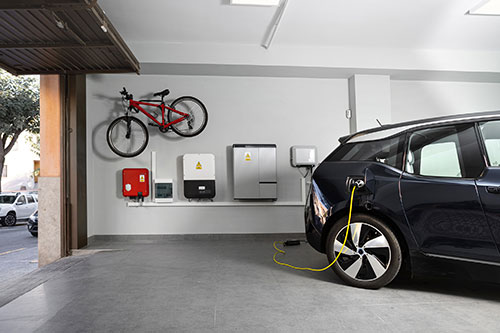
Electric cars have different fire safety risks than traditional cars. If you have an electric car or are in the market for one, make sure you know these safety tips.
- Hire a qualified electrician to inspect your home’s electrical system to make sure it can handle the charger.
- Install a circuit that’s only used to charge your car.
- Only use chargers that are nationally certified by a qualified testing laboratory.
- Follow the manufacturer’s guidelines to maintain your car and charging equipment.
- Install charging equipment away from combustible materials and high traffic areas.
- Never use a damaged or worn charger.
- Cover the charging outlet to keep water out.
- Keep children and pets away from the charging station.
- Don’t use an extension cord with the car charger.
Severe weather safety
Electric cars are generally safe to operate and charge during bad weather. But hurricanes and other severe weather can create hazards. Before storm clouds gather, make sure your electric car is ready to drive.
- Charge your battery if you think the power might go out.
- Don’t drive an electric car through a flooded street. The water can make the battery short circuit.
- If your car was submerged in water, get it professionally inspected to be sure it’s safe to use.
- During strong winds or lightning storms, don’t charge your car under trees or structures that could fall.
- Follow the manufacturer’s instructions to keep your battery working in extreme heat or cold.
In the event of an emergency
Electric cars are engineered to be safe. But it’s still good to know what to do if there’s a fire.
- If you see smoke or flames, exit the car immediately.
- Call 911 and report the fire.
- Stay away from the car while you wait for emergency responders.
- Don’t try to extinguish the flames with water or liquid.
- Don’t get back in the car until responders say it’s safe.
- Don’t try to drive your car again until it passes a professional inspection.
Pro tip: Water and electricity are a dangerous mix because water conducts electricity. Pouring water on an electric fire makes the flames bigger and puts you at risk of electrocution. If necessary, use a CO2 or dry chemical fire extinguisher on an electric vehicle.
December 5, 2025
Prepare your home before winter’s fury hits

Winter’s cold can freeze and burst your home’s pipes, causing costly misery.
But you can prepare before the temperature falls.
Before a freeze:
- Wrap outdoor and indoor pipes in unheated areas (like a clothes washer in your garage).
- Remove water hoses and wrap outdoor pipes.
- Drain and turn off your lawn sprinkler system.
Inside, open cabinets under sinks to let your home’s heat warm the pipes. Let faucets drip from the cold and hot taps or run water through your indoor faucets – hot and cold – before you go to sleep.
If your pipes freeze, turn off the water at the shutoff valve. This prevents broken pipes from leaking into your house after they thaw.
Learn about prepping your home and car for winter’s cold in TDI's Texas Insurance Podcast.
Learn more
- Winter storms: Tips for preparing your house and pipes
- How to prevent pipes from freezing (video)
- How to make your house winter-ready
December 2, 2025
Fire safety for holiday decorations

Did you know fire departments respond to about 832 home fires each year that are caused by holiday decorations? About 145 involve a Christmas tree. Whether you’re decking the halls or hanging lights, stay safe this season with these tips.
- Never use candles to decorate the tree. Use lights that are rated for indoor use by a nationally recognized testing lab. Turn off the lights before you go to bed.
- Check your lights. Whether they’re going on the tree or the house, replace any string of lights that has worn or broken cords or loose bulbs. Use clips or tape to hang lights. Nails can damage the cords.
- Use electric candles. If you choose to light traditional candles, keep them away from other decorations. Blow out the candles when you leave the room or go to bed.
- Choose the right extension cord for outdoor decorations. If you have an inflatable figure or lighting in your yard or on your house, make sure you use a cord that’s rated for outdoor use by a nationally recognized testing lab. Don’t use extension cords that are frayed or damaged.
- Display your decorations in safe locations. Keep them away from doors and paths you might use in an emergency. Don’t block windows.
Learn more
- Holiday fire safety tips (NFPA)
- Holiday fire safety (US Fire Academy)
December 1, 2025
Ask these questions before you buy and insure your home
Owning and insuring a home is a big deal. You’ll want to ask questions before you buy.
Here are a few questions that could affect how much you pay for home insurance:
- How far away are emergency services like the fire department? Is it a paid fire station or a volunteer fire department?
- Is the home in an area that has flooded in the past? Flood damage is not covered by most home insurance. You’ll need a separate flood policy to cover rising water.
- Have there been past insurance claims on this home? Ask the owner for a CLUE report; it shows claims filed for a property over recent years.
- Check if the home has features that could reduce the risk of future claims. Is the roof new? Does the home have an alarm system or fire sprinklers? Such safety features could qualify you for an insurance discount.
Learn more
- How much homeowners insurance do you need? (video)
- Home insurance guide
- FAQ: Homeowners insurance, claims, saving money, and more
- Tips to help you shop for homeowners insurance
- How to get a CLUE about your claims history
- Home policies: Replacement cost or actual cash value?
December 1, 2025
Staying safe when lightning strikes
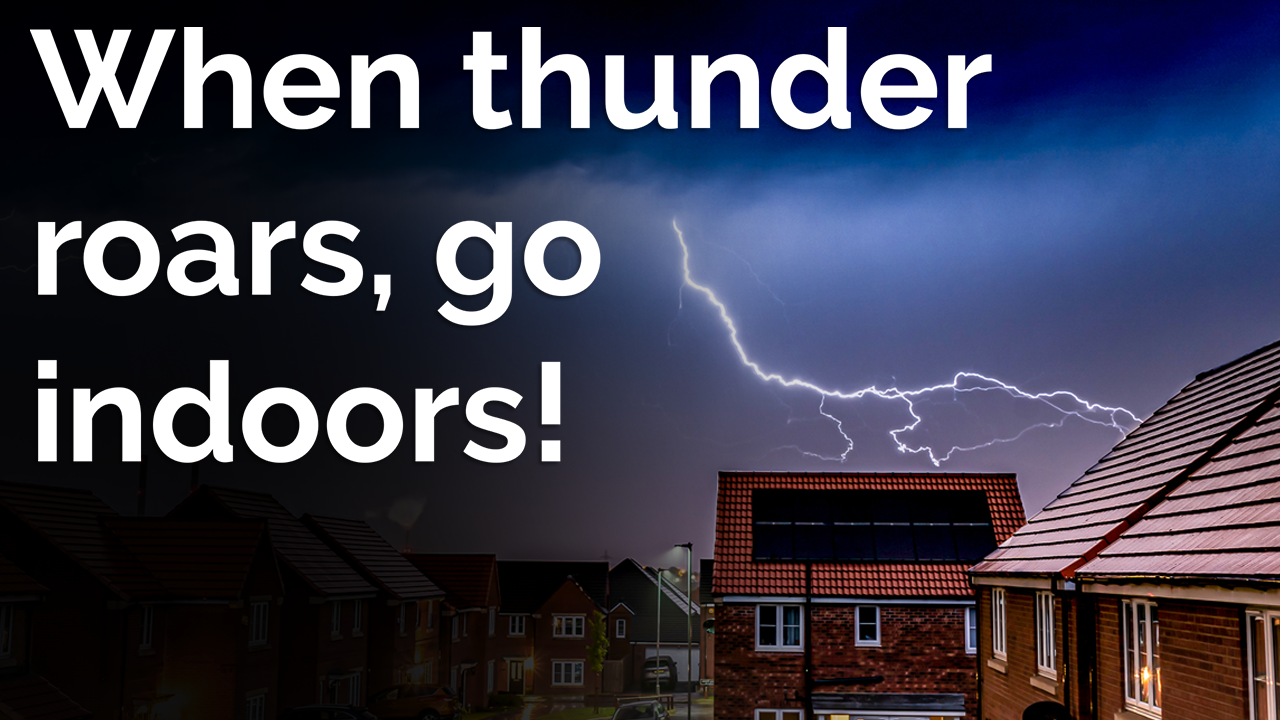
In any given year, your odds of getting struck by lightning are less than one in a million. Doesn’t sound too bad, right? But across your lifetime, the odds don’t look that great – they go to one in 15,300. Of course, the odds of you getting hit go higher if you ignore the dangers of thunderstorms.
Heed these tips and avoid zaps from the sky:
- If you’re outdoors and you see lightning or hear thunder, enter a sturdy building or get inside a car and close the windows.
- Stay away from utility poles and metal fences. And get out of cars with soft tops, tractors, and motorcycles.
- Don’t lie flat on the ground or in a ditch. Run to the nearest building or car. If your hair stands on end, squat down, and put your head between your knees.
- If you’re indoors, stay away from windows, plugged-in appliances, computers, and power tools. And don’t take a shower or bath, wash dishes, or stand near plumbing; water pipes conduct electricity.
There are also ways to protect your house from lightning.
Homeowners can invest in a lightning protection system, which has three parts:
- Lightning rod: Intercepts the lightning.
- Down conductor: Takes energy from the lightning down the side of the building.
- Ground terminals or grounding rods: Takes the energy from the down conductor and puts it deep into the ground.
If you want to install a lightning protection system, hire a professional certified by the Lightning Protection Institute.
In this video, John Jensenius of the National Lightning Safety Council talks about:
- Common outdoor activities that put people at risk of being struck by lightning.
- The odds of getting struck.
- How to protect your home.
Learn more
November 20, 2025
Disaster response coordinator leads TDI response to July 4 Central Texas floods

In the aftermath of the July 4th Flood Disaster, an exhausted woman arrived at the Family Assistance Center (FAC) in Kerrville seeking support after losing family and narrowly escaping the fast-rising flood waters with her life.
At the FAC, she found a team of grief counselors, government agencies, and aid organizations ready to help.
There she could replace her lost Driver License at the Department of Motor Vehicles booth, get a new Social Security card from Social Security Administration staff, and meet with Texas Department of Insurance (TDI) disaster assistance volunteers who shared tips on locating insurance policies and helped guide her through the claims process.
Training and scheduling TDI volunteers for disaster response and recovery are just two ways TDI Disaster Response Coordinator Andrew Davis helps Texas prepare and respond to natural disasters like hurricanes, tornados, wildfires, and flash floods.
“We have very dedicated staff that will help no matter what,” Andrew said. “Once the volunteer schedule was set, none of the volunteers backed out.”
The FAC is a special resource center for those who’ve lost loved ones in a disaster. After the July 4th Flood Disaster, the Kerrville FAC was set up in a school.
There, survivors were served meals, met with counselors, and accessed services from state agencies. Grief therapy dogs and cats were also available to ease frayed nerves.
“It was a very calm, soothing environment. They really did a great job,” Andrew said.
For those who lost property, seven Disaster Recovery Centers (DRCs) across Central Texas offered help. Affected Texans could meet with TDI volunteers to get assistance filing insurance claims, file a claim with FEMA, and talk to other federal and state agencies.
Andrew managed 30 TDI volunteers who were deployed to the FAC and DRCs for 12 hours a day, seven days a week during the 13-week s of the post-flood deployment.
Besides staffing the resource centers, Andrew also worked with the Texas Division of Emergency Management (TDEM) to help identify insurance carriers for the roughly 100 vehicles pulled from the Guadalupe River. The Texas Department of Public Safety identified owners using VIN numbers, then passed those names along to TDEM to find the insurers.
The July 4th Flood Disaster marked the second-longest ever TDI deployment at the State Operations Center (SOC) in Austin – surpassed only by Hurricane Harvey in 2017. The SOC is a 24-hour communications command center operated by TDEM during disasters. Once activated, it monitors threats, provides information to local, state, and federal authorities, and coordinates assistance requests from local governments.
Andrew spearheads TDI’s disaster response. A seasoned TDI staffer with seven years of service – including six years as a Disaster Assistance Response Team (DART) volunteer – he represents the agency at the SOC, oversees volunteer training and scheduling, and keeps a close eye on severe weather developments.
His current role aligns perfectly with a passion for weather that started during his youth in Houston, where he spent a lot of time tracking hurricanes.
“I’m a weather fanatic – always have been,” he said. “This is the next best thing to being a forecaster.”
Whenever severe weather looms, Andrew joins daily calls with TDEM and the National Weather Service. He listens closely and sends detailed summaries of the forecast and available state resources to managers, colleagues in the Consumer Protection Division, and TDI disaster duty volunteers.
“I love what I do. Every day is something different,” Andrew said. “I’m surrounded by a talented team and I get to work with staff from all over TDI.”
November 14, 2025
Did your health plan deny a treatment? Ask for an appeal.

Has your doctor told you that you need a medical treatment that your health plan denied? If so, you might have the right to appeal the decision.
The notice you got from the health plan telling you that it denied your treatment or service should tell you how to appeal.
State and federal laws require your plan to have an appeals process.
If you have Medicare or Medicaid, ask those programs about your appeal rights.
You, your doctor, or someone representing you can appeal a health plan’s decision.
Learn more
- How to file an appeal or ask for an external review
- How consumers are protected from surprise medical bills
- How to avoid costly mistakes with your health plan
November 6, 2025
How to choose the right health plan

Finding the right health plan starts with knowing your options. There are three main types of plans that offer major medical coverage:
- Preferred provider (PPO) plans. PPOs have higher premiums but more flexibility in doctors. You might need preapproval for some procedures.
- Health maintenance (HMO) plans. HMOs have lower costs, but you’re limited to in-network providers, so make sure your doctors are in the network. You must choose a primary care physician who coordinates your care and usually need a referral to see a specialist.
- Exclusive provider (EPO) plans. EPOs are like HMOs without any out-of-network coverage. You don’t have to pick a primary care physician and can see specialists without a referral. Premiums are usually higher than HMOs but less than PPOs.
Be careful about limited benefit health plans. These may have lower premiums, but they aren’t comprehensive. They don’t meet Affordable Care Act standards and often don’t pay for preexisting conditions, like diabetes.
Other costs you might pay
When you see a doctor or get a health care service, you might need to pay some of the cost yourself until you reach your plan's out-of-pocket limit. These costs are the:
- Annual deductible.
- Copays for doctors and specialists.
- Prescription drug costs.
- Coinsurance.
Know if the plan meets your needs
To see if a health plan is right for you, read its Summary of Benefits and Coverage. This document lets you make a side-by-side comparison of the coverage in different plans. Start by reviewing what you will pay for the care you are likely to need – such as visits to your doctors or specialists, urgent care, and emergency rooms. Compare what the plan will cover before you meet the deductible. Also review the plan limits and exclusions.
Before you buy a plan, ask if your doctors and specialists are in their network and check that your prescription medications are covered. Ask how much you will pay each month to refill for your prescriptions.
When to sign up for a health plan
You can get a new health plan during open enrollment. If you’re shopping on HealthCare.gov, this is from November 1 to January 15. Enroll by December 15 to get coverage that starts January 1. Have an estimate of your annual income ready to see if you qualify for a credit to lower your monthly premium.
Even if you’re keeping the same health plan you had last year, check that you can still get the same benefits. These can change from year to year.
If you have a health plan through your job, ask for open enrollment dates from your company’s human resources department.
Special sign-up times outside of open enrollment
There are special enrollment periods for big life changes, like the birth or adoption of a child, marriage, or moving to a new state or country where your plan isn’t available. Sometimes your income changes and you might qualify for a tax credit that you didn’t qualify for before.
If you qualify for a special enrollment period, contact HealthCare.gov or your job’s human resources department.
Learn more about enrolling for a health plan on the Texas Insurance Podcast.
Learn more
- Before you buy an alternative health plan... (video)
- Use these tips to shop smart for health coverage.
- Health care coverage guide.
- How to apply and enroll.
- Alternative health plans.
- Know what kind of health insurance you’re buying.
November 3, 2025
TDI employs more than 110 veterans and welcomes more applicants

TDI staff are proud to work alongside many of our nation’s military veterans—and welcome more.
We're honored to call these veterans our coworkers.
“Veterans bring invaluable experience and dedication to our team,” said Cynthia Olivier, associate commissioner of human resources. “We’re proud to have more than 110 veterans on staff and we’re always eager to welcome more.”
If you’re a veteran seeking work, check out our job postings and contact the TDI human resources team with questions at HR-Recruitment@tdi.texas.gov.
You also can sign up for email alerts to new openings.
If you are interested in applying for a job, be sure to read our Before you apply webpage for important notes and documents you will need to submit.
November 1, 2025
It’s health insurance shopping season—but watch for red flags

Across America, it’s sign-up season for health insurance—a chance to shop for coverage that fits your health and budget needs.
You have until Jan. 15 to browse insurance options on HealthCare.gov.
Warning: You should also watch for signs that something might not be right.
Some red flags:
- You get a call from someone you didn’t contact first. You should be in control of when you shop, what you’re shopping for, and who you ask for help.
- If an agent can’t answer basic questions—such as a plan’s copays, deductible or premium amounts, or give you specific plan information in writing—that’s a red flag; and it might be a scam.
- If you feel pressured to commit to a plan right away, just say no. No legitimate plan changes its price or other terms during enrollment season.
- If you see coverage that costs far less than other plans, hold off. There may be catches that cost you, like fewer benefits. If a deal sounds too good to be true, it probably isn’t true.
Learn more
- Find the health plan that fits your needs (video)
- Before you buy an alternative health plan... (video)
- Use these tips to shop smart for health coverage.
October 30, 2025
Open enrollment for Medicare runs through December 7
It’s that season, time to shop for what you want in Medicare.
Medicare, federally-funded health insurance, is open to Americans 65 or older, younger people with disabilities, and people with end stage renal disease.
You have until Dec. 7 to change your Medicare health or drug coverage for 2026. The open enrollment period lets you join, switch, or drop a Medicare Advantage Plan or a Medicare drug plan.
A Medicare Advantage plan provides Medicare through a private company.
Sometimes a plan offers additional benefits. For instance, you may not need a separate drug plan if your Medicare Advantage plan has drug coverage.
Any changes you make take effect January 1.
In our Texas Insurance Podcast, we spoke with the Area Agency on Aging of the Capital Area about tips to find a plan that works best for you.
Learn more
October 30, 2025
Does insurance cover treatment for mental health and substance use disorders?

If you’re dealing with stress, depression, anxiety, or substance abuse issues, your insurance should help cover your treatment—just like it would with a medical issue.
What Texans should know about insurance coverage for mental health and substance use disorders:
- Most health insurance plans cover services for mental health and substance use disorders. If you aren’t sure, check your policy or contact your insurance company.
- The law guarantees “parity” for most health plans, which means health plans must cover mental health and substance abuse treatment the same as medical health. Learn more on our How to get help with a mental health issue
- If your mental health insurance claim is denied, you may be able to file an appeal with your insurance company or ask for an external review.
- Texas Health and Human Services has resources to help you get access to mental health and substance use treatment through your insurance plan.
If you have questions about appealing an insurance claim or the claims process, call the TDI Help Line at 800-252-3439.
For more information, see our webpage, Insurance coverage and parity for mental health and substance use disorder services.
October 30, 2025
Your mental health: What to know about getting help.
If you have a fever or body aches, you’d go to the doctor. If you think you’ve broken a bone or have heart flutters, you might go to the ER.
Are you taking the same care of your mental health? Or are you worried about the cost or don’t know where you’d go for help?
Texas and the federal government have laws to protect consumers and guarantee that health plans give you the same level of mental health benefits as your medical benefits, such as the number of office visits. This is known as “mental health parity.”
The laws require mental health parity for:
- Payment limits. Some plans have limits on how much it will pay over your lifetime or over a year. If your plan has a limit for medical benefits, the limit should be the same for mental health benefits.
- Out of pocket expenses. Your plan should have the same copayments, deductibles, or coinsurance for mental health and medical benefits.
- Provider availability. Your plan should have a network of mental health providers and facilities, like it does for medical health.
- Treatment limits. Your plan shouldn’t limit the number of visits for mental health treatment if it doesn’t for medical health.
All of that may seem complicated.
But basically, your health coverage should have a mind-body connection. And that connection should be all the time, not just when there’s an emergency.
Don’t delay or deny yourself care because you don’t think your plan covers it. Contact your health plan first for information and a list of providers in their network.
The Texas Department of Insurance is here to help. If you have insurance questions or want to file a complaint, call our Help Line at 800-252-3439.
Learn more
- How to get help with a mental health issue
- Get help from Mental Health TX
- Understanding mental health systems and services in Texas
October 28, 2025
Billing protections with HealthCare.gov plans
It’s that time of year when people are looking at their health plans. Open enrollment to buy a plan on HealthCare.gov starts on November 1 and ends January 15.
If you buy a plan from HealthCare.gov, you don’t have to pay more than your deductible, copay, or coinsurance for:
- Care from in-network doctors and hospitals.
- An out-of-network doctor when you didn’t have a choice, such as the radiologist who reviewed your X-ray.
- Emergency care.
- Ambulance trips.
Learn more
- Find the health plan that fits your needs (video)
- Before you buy a health plan (video)
- Use these tips to shop smart for health coverage
- How consumers are protected from surprise medical bills
- If you got a bill by mistake
- Open enrollment dates and deadlines
October 22, 2025
Do you know the difference between insurance company and insurance group?

When you look at your home or auto insurance policy, you might notice that the insurance company name doesn’t exactly match an insurance brand you see in ads.
That’s because there’s a difference between an insurance company and an insurance group.
A company sells policies, collects premiums, pays claims.
A group consists of companies that it owns, each one offering coverages under different names.
Why this difference could matter:
- Financial strength ratings. Credit agencies like AM Best or Moody’s may rate the ability of companies — or sometimes the group — to pay claims. Check the rating for the company insuring you. Companies choose to be rated; so not every company will have a rating.
- Same group, different rules. Two companies that are part of an insurance group might offer different coverages, pricing, or customer service. Don’t assume all companies in a group are identical.
- Claims and service may differ. If you switch to a different company within the same group, you might notice different claim procedures, coverages, exclusions, and digital tools.
If you’re unsure which company is insuring you, ask your agent or the insurance company to explain.
Learn more
- Tips to help you shop for auto insurance
- Tips to help you shop for homeowners insurance
- Top 40 list of insurers in Texas
October 16, 2025
Where else you can buy flood insurance

Most people with flood insurance in Texas have a policy through the federal National Flood Insurance Program (NFIP).
But you can also buy flood insurance from an insurance company, like you would buy your home or auto insurance.
To find a company that sells flood insurance:
- Ask your home insurance company if it sells flood insurance.
- Find an independent agent (also called a broker). They can shop for you and find a company that offers flood insurance.
If you’re buying a home and need flood insurance, ask if the seller has an NFIP policy that can transfer to you.
Shop around to find the coverage that fits your needs and budget. The coverage and premium can be different between companies.
If you have a mortgage and your lender requires flood coverage, be sure you know what coverages they require. Then ask each company if they provide those coverages.
Learn more
- Flood insurance shopping guide (Office of Public Insurance Counsel)
- How do I find an insurance agent or company?
- Texas law encourages renters to buy flood coverage
- Flood insurance: Why you need a policy
October 14, 2025
Scary but safe: What to look for at a haunted house

Part of the fun of haunted houses is that they’re not like regular places. They’re meant to confuse, disorient, scare, and delight. This doesn’t mean they don’t have to meet safety codes, or that you should let your guard down.
“Even with all their terrifying features, treat haunted houses like you would any building,” says Kelley Stalder, SFMO’s chief deputy of inspections. “Make sure exits are properly labeled. Have an escape plan. Besides the ghosts and monsters, does the building look safe?”
The National Fire Protection Association calls haunted houses “special amusement buildings.” These businesses often have props and scenery that can make it harder to escape and can add fuel to the fire.
Here are some safety features to look for in a haunted house:
- Automatic sprinklers.
- Smoke alarms.
- Exit marks on the floor.
- Maximum occupancy signs.
Remember your safety when you’re out having fun this Halloween season, and you’ll be sure to have a “ghoul” time.
Learn more
- Fire safety for Halloween
- Haunted Houses: Codes and Guidelines
- What Are the Fire Code Requirements for Haunted House Attractions?
October 10, 2025
Insurance might help pay for drug that reverses fentanyl poisonings

Naloxone, the generic name for Narcan, is a nasal spray that can help save lives from fentanyl poisonings.
It’s widely available from Texas pharmacies without a prescription, at a cost of about $20 to $40 a dose.
Your health insurance might help. Ask your health plan if it covers naloxone and how much it will cost. For many plans, it will cost the same as other generic drugs.
Individuals and groups can request Narcan doses from the Texas Targeted Opioid Response project.
Learn more
October 10, 2025
Business owners charged after defrauding COVID-19 relief program
Five Rio Grande Valley business owners face 20 years in prison for submitting fraudulent loan applications to get $685,800 from a federal relief program.
Sandra Pope Solis, Lesley Chavez, Rolando Santiago Benitez, Bernardo Gomez Jr., and Edgar De La Garza were arrested in August for falsifying tax and business documents to inflate the amount of financial help they could get from two Small Business Administration (SBA) aid programs. The programs help small businesses with payroll costs, rent, and loss of revenue caused by the COVID-19 pandemic.
“They were taking funds away from other small businesses that may be in need,” said Chris Yates, the McAllen-based TDI Fraud Unit investigator who conducted interviews and analyzed records to help build the case.
The FBI and SBA’s Office of Inspector General led the investigation.
If you suspect insurance fraud, call TDI’s Help Line at 800-252-3439 Monday to Friday, 8 a.m. to 5 p.m. Central time.
October 9, 2025
Top 3 fire safety tips for lithium-ion batteries
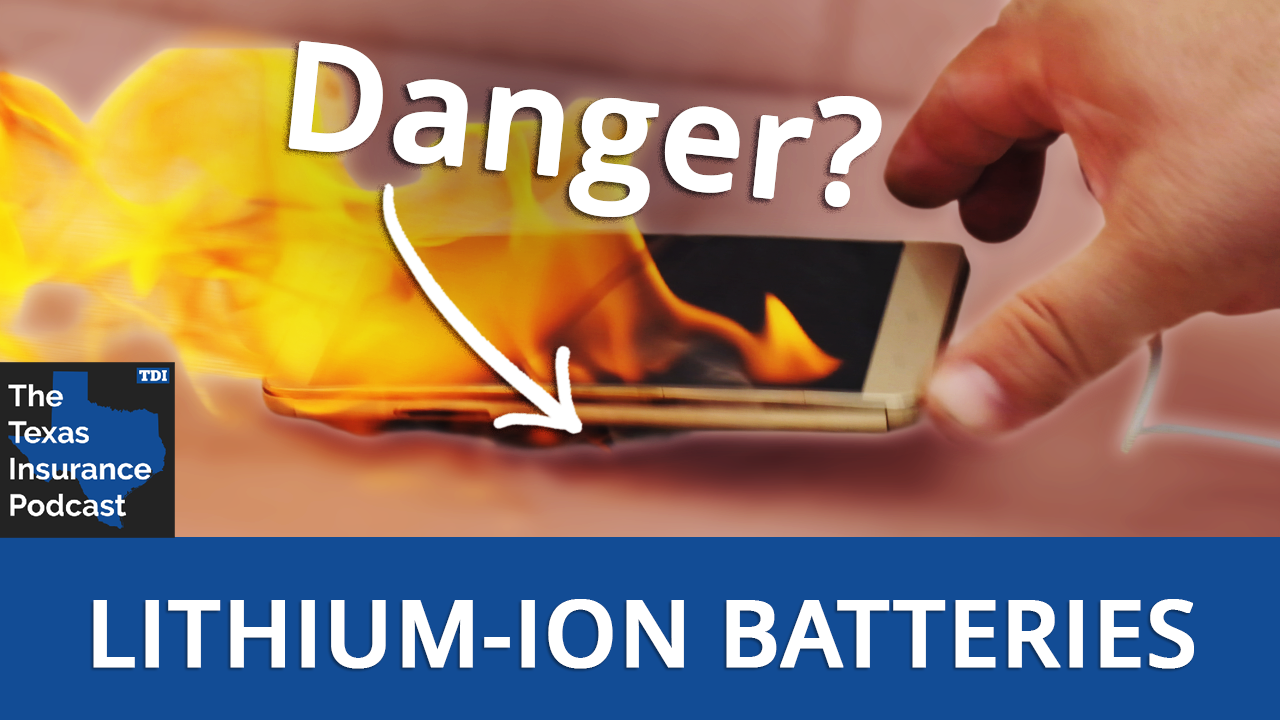
Lithium-ion battery fire safety is the focus of Fire Prevention Week October 5-11. Here are the top safety tips for protecting your home and family from an accidental battery fire.
Buy only certified products
When buying rechargeable devices in a store or online, look for a safety certification from a recognized testing laboratory. These certifications show the lithium-ion battery inside the product meets minimum U.S. safety standards for electrical and fire safety.
Charge devices safely
Charging is the riskiest time for lithium-ion batteries. To stay safe, always use the charger that came with the device or one that’s approved by the product manufacturer. Using an incompatible charger can lead to overheating, which increases the risk of fire.
While no method is risk-free, you can reduce your fire risk by following these safe charging practices:
- Charge on a hard, non-flammable surface.
- Keep devices away from flammable materials, like beds, rugs, and couches.
- Monitor the device.
- Unplug after charging.
Recycle batteries responsibly
Never place lithium-ion batteries in the regular trash or recycling bin. Damaged or improperly discarded batteries can ignite and cause fires in garbage trucks and landfills, creating a serious public safety issue. Instead, take used batteries to a certified battery recycling center. Find a spot near you at Call2Recycle.org.
Learn more about lithium-ion-battery fire safety on the Texas Insurance Podcast.
Learn more
- Smoke alarms: Where to put them, how often to replace batteries
- How to escape from a house fire
- Safe charging tips for your home (National Fire Protection Association video)
September 11, 2025
TDI investigators crack down on insurance fraud

Consumers, insurance companies, health plans, and others have filed about 22,000 cases of suspected insurance fraud with the Texas Department of Insurance (TDI) this year.
Licensed peace officers in TDI’s Fraud Unit investigate insurance fraud to build court cases that district attorneys can use to punish scammers.
The most common types of fraud schemes are:
- Insurance agents selling fake policies or pocketing premiums.
- People padding auto accident claims or filing a claim for an accident or theft that never occurred.
- Homeowners padding claims or filing fake claims for burglary and arson.
- Doctors and hospitals over-billing insurance companies for services, billing for services they didn't provide, or performing unnecessary tests and procedures.
Report insurance fraud online or by calling the Help Line at 800-252-3439.
Learn more about how the Fraud Unit investigates suspected insurance fraud on the Texas Insurance Podcast.
Learn more
- Holding insurance companies and agents accountable (video)
- 5 ways to stop insurance agent fraud (video)
- Learn about reporting fraud
- Insurance fraud could happen to you
September 5, 2025
When a storm enters the gulf, it’s too late to ask: ‘Do I have enough insurance?’
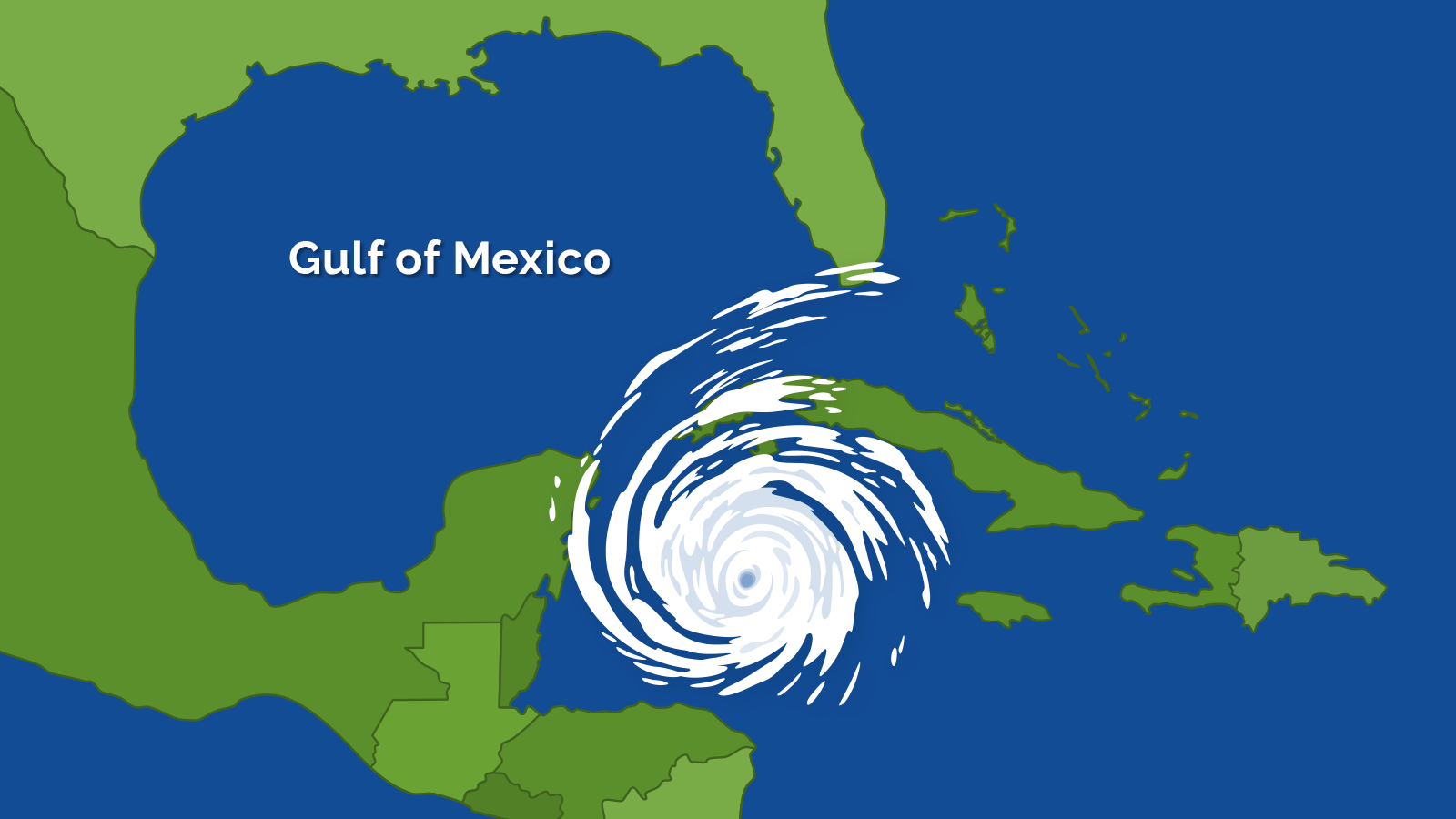
Once a named storm enters the gulf, most insurance companies, including the Texas Windstorm Insurance Association (TWIA), stop selling new policies or making changes to existing ones.
That means you can’t wait until a storm is approaching to think about your insurance coverage, because you won’t be able to buy or change it then!
Of course, this is especially critical for Texans with homes near the Gulf Coast. But the effects of a hurricane, like flooding and tornado force winds, can extend well beyond the coast.
Which leads us to another key point, flood insurance. Most home policies don’t pay for damage from rising flood waters. Most people buy flood coverage from the National Flood Insurance Program. And unless you’re buying coverage for a new home, these policies don’t go into effect until 30 days after you buy them.
So again, you can’t wait until a storm is coming to ask: “Am I covered?”
Learn more
- Where else you can buy flood insurance
- How to prepare for a hurricane (video)
- Hurricane season: How to prepare your home and property
- Texas summer storm safety
- Hurricane Preparation Fact Sheet
August 27, 2025
Title insurance isn’t required by law. But it protects you.

Having a property title means you own the property and can sell, rent, or transfer ownership of the property. Title insurance protects you against problems with getting a title when you buy property.
Title insurance companies search for problems with a title that need to be corrected before it’s given to you. Possible problems could be:
- Unpaid property taxes.
- Fraud or forgery of a previous deed (the legal document used to transfer the title).
- A spouse or unknown heir who could make a claim against the property.
If there’s a challenge to your ownership later, your title company will handle the dispute.
If you’re borrowing money to buy a property, your lender will require you to buy a Loan Policy of Title Insurance (PDF) to protect their interest.
Otherwise, you can get peace of mind from an owner’s title insurance policy, which lasts for as long as you or your heirs own the property.
TDI sets premium amounts for title insurance policies sold in Texas, so the rates are the same for all title companies. It still might be worth researching title companies. You should make sure the title company is licensed and has good customer reviews. You also might want to check their closing costs, which can vary.
Learn more
August 27, 2025
Got insurance? Questions to ask at a job interview

Congrats, you got a job interview! After you talk about pay and telecommuting, don’t forget to ask about the benefits. And we don’t mean days off – we mean insurance.
On average, benefits make up a third of a company’s compensation package, according to the U.S. Bureau of Labor Statistics. Health insurance is a big part of that.
Ask if the company offers health insurance and how much of the premium you’ll pay. Also ask if they offer health insurance for your family. And look at the plan’s copays, deductibles, and coinsurance. Those are all amounts you’ll have to pay yourself.
If you already have health insurance, getting it through your job will probably cost less and offer more benefits. But always compare costs and benefits before you switch.
If a company doesn’t offer health insurance, ask if there’s a health savings plan. It’s a plan you pay into to help with the cost of health care.
Learn more about what to ask about insurance before you switch jobs.
August 27, 2025
Hold on! My totaled car is worth more than insurance wants to pay
You’re already bummed by your car wreck. Now your auto insurance company wants to total your car. This means the insurance company will pay the market value of your car—instead of covering the cost of repairs.
If your company isn’t offering the amount you think your car is worth, you have some options:
- Find out what a car like yours – the same make and year – would sell for in your area. Get written quotes from used car dealers. Also, look online for cars being sold near you.
- Write down any special features or custom parts that make your car worth more. (You probably can’t count that thingie hanging from your rear-view mirror.)
- Call your insurance company or adjuster and ask if they’ll pay more than what they have offered. Give them the quotes you collected and point out the car’s special features.
- If your company won’t pay more, ask about using an appraisal process. You and the company each hires an appraiser to determine the value of your car. The appraisers choose a third appraiser to act as an umpire. The umpire rules on any disagreements. You pay for your appraiser and half of the umpire's costs.
- If you owe more than your car is worth, check your purchase documents to see if you bought gap insurance when you bought your car. You might also have loan/lease coverage in your auto policy.
If you’d rather keep your car as is, let your company know quickly. It will subtract the car’s salvage value from the original amount it was planning to pay you. You can spend your revised payment on the car or not.
Hear more expert advice about totaled cars in this Texas Insurance Podcast.
View podcast Q&A: How to deal with a totaled car
Learn more
- My car was totaled! Now what?
- Do you need gap insurance for your car? How does it work?
- How can I avoid scams when I buy a used vehicle?
August 14, 2025
Texas insurance questions? Call TDI’s Help Line
Have a question about insurance in Texas? Call the Texas Department of Insurance’s Help Line at 800-252-3439.
It’s open weekdays from 8 a.m. to 5 p.m. Central time. Experts take questions in English, Spanish, and other languages.
Operators can:
- Talk you through steps you need to take to file an insurance claim—and share your rights under Texas law.
- Connect you to consumer tips about auto, home, health, life, and other kinds of insurance.
- Check if a company or agent is licensed in Texas – and if they faced disciplinary action.
- Tell you how to file a complaint so TDI can look into your issue.
Learn more about the Help Line from the Texas Insurance podcast.
Learn more
- Getting help with an insurance complaint
- File an insurance complaint
- Steps to getting your home or car insurance claim paid
August 13, 2025
Will your car’s rubber tires keep you safe from a lightning strike?
True or false: Your car’s rubber tires will protect you if lightning strikes your car.
False!
John Jensenius of the National Lightning Safety Council says it’s the type of car – not the tires – that protect you from lightning. You’re the safest in a hard-topped vehicle. When lightning hits, he says, the shock gets dispersed by your car’s metal shell and keeps the people inside safe.
Tire twist: If your car or truck has steel-belted tires, a lightning strike can blow them out.
Learn more from Jensenius about staying safe from lightning on this Texas Insurance Podcast.
Learn more
Thunderstorms: How to protect yourself from lightningAugust 6, 2025
Fire in your house? Get out fast.
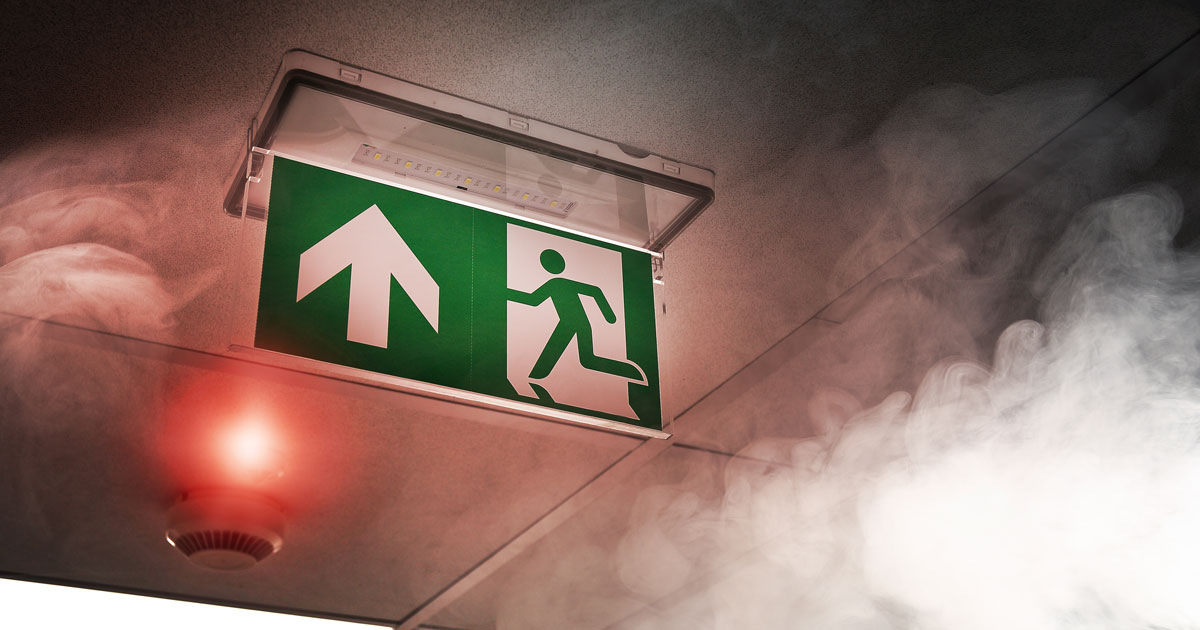
If a fire breaks out in your home, you might have just minutes to escape.
So get out.
Leave.
Don’t hesitate.
Use these tips to plan how you’ll get your family and pets out safely:
- Make a home escape plan and practice it with everyone in your home. Have someone watch the drill and time it. Practice the plan until it’s automatic for everyone.
- Practice your escape plan twice a year. Try one practice at night, one in daylight.
- Practice finding more than one way out.
- Know at least two ways out of every room, if possible. Make sure exit doors and windows open easily.
- Agree on an outdoor meeting place—a tree, mailbox, light pole. Make sure everyone knows to go there.
- Teach your children how to escape without your help. Tell them not to hide under a bed, in a closet, or in a bathroom.
- Never go back inside a burning building. Get out and stay out!
Learn more
August 4, 2025
Hear a beep? Get on your feet!
Smoke and carbon monoxide alarms in your home deliver potentially life-saving messages.
Your alarm’s sounds can signal different dangers:
- A set of three loud continuous beeps means smoke or fire.
- A set of four loud continuous beeps means carbon monoxide is present.
- A single chirp – repeating every 30 to 60 seconds – means your alarm battery is low and needs to be changed. If your alarm continues to chirp after replacing the battery, that means the alarm unit needs to be replaced.
Learn more about how smoke and carbon monoxide alarms keep you safe in the This Is TDI podcast featuring Kelly Ransdell of the National Fire Protection Association.
“We want people to learn the sounds of fire safety,” Ransdell says.
View podcast Q&A: How to know what your smoke alarm is telling you
Learn more
- How to protect your family from a home fire
- How to avoid carbon monoxide poisoning at home
- How to escape from a house fire
July 16, 2025
Is your smoke or carbon monoxide alarm chirping? Here’s what it’s telling you.
Just about everyone has woken up to the sounds of a smoke or carbon monoxide alarm going off in the middle of the night. But what do those chirps and beeps mean? In this video, we asked the National Fire Protection Association what the noises mean and how to stay safe from fires and carbon monoxide. Here’s a simple guide:
- Smoke alarms alert you with three beeps in a row.
- Carbon monoxide alarms alert you with four beeps.
- A single chirp means the battery is low or the detector should be replaced.
Some newer alarms also have a voice that gives you directions. Other alarms, made for people who are deaf or hard of hearing, shake your pillow or have a strobe light.
- Every alarm has a manufacture date or an expiration date. Replace your alarms before the expiration date, or within 10 years of the manufacture date.
- Test your alarms once a month.
- Replace the batteries once a year.
- Replace the alarms at least every 10 years.
When you buy new alarms, put them inside and outside each sleeping area. Not just bedrooms, but anywhere people sleep. If your garage is attached to your home, you need one there too.
Have a family escape plan and pick a safe place to meet outside. Then practice your plan so everyone’s ready when an alarm goes off. If someone in the house has mobility issues, make sure they sleep on the ground floor. It could be a matter of life and death.
Learn more
- Smoke and carbon monoxide alarms sounds (video)
- Fire in your house? Get out fast
- How to avoid carbon monoxide poisoning at home
- How to protect your family from a home fire
July 9, 2025
How to apply for FEMA assistance

Do you have repairs or extra expenses from the July flooding?
Homeowners and renters with damage or other storm-related costs not covered by insurance policies can apply for federal disaster assistance.
FEMA might be able to help with:
- Immediate needs like food, water, baby formula, breast-feeding supplies, and medicine.
- Temporary housing.
- Repair to your primary vehicle.
- Extra childcare expenses.
FEMA disaster declaration
EM-3649-TX: For damage starting on July 12 in Atascosa, Bandera, Bexar, Blanco, Brewster, Comal, Crockett, Dimmit, Duval, Edwards, Frio, Gillespie, Jim Wells, Kendall, Kerr, Kimble, Kinney, La Salle, Live Oak, Mason, Maverick, Medina, Menard, Pecos, Real, Schleicher, Sutton, Terrell, Uvalde, Val Verde, Webb, Wilson, and Zavala counties.
To apply, visit DisasterAssistance.gov or call 800-621-3362.
Learn more
- Insurance claim tips for Texas flood victims
- Steps to getting your home or car insurance claim paid
- How to avoid contracting scams
- What if my insurance isn't paying enough?
- Workers’ compensation resources for Central Texas flooding
July 6, 2025
Can I make an insurance claim for additional living expenses?

Texans with flood damage might be wondering if their homeowner policies pay for hotels, food, and other expenses if they need to leave during repairs.
When do policies pay for additional living expenses?
Homeowners and renters policies may cover additional living expenses if you can’t stay in your home because it was damaged by an event that’s covered in your policy.
For example, you need to move out during repairs because a tornado damaged your house, and your home policy covers tornadoes.
If you left your house because of a power outage or evacuation – and your home wasn’t damaged – your policy won’t cover additional living expenses.
Does my home policy cover floods?
Most home policies don’t cover floods.
Some people buy flood insurance through the National Flood Insurance Program (NFIP). But NFIP policies don’t pay for additional living expenses.
If your home policy includes flood coverage, it probably will pay for additional living expenses.
Call your agent or company to ask if you have a NFIP flood policy or have flood coverage in your home policy.
Learn more
- Does your insurance cover additional living expenses? (video)
- When do policies pay for additional living expenses?
- Recovery tips
July 3, 2025
TDI tracks insurance companies’ finances to make sure they can pay claims

When you file an insurance claim, you’re counting on your insurance company having enough money to pay that claim.
TDI’s Financial Regulation Division works to make sure that happens for consumers.
Part of what TDI does as the state's insurance regulator is monitoring the financial health of insurance companies. This includes tracking how much insurance companies collect in premiums and spend on claims and other expenses.
TDI requires auto, home, health and all other insurance companies to provide these details in quarterly and annual reports. The agency's financial analysts then comb through those details.
"We go into financial statements, assets, liabilities, income, cash flow, and copious amounts of notes," said Jamie Walker, who leads the division.
TDI monitors about 500 Texas-based companies. Another 3,000 companies that sell insurance in Texas are monitored by their home states.
TDI makes sure companies comply with state laws and fulfill the terms of their policies.
Every five years, TDI's examiners conduct detailed financial exams of each Texas-based company. They talk to company executives and personnel, including actuaries, about their business practices, financial reporting, and new risks on the horizon.
Insurance companies manage risk to make sure they can pay current and future claims. A homeowners insurance company, for example, might only sell a certain number of policies in each area of the state so that if a weather event happens, they have a manageable amount of exposure.
Walker said: "We look at how the company is assessing risk and then determine if they have the financial capacity for unexpected losses, whether that be a major natural event or a significant and extended downturn in the investment market.”
This results in the Financial Regulation Division making sure insurance companies have enough assets to pay their claims and treat consumers as required by state laws and rules.
Learn more
How are your auto and homeowners insurance costs calculated?
July 1, 2025
Texas law encourages renters to buy flood coverage
A Texas law (House Bill 531) emphasizes that renters insurance doesn’t pay for flood damage.
Renters insurance, available for about $20 a month, pays to repair or replace the things you own if they’re damaged by fire, smoke, theft or vandalism, and certain kinds of water damage.
But most renters policies don’t pay for losses caused by floods.
Renters worried about flooding should consider buying a separate flood policy. Ask your agent if they sell flood insurance. If not, you can buy a policy from the National Flood Insurance Program. You can also call them at 877-336-2627.
Landlords are now required to:
- Tell potential renters if they know the dwelling is in a 100-year flood plain.
- Tell potential renters if they know the dwelling had flood damage at least once in the previous five years.
- Encourage renters to buy flood insurance.
Even if your home isn’t in a flood plain, you might want to consider a policy. Flooding can happen anywhere at any time. Poor drainage systems, broken water mains, neighborhood construction, and summer storms can result in flooding.
Learn more
- Flood insurance: Why you need a policy
- Renters insurance: What does it cover and how much does it cost?
- How do you know if you need flood insurance? (video)
June 19, 2025
RV, pool, or boat? Insurance for your summer survival tools

Texans typically use the heat index instead of the calendar to mark the arrival of summer. Whether you wait for a 100-degree day or the official summer solstice, summer is here. Stay cool, Texas. We’ve got ideas to beat the heat and make sure your investment is insured.
Hit the road: If you’re taking your vacation on the road this year, watch our video to understand how insurance works for your home on wheels.
Hit the pool: Thinking about adding a pool or outdoor kitchen to your home? Yes, please! It’s a big investment, so talk to your insurance agent or company about getting the right coverage.
Hit the lake: With thousands of lakes and 367 miles of coastline, it's no wonder Texas is home to more than half a million recreational boats. If you have a boat, your homeowners insurance may include enough coverage. To make sure, check our tips on boat insurance.
June 13, 2025
House damaged by Hurricane Beryl? File your wind/hail claim soon.

July 8 is the deadline to file a claim with the Texas Windstorm Insurance Association (TWIA) if wind and hail from Hurricane Beryl damaged your house.
You can start the claims process online or by calling your agent.
Learn more
- Texas General Land Office (GLO) 2024 Disasters Programs to Help Homeowners: Home Repair Reimbursement or Rebuilding Assistance
- Texas Coastal Outreach and Assistance Services Team (COAST) (PDF)
- Protect yourself from contractor scams
- Steps to getting your home or car insurance claim paid
June 12, 2025
Dogs sniff out fire accelerants for Texas State Fire Marshal’s Office
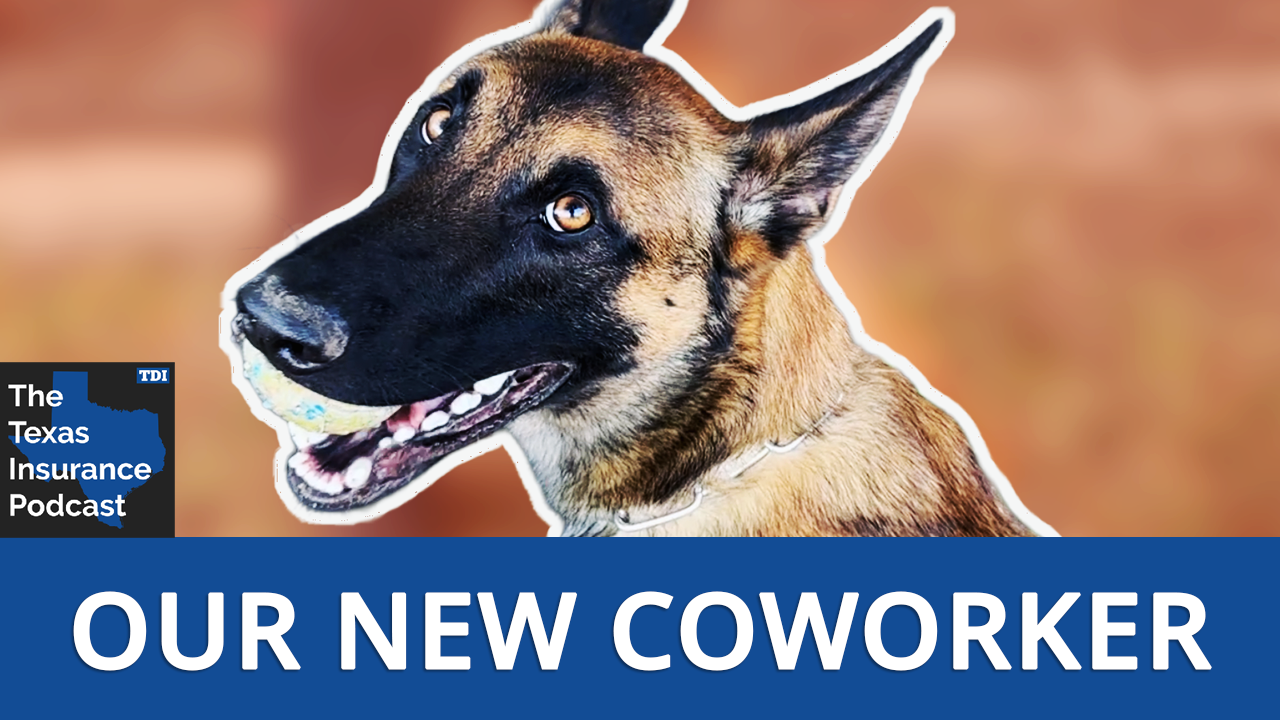
Ever wish you could work with your best friend? Well, a few employees with the Texas State Fire Marshal’s Office (SFMO) get to do that.
Positioned around the state, these handlers live and work with dogs that sniff out liquid accelerants at fire scenes.
Trained dogs have helped the SFMO look for traces of ignitable liquids for over 30 years. Each time a dog detects a suspicious smell, it’s rewarded with a toy or ball.
Learn more about these dog detectives on this Texas Insurance podcast.
Learn more
- Dog burned in fire now helps state investigate fires
- Fire Investigations Division Accelerant Detection Canine Unit
June 11, 2025
You live in a floodplain
Your home lender may only require flood insurance if you live in an area at high risk of flooding, but we all live in a floodplain. We talked to a FEMA expert about how flood insurance works and why you may need it.
Check FEMA’s Risk Mapping, Assessment and Planning to see if you live in or near a flood hazard area. But as the FEMA expert explained, even those living outside high risk areas may flood. He said as many as 65% of disaster assistance claims for flood damage have come from people living outside areas designated as flood hazard areas.
He also explained the limits of disaster assistance. It’s not a substitute for flood insurance. First, you can only get disaster assistance after a disaster declaration. And disaster assistance is designed to help you get back on your feet – to make your home livable – but not to rebuild it as it was before. For that, you need flood insurance.
Just one inch of water can cause $26,000 of damage to a home. To make sure you’re protected, ask your insurance agent or company about flood insurance.
To learn more, go to FloodSmart.gov or review these tips.
June 6, 2025
Insurance tips for newlyweds

Recently married? We have insurance tips to get you off to a good financial start.
Home or renters insurance
Home and renters insurance are great ways to protect those nice wedding gifts. Both typically cover items damaged by a burst pipe or fire. They’ll also cover personal items stolen from your home or car.
Home and renters policies have limits on certain items like jewelry. If you want to make sure your new diamond ring is covered, you may want to add a jewelry rider, or endorsement. Ask your agent.
Auto insurance
Combining auto policies with your spouse might save you money. Most insurance companies offer a discount if you have more than one vehicle, and rates are usually lower if you’re married.
Health insurance
You have several options for health coverage. If both of you have coverage through work, compare the policies. One may have better benefits, a lower deductible, or a lower cost to add a dependent. And check to see if there’s a deadline to add a spouse.
Life insurance
As your situation changes and your family grows, you may need life insurance. Consider how much income would need to be replaced to help with childcare, your mortgage, and other debts.
May 23, 2025
TDI prepares to help Texans before hurricane season begins
Hurricane season runs from June through November. To prepare, the Texas Department of Insurance (TDI) recommends you make a home inventory, review your insurance policies, consider buying flood insurance, and check the condition of your windows and roof to reinforce your home’s hardiness where you can.
In 2001, TDI, the Texas Division of Emergency Management, and the Institute for Business & Home Safety founded the Texas State Disaster Coalition. Members of the coalition, including dozens of stakeholders from the Red Cross to insurance companies, can be activated as part of TDI’s disaster response.
Before hurricane season, TDI staff make sure coalition members have what they need. Also, TDI volunteers commit to join disaster response teams as needed.
Randall Evans, who heads the Consumer Protection Division, said: “As the frequency and severity of storms have increased, we have adjusted the model of our disaster program and increased our resources, escalating our readiness.”
After a hurricane, TDI’s role is to give insurance-related information to the public, handle consumer complaints, and make sure that filed claims are handled appropriately. Staff also investigate unfair or illegal practices.
“The Texas Department of Insurance prepares for weather disasters year-round,” said TDI Commissioner Cassie Brown. “We are ready to help Texans.”
Have an insurance question or concern? Call TDI’s Help Line, 800-252-3439, weekdays from 8 a.m. to 5 p.m. Central time.
Learn more
Hurricane season: How to prepare your home and property
May 15, 2025
Distracted drivers are dangerous. How not to be one.

Don’t you hate distracted drivers?
You know—the driver sending a text message, fiddling with the car’s radio, or eating while driving.
Distracted drivers are dangerous. TxDOT notes that in 2024, a distracted driver caused one in five car crashes on Texas roads.
To avoid distraction behind the wheel, remember:
- Texting while driving is illegal in Texas.
- If you must communicate on the move, pull over and park in a safe place.
- If a driver acts out of line, stay calm. Keep your distance and let that driver go.
- If you think another driver is dangerous to others, pull over in a safe place and call 911.
May 12, 2025
Auto insurance not renewed? You have options.

If your auto insurance is not renewed, you have options.
Your insurance provider must tell you about nonrenewal 60 days before your policy ends. This leaves time for you to shop for a policy meeting your needs and budget and have a new policy in place before your current policy expires
Tips for shopping:
- Get sample rates on TDI’s HelpInsure.com. Next, follow up with companies directly for quotes.
- Work with an independent agent who can help compare policies from different companies.
- Ask friends or family about their insurance providers.
If two insurance companies turn you down, you can get minimum coverage through the Texas Automobile Insurance Plan Association (TAIPA). Ask an agent for help getting a TAIPA policy.
Have an insurance question? Call TDI’s Help Line at 800-252-3439 weekdays from 8 a.m. to 5 p.m. Central time.
Learn more
- Was your auto insurance not renewed or canceled?
- Is your auto policy up for renewal? Here’s what to look for.
- How to shop smart for auto insurance
May 9, 2025
Home insurance not renewed? You have options.

If your insurance company says it’s not renewing your Texas homeowners insurance, you have options.
The company must tell you about nonrenewal 60 days before your policy ends. This leaves time for you to shop for a policy meeting your needs and budget and have a new policy in place before your current policy expires.
About 160 companies sell home coverage in the state.
Tips for shopping:
- Get sample rates on TDI’s HelpInsure.com. Next, follow up with companies directly for quotes.
- Work with an independent agent who can help compare policies from different companies.
- Ask friends or family about their insurance providers.
If at least two companies decline to insure your home, you may buy a policy through the state’s provider of last resort, the Texas FAIR Plan Association.
Have an insurance question? Call TDI’s Help Line at 800-252-3439 weekdays from 8 a.m. to 5 p.m. Central time.
Learn more
- Was your home insurance canceled or not renewed?
- Other ways to get auto, home, and wind insurance in Texas
- Tips to help you shop for homeowners insurance
May 7, 2025
Insurance companies must meet deadlines to respond to Texas claims

Are insurance companies allowed to take forever to respond to your insurance claim?
Not in Texas.
State law gives your company 15 business days to tell you it’s received your claim.
Your insurance company will determine if your policy covers the damage you had. An adjuster might inspect or look at photos of the damage. Also, the company might ask you for more information before deciding to accept your claim.
Your company has 15 business days after getting what it needs from you to decide if it will pay. The company can extend this deadline by 45 days if they tell you why they need more time. If the company rejects your claim, it must say why in writing.
The Texas Department of Insurance may be able to help if you have a problem with your company, agent, or adjuster. We can make sure companies are following the law and paying you according to your policy. Learn about filing a complaint here.
Have questions? Call TDI’s Help Line at 800-252-3439. It’s open weekdays from 8 a.m. to 5 p.m. Central time.
Learn more
- Steps to getting your home or car insurance claim paid
- How to file your insurance claim
- Working with an insurance adjuster
May 1, 2025
Safely store flammable and combustible liquids and gasses

You might not always think about it, but vapors from flammable and combustible liquids and gas can ignite easily. Make sure you are storing them properly and safely.
- Read the label. Hazardous products should have storage and safety information written on the label. Read that information before you use or store the product.
- Store them away from vapors and heat sources. Gasoline, kerosene, paint thinner, paint solvents, and some cleaning fluids, have vapors that can ignite. Store them away from heat sources, including stoves and electric motors. An ideal place would be outside the home, like a garden shed.
- Watch those dirty rags. Oily and solvent-wet rags just sitting in open air can catch fire. Store these rags in tightly-sealed metal containers away from structures.
- Be careful with your hairspray. Some items in your bathroom, such as hairspray, nail polish, and nail polish remover are flammable and shouldn’t be used near flames—and definitely don’t smoke while using them.
Learn more
April 25, 2025
Tips to avoid a tornado: Follow weather reports
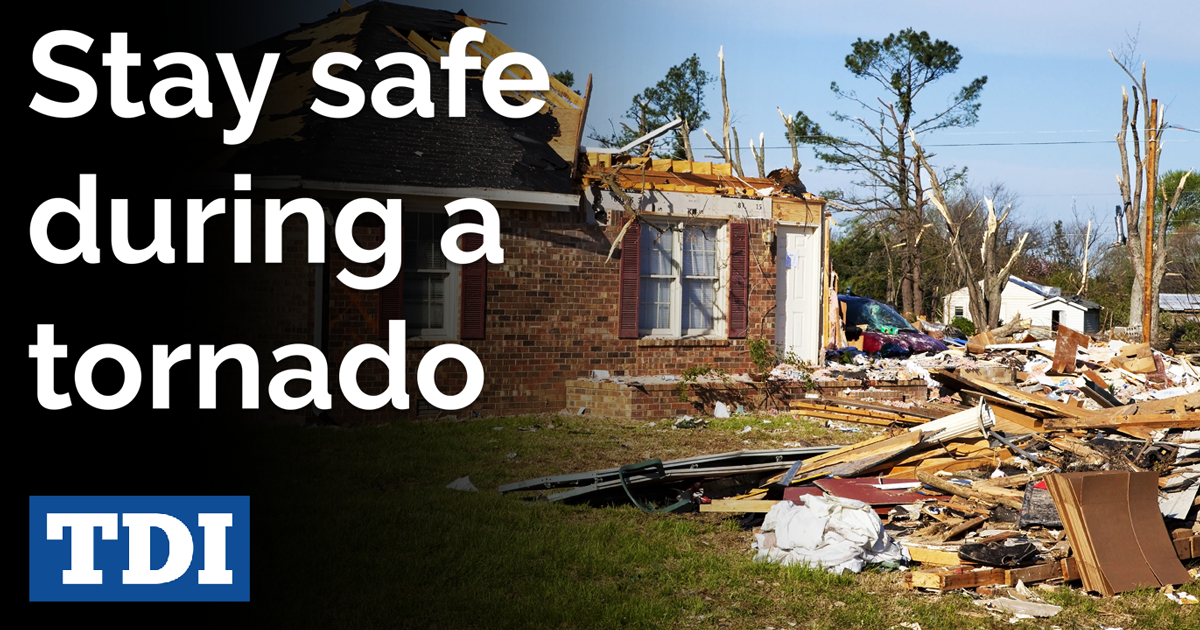
You’re driving home from work, inching along in highway traffic. Then you hear a tornado warning on the radio. Or worse, you see a tornado twisting your way.
Don’t get yourself into that situation!
A National Weather Service expert urges everyone to follow the weather, especially during the spring and summer tornado and hurricane seasons.
If your city or county is under a tornado watch, plan to be inside a building—and not sitting in your car or truck.
Learn more
- Danger, danger! Don’t mix up tornado watches and warnings.
- Are you prepared for a tornado? Here’s how to protect your home
April 23, 2025
Insurance tips for new graduates
If you’re graduating and moving into your own house or apartment, there’s a lot to consider. Here’s what you need to know about insurance.

Protect your stuff: Renters insurance pays for your clothes, furniture, electronics, and other belongings if they’re stolen or damaged by a fire or other cause. Most renters policies also pay for your belongings if they’re stolen from your car.
Shop for auto insurance: If you need your own auto insurance, compare rates and policies. Then ask several companies for quotes. Also ask if you qualify for any discounts.
Finding health insurance: If you have a job that offers health insurance, that’s great. Be sure to ask if your doctors are in its network to avoid a big bill. Also look at the plan’s website to find hospitals and urgent care centers near you for when you need a doctor after hours.
Learn more
- Renters insurance: What does it cover and how much does it cost?
- Tips to help you shop for auto insurance
- Need health insurance? How to find a new health plan now.
April 21, 2025
TDI rate reviews save Texans millions on home and auto premiums
In Texas, the insurance industry is driven by market forces including demand for coverage, the cost of paying claims, and competition among the more than 322 companies selling home and auto insurance. Each insurance company determines the rates it charges its policyholders.
While the Texas Department of Insurance (TDI) does not set insurance rates, every year, our actuarial staff review thousands of rate filings made by insurance companies.
In 2024, TDI’s actuarial staff reviewed 2,343 rate filings. 132 filings were rejected for technical reasons, and another 174 were withdrawn by the companies.
An insurance company might withdraw a rate filing if they:
- Need more time to respond to TDI’s questions about the filing.
- Are forced to withdraw a filing because it doesn’t follow state law.
- Decide to make a new filing at a different rate.
Of the rate filings reviewed, TDI determined that 2,037 complied with Texas law. TDI staff had questions or asked companies to provide more information on 77% of filings.
This is where most of TDI’s regulatory work on rates happens—requiring insurance companies to provide more information on incomplete or insufficient filings.
This review process saves consumers on average more than $29.2 million a year.
Learn more
- How are your auto and homeowners insurance costs calculated?
- Ways to save money on home insurance
- Lower your car insurance rates: Tips for saving money
April 17, 2025
Do you know the difference between a copay and coinsurance?

Twenty five percent of Americans with health insurance recently told a pollster they find terms such as “copay” and “coinsurance” hard to understand.
We get it.
After all, the words sound alike.
And both relate to your paying money out of pocket when you get health care.
But there are differences:
- You get charged a copay when getting treatment covered by your health plan.
- Your copay is a fixed amount. It varies based on the service you get. For instance, your plan might charge a $15 copay for a generic prescription drug, $30 to visit your primary care doctor, or $50 to see a specialist.
- Coinsurance kicks in after you have met your plan’s annual deductible, which is what you pay out of pocket before your plan starts picking up a share of medical expenses.
- What you pay in coinsurance for a health care service is a percentage of what your plan pays the doctor or medical provider. Example: If your plan’s allowed amount for a treatment is $100, your coinsurance payment of 20% would be $20. Your plan pays the remaining $80.
Learn more
- What is an explanation of benefits? (video)
- Don't get scammed shopping for a health plan.
- Use these tips to shop smart for health coverage
- Health care coverage guide
April 10, 2025
Protect or harden your home before bad weather hits

Texas gets more tornadoes than any other state and plenty of hail. Hurricanes too.
Homeowners can prep their homes for all kinds of bad weather.
Some tips:
- Trim your trees. Broken limbs can damage your roof, break windows, and more.
- Know where to shut off your utilities outdoors.
- Make sure any sheds, outdoor furniture, and grills are tied down so they don’t become flying objects in heavy wind.
- Make sure all your gutter fasteners are tight. If you live in a hail-prone area, consider upgrading your gutters to steel. Steel is more durable than vinyl or aluminum.
- Keep your roof in shape. As shingles age, they can lift or let water inside your home. When it’s time to replace your roof, use impact-resistant shingles and make sure they’re properly installed.
Learn more about protecting or “hardening” your home in an expert interview on the Texas Insurance Podcast.
Learn more
- Are you prepared for a tornado? Here’s how to protect your home.
- Are you ready for a disaster?
- Hurricane season: How to prepare your home and property
March 28, 2025
Flooded home or car? What to do next.

If your home or car has flood damage, insurance could help you recover.
Some tips for property owners:
- Take photos or video of the damage as soon as it’s safe. Don’t throw away damaged items until you talk to your insurance adjuster.
- If your home floods, call your insurance company to file a claim as soon as possible. If you have a policy through the National Flood Insurance Program (NFIP), call 877-336-2627. NFIP policies require you to file a claim within 60 days. If you can’t find your insurer’s phone number, call the TDI Help Line at 800-252-3439.
- Most home and renters policies don’t cover flood damage, but there are exceptions. Even if you lack flood coverage, you still might need a denial from your insurance company to apply for disaster assistance if available.
You can also make an insurance claim if you have other damage. Most home policies cover damage from wind or falling tree limbs. They also might cover damage to fences and other structures on your property.
If your car floods:
- File an auto insurance claim if you have comprehensive coverage; it covers flood damage.
- Take photos or video of the damage. If it’s safe to do so, also take pictures of your car in the water.
- Talk to a mechanic before trying to dry out a car that got water inside. It may have hidden damage.
Have insurance questions? Call the TDI Help Line at 800-252-3439.
Learn more
- National Flood Insurance Program: How to file a claim
- Flooded cars: What to know about insurance claims and repairs
- When are water damage and mold covered by insurance?
- Can I make an insurance claim for additional living expenses?
- Steps to getting your home or car insurance claim paid
- How to avoid contracting scams
March 13, 2025
¿Un minuto? Podcast highlights insurance tips in Spanish

¿Tiene un minuto?
Then you have time for TDI’s 60-second consumer videos in English and Spanish.
Lorna Camacho advises consumers in the Spanish versions of the department’s One Minute of Insurance videos. They’re called Un Minuto de Seguro.
“Insurance can be challenging in any language,” Camacho said. “Our videos deliver basic information. You can then get more detail from our online consumer tips pages, in English and Spanish.”
Camacho shares more in this Texas Insurance Podcast.
Get to TDI’s Spanish-language page from the Español tab on TDI’s home page at tdi.texas.gov.
Have an insurance question in English or Spanish? TDI’s Help Line is 800-252-3439. It’s open weekdays from 8 a.m. to 5 p.m. Central time.
Learn more
- TDI expands access to insurance information in Spanish
- Get consumer tips
- Read blog posts
- Watch one-minute videos
March 7, 2025
What to know about garage fires and safety
You’re an expert at safety. Smoke alarms? Installed and tested. Escape plan? Posted on the fridge and practiced. But have you thought about every room in your house? Have you thought about the garage?
Garages pose unique fire and safety challenges. Here are some tips to make your car’s bedroom as safe as your own.
- Don’t run generators inside. This means your garage too. Always run your generators at least 20 feet away from the house.
- Store combustible materials away from the home. This includes paints, varnishes, oil, gas, and propane. A shed is a good place.
- Leave the garage right after you start your car. Never leave your car idling, even with the garage door open. This could lead to carbon monoxide buildup.
- Keep a fire extinguisher in your garage. Make sure it’s loaded, and you know how and when to use it.
- Turn off your car. If you accidentally hit the button on your key fob, it could start your engine. Keep your key fob in a place where you can’t hit the button by mistake.
As motivation to keep your garage clean, get rid of clutter and anything combustible. Your fire department will thank you!
Learn more
- Using a generator? Stay safe from carbon monoxide
- How to avoid carbon monoxide poisoning at home
- USFA garage fire safety
March 7, 2025
Protect against other drivers with uninsured motorist coverage

Texas law requires drivers to have liability coverage on their vehicles.
But some drivers fail to get coverage. Warning sign: More than 2.4 million state-registered vehicles are not matched to an insurance policy. That’s 12% of the state’s registered vehicles.
So, it could pay for you to consider uninsured/underinsured motorist coverage, which insurance companies must offer when you buy auto insurance. If you don’t want it, you have to turn it down in writing.
If you add uninsured/underinsured coverage, you’ll have extra financial protection after an accident involving a driver with little or no insurance. The coverage pays your car repair and medical bills. You’ll have to pay a $250 deductible for car repair.
Related tips:
- Uninsured/underinsured coverage also pays to replace the property in your car, a rental car if you need it, your medical bills, and pain and suffering costs. If you don’t have this coverage, your collision coverage will pay to repair your car. But you won’t get these extra coverages and your deductible will likely be higher.
- If an accident leaves you with long-term care needs or you aren’t able to work, your health plan probably won’t cover those costs.
- Uninsured/underinsured motorist coverage pays if you’re in a hit-and-run accident and the other driver can’t be found to pay for damage.
- You can usually add uninsured/underinsured coverage in $5,000 increments. A rule of thumb is to add at least enough property damage coverage to replace your vehicle. Ask your agent what coverage works for you.
Learn more
- 10 insurance tips to follow after a wreck (video)
- What is uninsured motorist coverage, and do I really need it?
- Were you in a wreck? Tips for auto insurance claims
- Will your auto insurance pay after a hit-and-run crash?
February 21, 2025
Dallas man sentenced to 13 years in prison, must pay $4 million in restitution after insurance fraud investigation by FBI and TDI

A judge this week sentenced a Dallas man who steered a multi-million dollar insurance fraud scheme to 13 years in prison.
U.S. District Judge Mark Pittman also ordered Jordan Ford to pay over $4 million in restitution to defrauded insurance companies.
The action capped an investigation by the FBI and Texas Department of Insurance.
Capt. Tyler Hampton of TDI’s Fraud Unit said investigators fielded their first referral from an insurance company suspecting Ford of fraud in 2023. Resulting inquiries revealed that nearly $1 million in claims payments to over 50 consumers had been illegally diverted to Ford and numerous co-conspirators—with other companies similarly defrauded.
“They saw an opportunity, they saw something in the system they thought they could exploit,” Hampton said. “They gave it the old college try—and ultimately got caught.”
Ford, 32, pleaded guilty in September to conspiracy to commit wire fraud, according to an announcement by the U.S. Attorney’s Office for the Northern District of Texas.
According to court documents, Ford and his co-conspirators recruited insurance company employees to pull clients’ personal information from legitimate insurance claims.
The employees gave those details to Ford; he then used the information to pose as a client and call the insurance companies to request they update the payment information to accounts he and co-conspirators controlled.
Other times, Ford paid insurance employees to lend him their company-issued laptops, logged onto company systems, and authorized and issued payments sent to accounts he and his co-conspirators controlled.
In total, the co-conspirators misdirected funds from at least three insurance companies, netting more than $4.4 million.
All nine defendants charged in the scheme have pleaded guilty.
If you suspect fraud, call TDI’s Help Line at 800-252-3439.
Learn more
February 13, 2025
TDI prosecutors embed in Texas district attorney offices
State lawyers who fight insurance fraud, pursuing millions of dollars in restitution, work closely with local authorities.
A few Texas Department of Insurance (TDI) lawyers are even sworn in as assistant district attorneys. These attorneys are embedded in district attorney offices from Dallas and Fort Worth to Austin, Houston, and San Antonio.
“District attorneys don't always have the resources or expertise to address insurance fraud as a crime,” said Dallas-based Kyson Johnson, who leads the TDI Fraud Unit’s 20-year-old; prosecutor program. ”Every tip or fraud report that we receive is looked at on a case-by-case basis.”
In 2024, TDI’s Fraud Unit contributed to investigations landing nearly $58 million in court-ordered restitution.
Learn more about TDI’s embedded prosecutors from the latest Texas Insurance Podcast.
Learn more
- Holding insurance companies and agents accountable (video)
- About the TDI Fraud Unit
- Report Texas insurance fraud
- Fraud Unit chief prosecutor promoted in Army Reserve
February 11, 2025
Companies may offer auto insurance discounts. No law requires discounts.

Drivers should beware of auto insurance offers, often on social media, hinting at required discounts based on factors such as your age, your car’s age, or driving habits.
Dozens of Texas consumers have called the Texas Department of Insurance asking about so-called laws or regulations enabling discounts for the elderly or for driving less—sometimes only if you act quickly.
“Insurance companies may offer discounts, but no state law or rule mandates discounts or puts a time limit on them,” said Insurance Commissioner Cassie Brown. “Such claims are misleading.”
One risk: Personal information you provide in response to an ad might be going to a third-party vendor that sells your information to others.
You can avoid misinformation by shopping directly with insurance companies or agents. You can then ask about available discounts and how you can qualify.
Compare auto insurance policies and pricing at HelpInsure.com, which posts sample rates and policy terms.
If you suspect an insurance company or agent of misleading advertising, you may file a complaint with TDI. We can review the advertising.
Have an insurance question? Call TDI’s Help Line at 800-252-3439 weekdays from 8 a.m. to 5 p.m. Central time.
Learn more
- Lower your car insurance costs: Tips for saving money
- Auto insurance shopping checklist
- Ways to save money on car insurance
January 31, 2025
How to file your insurance claim
Need to make an auto or home insurance claim?
Tips to help you succeed:
- After a car accident or incident at your home, talk to your insurance company. You’ll want to discuss your options. Maybe you don’t want to file a claim. Consider your deductible—how much you pay before your insurance pays.
- If you make a claim, write down details including when you called the company, who you talked to, and your adjuster’s name. Also, make a list of documents or information the company wants from you.
- After a car accident, move your car to a safe location. Take photos of the accident scene, including your car, other involved cars, and anything that’s been hit such as trees, buildings, or street signs. Also photograph the other driver’s insurance information, driver’s license, and license plate.
- If your house is damaged, write down the time and date you first saw the damage. Also note what the weather was like at the time. Take photos of any damage. Protect your home from further damage by covering broken windows or putting a tarp over a roof hole. Don’t make permanent repairs until your company gives the OK.
- On any claim, save all receipts.
.
Want more tips about making a claim? Listen to this Texas Insurance Podcast.
Learn more
- Tips for filing a claim with your insurance company
- Were you in a wreck? Tips for auto insurance claims
- Steps to getting your home or car insurance claim paid
January 16, 2025
Rating tied to local fire protection can affect home insurance
If you live in a city, it probably has a score tied to its fire protection capabilities.
That score could affect your homeowners insurance.
Each Public Protection Classification System (PPC) rating comes from an organization, the Insurance Services Office (ISO). Half of each rating is based on the local fire department’s record. The ISO also considers the water department and water supply, emergency communications, and community efforts to reduce fire risks.
That rating could affect your homeowners insurance and its cost. You can ask your insurance agent or company to check the current PPC rating for the location of your residence. Get more details about the PPC in this Texas Insurance Podcast.
Learn more
- FAQ: Public Protection Classification
- Public Protection Classification (PPC) Oversight
- How the State Fire Marshal’s Office helps Texans (PDF)
January 16, 2025
Another Texas freeze in forecast? Podcast has steps to protect your home.
Just saying “freeze” can make a Texan flinch.
But you can take steps to protect your home before temperatures drop.
For starters, wrap indoor pipes with insulation. Wrap your attic pipes first.
And when a freeze happens, you can run water through your indoor faucets – hot and cold – before you go to sleep. Or you can let faucets drip from the cold and hot taps. Be sure to follow your local government’s instructions, which may limit water use.
Hear more about prepping your home on “The Texas Insurance Podcast,” featuring David Yelovich, a Texas State Board of Plumbing Examiners board member. Our podcast closes with TDI advice on insurance and water-related damage.
January 15, 2025
Unknown fire hazards in your home
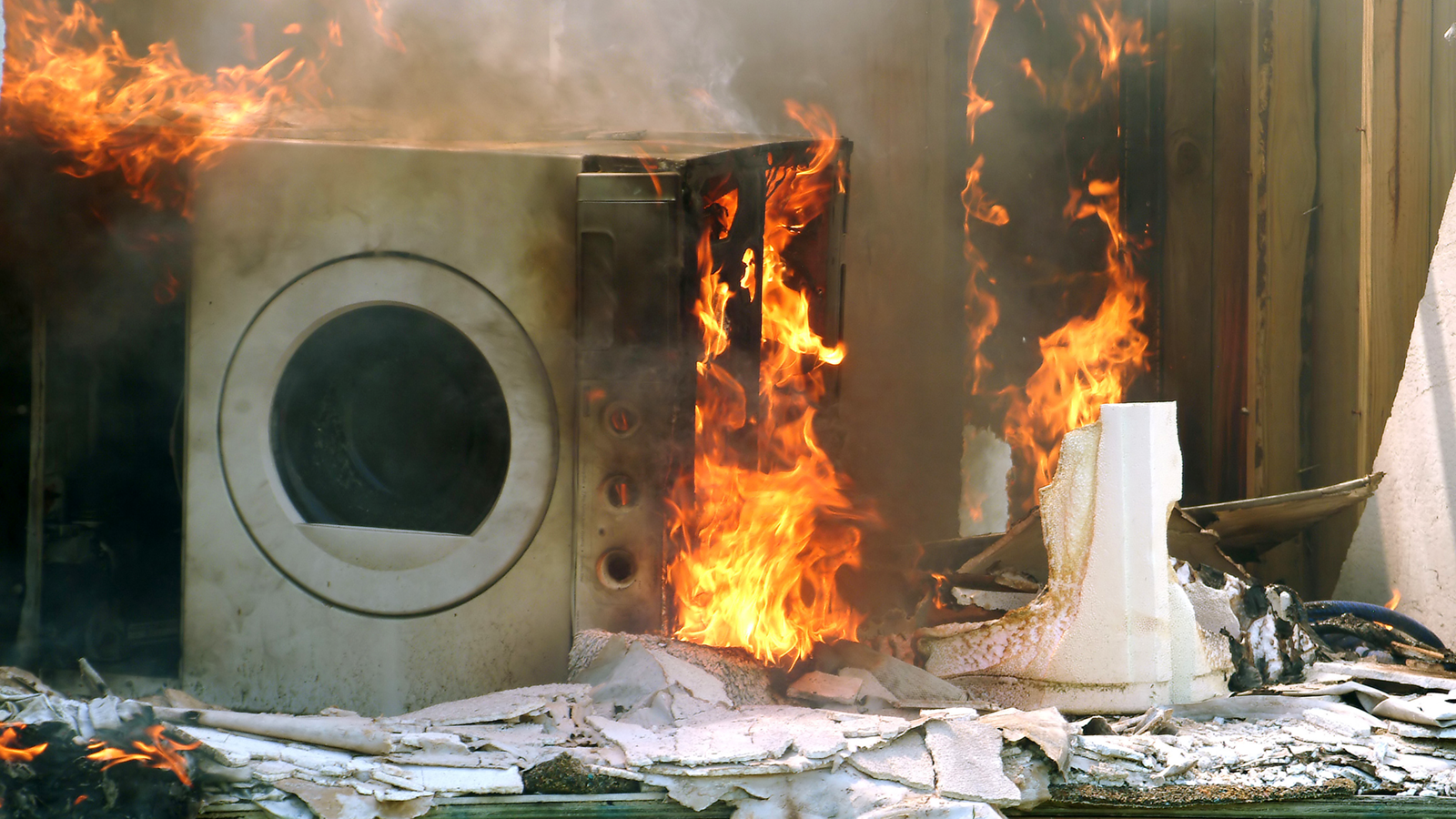
Most people know that stoves, ovens, and candles are dangerous and can start fires.
But there are other fire risks in your home that you might not have thought about:
- Dryers. Clean your lint filter before each use. Make sure the air exhaust vent pipe leads to the outside and is unblocked. Clean the lint out of your vent pipe every three months. There are tools available at local home improvement stores that allow you to do it yourself. Or, you can hire a professional or get your apartment’s maintenance to do this. You want clothes to be fire, not on fire.
- Kitchen appliances. Our kitchens have all sorts of gadgets, like air fryers, microwaves, and coffee makers. Plug your appliances into a wall outlet, never an extension cord. Place them where they won’t get bumped or knocked over.
- Lithium-ion batteries. Smartphones, laptops, hoverboards – so many devices in our homes now use lithium-ion batteries. Don’t overcharge your devices, and don’t place them on a pillow, bed, or couch while charging. Keep devices that use lithium-ion batteries at room temperature.
If there is a fire in your house, get out and stay out. Use your cell phone to call for help or ask a neighbor to call 911.
January 13, 2025
Will your auto insurance pay after a hit-and-run crash?
Every 43 seconds someone in the U.S. is involved in a hit-and-run accident. We hope it never happens to you, but statistics show it’s something that unfortunately happens a lot. So, what can you do?
Make sure you have the right auto coverage to repair your car.
In Texas, the law requires you to have liability insurance, but that won’t pay to repair your car after an accident. Liability insurance only pays to repair the other person’s car if you’re at fault in an accident.
To get your car repaired, you’ll need a car insurance policy with collision coverage or uninsured/underinsured motorist (UM/UIM) property damage coverage. Both pay for car repairs after a hit-and-run accident. UM/UIM coverage usually has a lower deductible than collision coverage and may pay for a rental car if you need it.
If you don’t have collision or UM/UIM coverage, consider asking your agent how much they would cost to add to your policy. Read about other coverages you might need in our Auto insurance guide.
Also read: Were you in a wreck? Tips for auto insurance claims
December 6, 2024
Protect your home while you’re away

Before you head out for a vacation, we have some tips to keep your home safe while you’re gone.
Set timers on interior lights. Criminals are looking for an easy target. Use a timer on a few lights to make it appear that someone is home, and don’t let newspapers or mail pile up. Make sure valuables aren’t visible to someone looking through windows, and never leave a key outside.
Don’t post on social media. It’s best not to post that you’re away even if you think only friends and family can see your social media accounts.
Lock doors and windows. It’s obvious, but it’s also easy to forget. Before you leave, take one last trip around the house to make sure everything is locked.
Unplug TVs and computers. It’s Texas so you never know when an electrical storm could cause a power surge. To protect expensive electronics, unplug them or use a surge protector.
November 21, 2024
Your insurance might pay for at-home COVID-19 tests

You can buy your own COVID-19 tests at the store or online.
- Some health plans will pay you back for tests. Save your receipts.
- Ask your health plan:
- If it will pay to reimburse you for COVID-19 tests and for how many.
- What steps you have to take to get paid back (reimbursement).
November 15, 2024
FBI-TDI investigation capped by judge sentencing fraudulent pharmacy owner to prison

A judge sentenced a fraudulent Texas pharmacy owner to 10 years in jail after a multi-year investigation by the FBI and TDI.
Ivor Jallah, 37, earlier pleaded guilty to routinely billing insurance companies for headache sprays and pain and scar creams not dispensed to customers. U.S. District Judge Sam Lindsay in October also required Jallah to pay more than $41 million in restitution.
Authorities indicted multiple people after a multi-year joint investigation that began when insurance companies alerted TDI’s Fraud Unit to suspected billing irregularities.
Jallah and a co-conspirator operated at least nine Texas pharmacies.
Before Jallah’s sentencing, eight people were convicted and sentenced to a combined 290 months in federal prison. Three co-defendants await sentencing.
Christopher Davis, who heads the Fraud Unit, said: “Every time we catch someone bilking insurance companies and health plans, we’re fighting fraud that can raise everyone’s health care costs.”
You can report suspected insurance fraud by calling TDI’s Help Line at 800-252-3439. It’s open weekdays from 8 a.m. to 5 p.m. Central time.
Learn more
- Pharmacy owner sentenced to 10 years in prison for $41 million health insurance fraud (U.S. Department of Justice press release)
- Tips to avoid fraudulent insurance sales scams (blog post)
- Insurance fraud guide
November 14, 2024
Fraud investigators catch insurance criminals

Insurance fraud happens daily – and it drives up everyone’s premiums.
But TDI fights fraud. About 30 TDI investigators identify and help catch and prosecute people for fraud.
More than 200 TDI Fraud Unit investigations a year lead to consumers getting restitution and criminals facing prosecution and prison time.
Types of fraud include identity theft and not sending your premium payments on to the insurance companies.
Hear more from the unit’s financial analyst in this episode of the Texas Insurance Podcast.
Learn more
- 5 ways to stop insurance agent fraud (video)
- Fraud investigators: How TDI solves insurance crimes (video)
- Report insurance fraud
- Insurance fraud guide
- Fraud investigator helps shut down COVID-19 testing fraud
- How "Doc" Gallagher defrauded investors of millions (video)
November 13, 2024
Fraud Unit chief prosecutor promoted in Army Reserve

As Brig. Gen. Kyson Johnson looked around the conference table at the Pentagon, he saw the judge advocate general of the United States Army and chair after chair of military generals. He pondered how he got there.
“And then here I am, a Baptist preacher’s kid from Oklahoma,” he said. “It was like imposter syndrome.”
Kyson was in Washington, D.C. to talk about his job duties after his October promotion from colonel to brigadier general in the Judge Advocate General (JAG) Corps in the Army Reserve. There are only three brigadier general positions.
“The Army Reserve has 3,000 JAG Corps soldiers. And you're one of those 3,000. It's very humbling,” Kyson said.
As he’s done for 20 years, Kyson will continue to lead the TDI Fraud Unit’s prosecutor program and fulfill his military service. Kyson’s legal career began 10 years earlier.
Kyson worked at law firms while a student at Dallas Baptist University and then law school at Texas Wesleyan University School of Law (now the Texas A&M University School of Law).
After college, Kyson was a personal injury lawyer until one eye-opening day in court.
“I stood up to argue to the jury and I found myself questioning whether or not I believed my client,” he said. “I recall walking to the office and saying, ‘I'm done.’”
Kyson switched legal sides and became a prosecutor in Grayson County, Texas.
“I felt like I was a good guy. I was doing something with my law degree that made me feel good about myself,” he said.
In March 2001, Kyson made another life-altering decision and joined the JAG Corps in the Army Reserve. He could work full-time during the week and serve his country on weekends.
“Serving my country has always been a big thing to me,” he said. “There really was no conflict between the two jobs until 9/11 happened.”
One of Kyson’s first jobs after deploying to Iraq in 2004 was to help prosecute the first prisoner abuse case at Abu Ghraib prison. Shortly before the trial, he was promoted to captain.
“It was just a surreal experience frankly. I turned around in court, looked over my shoulder, and there were seat placards for Connie Chung and Dan Rather,” he said.
After getting home, he saw an ad for a prosecutor position in the Fraud Unit. TDI was starting a program to put lawyers in district attorney’s offices around the state to prosecute insurance fraud.
“Insurance fraud was appealing because it didn't carry the emotional baggage of prosecuting those really difficult criminal cases,” he said.
That was in 2005. Kyson – the first insurance fraud prosecutor – now manages the program as it enters its 20 th year. The team has TDI lawyers in Tarrant, Bexar, Dallas, Harris, and Travis counties.
Kyson is also the Fraud Unit’s chief prosecutor and helps out when he’s not on military duty. On one of his mobilization assignments to the Pentagon, he went to the Army War College and learned about developing operational plans.
“Not only has TDI been super supportive of the military, but my military service has brought back some increased skills and competencies that have benefited TDI,” he said.
For his last military assignment, he was the chief of staff for 1,700 soldiers in the Army Reserve Command.
“As chief of staff of the largest command of military lawyers in the nation, he played a critical role in leading that organization,” said Major General Bill, Kyson’s friend and mentor. “We project great things in his future.”
As he begins his next assignment as a newly-promoted brigadier general, Kyson takes stock of how far he’s come.
“It's overwhelming. But I am very grateful for the opportunity,” he said. “I feel like I've been put into a position of trust where I can help soldiers. And in doing so, I can help our Army Reserve and our country.”
October 10, 2024
Smoke alarm tips to protect your family before there’s smoke

If a fire breaks out in your home, you typically have about two minutes to escape.
Make sure you have working smoke alarms.
Key tips:
- Put alarms on each level of your home and in every sleeping area.
- Agree on a home escape plan so every family member knows where to go outdoors if an alarm goes off.
- Test your alarms monthly and replace them every 10 years.
For more life-saving alarm advice, watch the latest Texas Insurance Podcast.
Learn more
- Smoke alarms: Where to put them, how often to replace batteries
- Smoke and carbon monoxide alarm safety
- Is your smoke or carbon monoxide alarm chirping? Here’s what it’s telling you
October 3, 2024
Fraud investigator helps shut down COVID-19 testing fraud

Multiple health plans were getting COVID-19 testing bills from providers their systems hadn't seen before. The health plans contacted Sgt. Dana with TDI's Fraud Unit, who they worked with on other fraud cases.
"When the system throws up red flags, it means someone needs to look at it," said Dana. "The plans tried to verify the provider and make contact, but they were shell companies."
Dana started investigating and found several fake North Texas-based labs unlawfully using patient information to bill health plans more than $30 million for running COVID-19 tests.
The primary suspect stole patient information from pain clinics where he worked as a contract lab tech. Three friends helped with the scheme.
One patient said he got a letter in the mail saying his health plan was billed for 15 COVID-19 tests he supposedly took. The patient had no idea. He’d taken no tests.
Dana investigated the case with help from several federal agencies, including the FBI, U.S. Department of Labor and Employee Benefits Security Administration, and the U.S. Attorney’s Office in the Northern District of Texas.
Four people pleaded guilty to health care fraud. The lab tech got seven years in prison and was ordered to pay back $7 million.
Dana joined TDI in 2019 after retiring from the Arlington Police Department.
He said he likes his job investigating insurance fraud. "I like putting puzzles together. It’s a big puzzle trying to figure out what people are doing, how they’re doing it, and holding them accountable."
Learn more
October 1, 2024
TDI expands access to insurance information in Spanish
TDI launches new Spanish-language resources on its website to help Texans understand insurance.
Get to the new Spanish-language page from the Español tab on TDI’s home page at tdi.texas.gov.
Features include:
- Search: Find information using Spanish keywords.
- Plain-language content: Get over 300 webpages of tips, blog posts, podcasts, and other information in plain language.
- Multimedia: Watch Spanish videos to get quick insurance tips.
TDI Commissioner Cassie Brown said: “This is a great way to reach more people with information to help them make good insurance decisions. We want to make insurance easier to understand for everyone.”
Resources
- Vea nuestros consejos sobre seguros
- Lea nuestro blog
- Un minuto de seguro (vídeos cortos)
September 24, 2024
How the State Fire Marshal’s Office keeps you safe during fireworks seasons

Attending your town’s fireworks show or buying firecrackers from a roadside stand? Do you ever think about safety in these situations?
The State Fire Marshal’s Office (SFMO) has you covered.
SFMO investigators and inspectors check fireworks retail stores all over the state during selling seasons, like the Fourth of July and New Year's Eve. They’re looking to make sure stand operators follow safety rules and make sure Texans are safe. After all, we’re dealing with a lot of fire power.
“We’re looking for anything that could be a threat to public safety,” said Lt. Chris Kress, an SFMO licensing investigator. “Things like proper exits, proper lighting, and making sure there’s nothing around the stand that could light on fire.”
Each fireworks store in Texas must have an SFMO-issued permit. What should you look for in a fireworks store? “Make sure it’s in a safe location,” said Lt. Chris Rusche, a SFMO life safety inspector. “You want something in an easy-to-get-to area with plenty of lighting.”
From December to July, SFMO inspected 1,014 fireworks stands and stores.
Rusche said: “Thankfully, the majority are safe and follow the code.”
And what about local fireworks shows or shows at baseball games and theme parks? SFMO makes sure those are safe too. Every fireworks show must have an SFMO permit. The permitting process makes sure licensed professionals operate the shows, that local fire officials know about them, and that they’re a safe distance from anyone or anything that could be in harm’s way. SFMO issued 1,598 display permits since December. That’s a lot of oohs and ahhs.
SFMO is committed to keeping Texan’s safe year-round. If you have questions about fireworks, call us at 512-676-6800 or email Fire.Marshal@tdi.texas.gov.
SFMO is a division of the Texas Department of Insurance.
Learn more
September 12, 2024
How to make a home inventory for insurance

Ever heard of a home inventory?
It’s not a list of homes.
It’s a list of stuff inside your home that you’d want to replace when making an insurance claim after a theft, flood, fire or other disaster. Items in an inventory include furniture, clothing, appliances, silverware, glassware, and other personal property.
In this Texas Insurance Podcast, TDI’s Margo Morris shows how to make your inventory.
Learn more
September 9, 2024
How to prepare for a hurricane or tropical storm
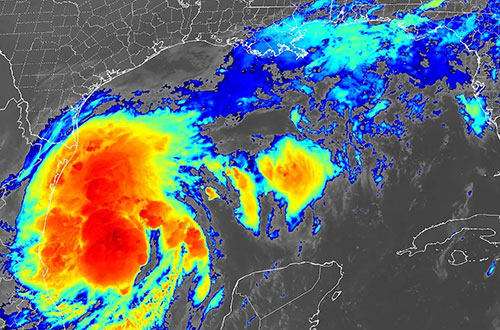
Hurricanes and tropical systems can bring strong winds and rain. Here’s how you can prepare:
1. Invest in a weather radio
Have a way to get updates if cell services or power lines go down. Many weather radios now work as backup power banks with ports to plug in your phone and with solar and crank handles to recharge the battery.
2. Add your agent to your phone contacts
Put your agent and insurance company in the contact list on your phone. Make copies of important documents, such as your policy’s declaration page and auto and health ID cards and email them to yourself so you can get to them if you have to evacuate.
3. Prepare your home
- Remove dead tree limbs and branches that hang over your house.
- Check for items that can become windborne, such as yard furniture or trampolines, and tie them down or bring them inside.
- Clean gutters to let the water drain faster.
- Close doors to keep your roof on.
- If you plan on using a generator if the power goes out, make sure you have enough fuel. If you haven’t used it in a while, make sure it starts.
4. Be ready to evacuate
- Pack a bag with your insurance policies, home inventory, health plan cards, medication, water, and food in case you need to leave your house.
- If you have pets, make sure you have their vaccination records, food, water, leash, collar, tags, and crate.
- Keep your gas tank full.
- Plan an evacuation and a backup evacuation route.
- Let family members know where you’ll meet if you need to evacuate.
5. Listen to the news
Follow any evacuation orders from your local government.
Learn more
- How to prepare for a hurricane (video)
- Before the storm
- Home inventory (video)
- How to safely use a portable generator (video)
- How to prepare for hurricane season (video)
- Texas Division of Emergency Management (TDEM) Disaster information page
August 22, 2024
Am I covered by insurance when I rent a scooter?

Before you rent or jump on one of those cute zippy scooters, remember these tips.
- Scooter rental companies don’t cover you in case of accident or injury. Rental agreements give you all liability. That means you could be paying for any damages and injuries, not just your own.
- Home policies usually don’t cover damage from motorized vehicles and your auto policy probably won’t extend to an electric scooter.
- Don’t forget to read your scooter rental agreement before you ride. And to be safe, wear a helmet.
So, what covers scooter accidents? Your health insurance probably will cover your injuries—though it won’t cover anyone in your path.
Learn more
- Electric scooter insurance: What to know before you hop on
- Does insurance cover ATVs and golf carts?
- Do I need insurance for a motorcycle or moped?
August 20, 2024
Fraud Unit investigator helps stop human smuggling ring

While working out of the FBI field office in South Texas, Fraud Unit investigator Sgt. Chris helped the federal agency uncover a $2 million human smuggling operation.
Sgt. Chris was investigating an insurance fraud scam when he came across Luis Enrique Moctezuma-Acosta and Scarlett Fuentes-Gavarrete. Moctezuma-Acosta is a Mexican National and Fuentes-Gavarrete is a Honduran National living illegally in Mission near the Texas-Mexico border.
"As we followed the money and did interviews, we found these people that were buying properties – and then found out what they did for a living," Sgt. Chris said.
Moctezuma-Acosta and Fuentes-Gavarrette could afford to buy properties thanks to money raised running a human smuggling ring. Their network, reaching from Honduras to Boston, smuggled 2,400 people into the U.S.
Once people were smuggled across the Rio Grande into the U.S., the self-titled “LEMA” smuggling organization used several methods to circumvent U.S. Border Patrol checkpoints, including tractor trailers, commercial planes, and guides to walk travelers around the checkpoints. They laundered their proceeds through businesses they created, including a used car lot.
"We paused the primary case,” Sgt. Chris said, “and worked on this case to get these people in custody and made sure that everybody was safe.”
In March, Moctezuma-Acosta and Fuentes-Gavarrette pleaded guilty to money laundering and conspiracy charges. In July, they were each sentenced to 20 years in federal prison. They face deportation after they're released.
Authorities seized over $1.5 million in cash and $2.7 million in luxury vehicles, jewelry, and property. Two other family members pleaded guilty to money laundering charges. The investigation identified one immigrant who died while being smuggled.
Sgt. Chris said of the couple: "I’m glad they’re off the street. They had no concept of the harm they were doing."
Sgt. Chris joined TDI in 2016 after 30 years in law enforcement. Chris works closely with the FBI combatting financial crimes and insurance fraud.
"I love what I do," he said. “I like helping my community and people who can’t help themselves.”
Learn more
- Las compañías de seguros y los agentes deben responsabilizarse por sus acciones (video subtitulado en Español)
- Holding insurance companies and agents accountable (video)
- Insurance fraud guide
- Report fraud
August 5, 2024
Get a free clue about your insurance claims history
Wondering why you’re paying more for home or auto coverage than your neighbor?
It might have to do with past insurance claims.
The good news is that you can get details for free by asking for a report.
What’s the report? It’s the Comprehensive Loss Underwriting Exchange or CLUE report. It shows claims filed for homes and cars for the past seven years. Most insurance companies report information based on filed claims, including:
- Date of loss.
- Loss type.
- Amount paid on claim.
How do I get a report? You can get a report on any property you own by contacting LexisNexis. Click on “Request a Consumer Disclosure Report.” You can contact LexisNexis to dispute incorrect information in the report or to add an explanation.
If you’re buying a home or car, you can ask the current owner for the report.
Learn more
- How to get a CLUE about your claims history
- Buying a new home? What you need to know about insurance. (video)
August 1, 2024
Tips to avoid fraudulent insurance sales scams

Avoid fraudulent sales scams with these tips:
Beware of unexpected calls. If you didn’t call them first, the salesperson probably found your information on a mailing list.
Don’t buy over the phone. The risk of fraud is greater if you buy insurance over the phone or online. Hang up on callers if something doesn’t sound or feel right.
Never be rushed. Be wary of offers for a “last-chance deal" or other appeals to make a quick decision. Take your time. If someone calls, emails, or mails you an offer, decline it. Next, look it up online to see if it’s true and the company is real.
Watch for scam artists. Be wary of people who say they are from Medicare, Social Security, or any government agency. Medicare doesn’t make sales calls. Also, health plans and annuities are never offered at a discount or sale price.
Keep all documents and take notes. Keep any paperwork you get from an insurance company. Write down the names of people you talk to and details of conversations you have.
Verify agents and companies. Before you buy insurance, call TDI to make sure the agent and company are licensed. We can also tell you a company’s financial rating. Call our Help Line at 800-252-3439. You also can call us to report insurance fraud or ask questions about insurance.
A TDI financial crime investigator helped nab a fraudulent radio host who lured people into signing over their annuities. Hear more on our latest Texas Insurance Podcast.
Learn more
- 5 ways to stop insurance agent fraud (video)
- How to avoid scams aimed at older adults
- How to avoid contracting scams
- Buying a house? Beware of seller impersonation fraud.
- Insurance fraud guide
July 31, 2024
Forensic accountant follows the money to help victims

Vivian says her job as a financial analyst performing forensic accounting is like piecing together a puzzle. Typically, the pieces are bank statements, business records, and other official documents.
It’s Vivian’s challenge to make the pieces fit.
Recently, Vivian helped TDI's Fraud Unit stop two doctors – Desi and Deno Barroga of Dallas – who were overprescribing opioids and falsely billing health plans.
Fraud Unit investigators got Vivian subpoenas for the records she needed. Next, she combed through the doctors' personal and business bank records to trace the $45 million they billed and the $9 million they were paid.
"It's my job to find where that money is and where it's going," Vivian said
TDI's investigators used what Vivian found to help federal agencies, including the FBI, build a criminal case. The doctors pleaded guilty and face up to 10 years in prison.
Aside from stopping criminals, the Fraud Unit also wants to get restitution for victims. Courts can order criminals to pay restitution.
Vivian said: "One way agencies can do that is by seizing their assets. To be able to seize those assets, we have to prove that they were bought with dirty money.”
Before joining TDI, Vivian traced properties and assets for an accounting firm. Her college degree was in finance with an emphasis on business evaluations.
She loves taking rows and columns of numbers on a spreadsheet and making sense of them.
"That's what I love about this job: making sense of the numbers for everyone else. It's my contribution to the team effort."
Learn more
July 25, 2024
Fraud Unit warns local officials about scams
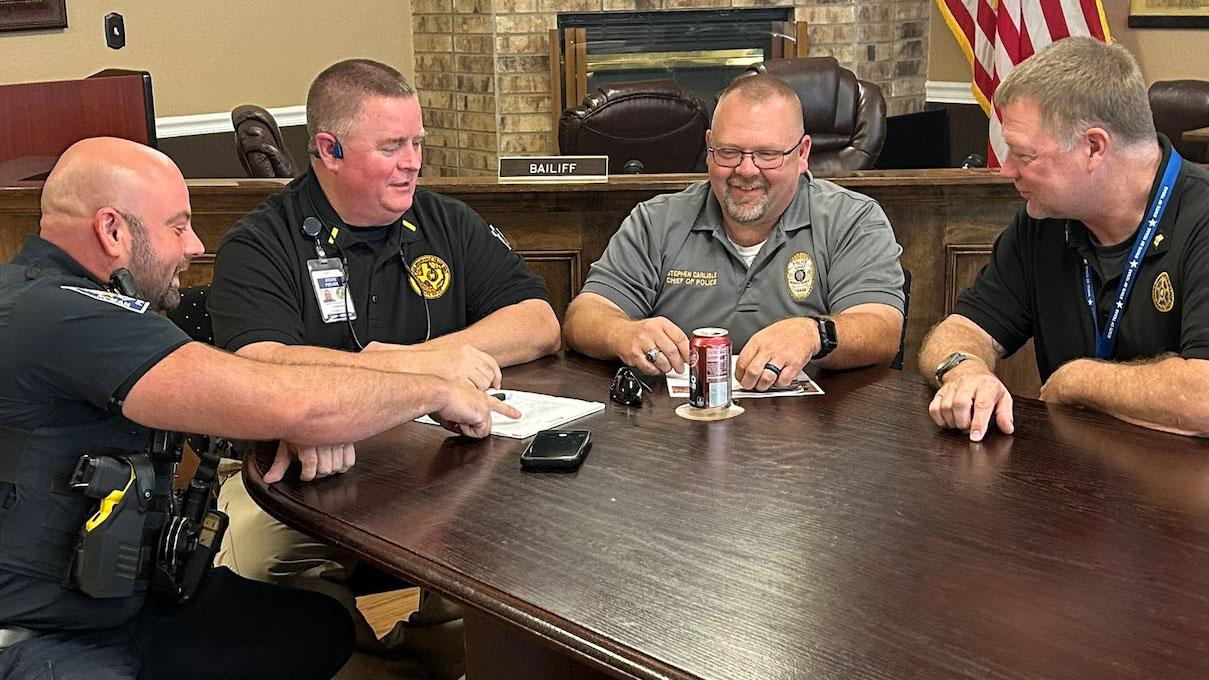
Members of TDI Fraud Unit’s Catastrophe Response Team met with Roman Forest Police Department staff.
Out-of-town scam artists are often the first to knock on doors after disasters. TDI gives tips to avoid scams, like hiring local contractors, getting written bids, and checking references.
Our toolkit for preventing fraud has tips and flyers that city and county officials can use to warn residents about contractor fraud.
After Hurricane Beryl, the TDI Fraud Unit’s Catastrophe Response Team visited city and county officials to talk about the toolkit and fraud prevention.
“Unfortunately, after a big storm we see an influx of criminal activity from scam artists looking to profit from people who are trying to start the recovery process,” said Chris Davis, who leads the Fraud Unit.
To report suspected fraud, call our Help Line at 800-252-3439 or visit our fraud page.
Learn more
- Preventing fraud after a storm: a toolkit for city and county officials
- How to avoid contracting scams
- Do you know the signs of a contracting scam?
July 10, 2024
Know the dangers of carbon monoxide poisoning

Cell phones and other devices are a big help in a weather emergency. They're a quick way to check in with friends and relatives or call for help. But if the power’s out and your battery is low, be careful where you recharge your devices.
It may be tempting to use a running car or truck to charge your phone, but never do that when your vehicle is in a garage. Most engines put out carbon monoxide, a deadly gas you can’t see or smell.
A running car can create enough carbon monoxide build-up to kill you, even if the garage door is open. Wind can blow carbon monoxide back into your garage, or even inside your house if doors, windows, or vents are open.
If you can do so safely, move your vehicle out of the garage and away from your home. Then it’s OK to start the engine and recharge your phones and devices in the vehicle.
Be careful when you use generators and other sources of carbon monoxide as well.
Learn more
Carbon monoxide detectors save lives (video)
June 13, 2024
Lighting a fire? Heed these Texas safety tips.
Remember to stay safe every time you light an outdoor fire.
Some Texas tips:
- Check with your city and county about burn bans and local rules for outdoor fires. The Texas A&M Forest Service’s map lists county burn bans.
- Statewide, Texas limits outdoor burning to campfires, bonfires, fire pits, cooking fires—and household trash fires on your home property and only if you don’t have trash pickup.
- Avoid starting an outdoor burn on dry, windy days.
- Always stay by your fire until it’s out.
- Keep water and a shovel and rake handy to douse the fire if it starts to spread.
Listen: The state fire marshal, Debra Knight, talks about summer fire safety on the Texas Insurance podcast.
Learn more
- Outdoor burning: What to know before you light the match
- Wildfire risks: Projects to help you protect your home
- Texas Commission on Environmental Quality: Outdoor Burning in Texas
- Texas A&M Forest Service: Prevent Wildfire| video
January 11, 2024
Shopping and saving on Texas auto insurance

Your auto insurance is up for renewal and you want to lower your costs.
Here are some ways to reduce your premium:
- Seek discounts. You may be missing available discounts. Ask your insurance company about discounts for having a student driver with good grades—or for drivers in your family being accident free. Discounts can also apply if you’re insuring your home with the same company.
- Choose a higher deductible. You could reduce your premium by paying a higher deductible if you need to make a claim. Keep in mind this kind of price cut up front could mean you have to pay more out of pocket if you get into a wreck.
- Review your coverage. The various coverages in your policy add up to your total premium.
If you have collision coverage on an old car that's paid off, make sure the car’s value is worth more than what you’re paying for that coverage. And tell your insurance company if you’re working from home and no longer driving to work. They might offer a pay-per-mile policy that would save you money.
Hear more about shopping for auto insurance in the latest Texas Insurance Podcast.
Learn more
- How are your auto and homeowners insurance costs calculated?
- Lower your car insurance rates: Tips for saving money
- How you drive could save you money on car insurance
- Ask for discounts to lower your auto insurance premium amount
- What to know about deductibles
November 29, 2023
Five reasons to always lock your car or truck
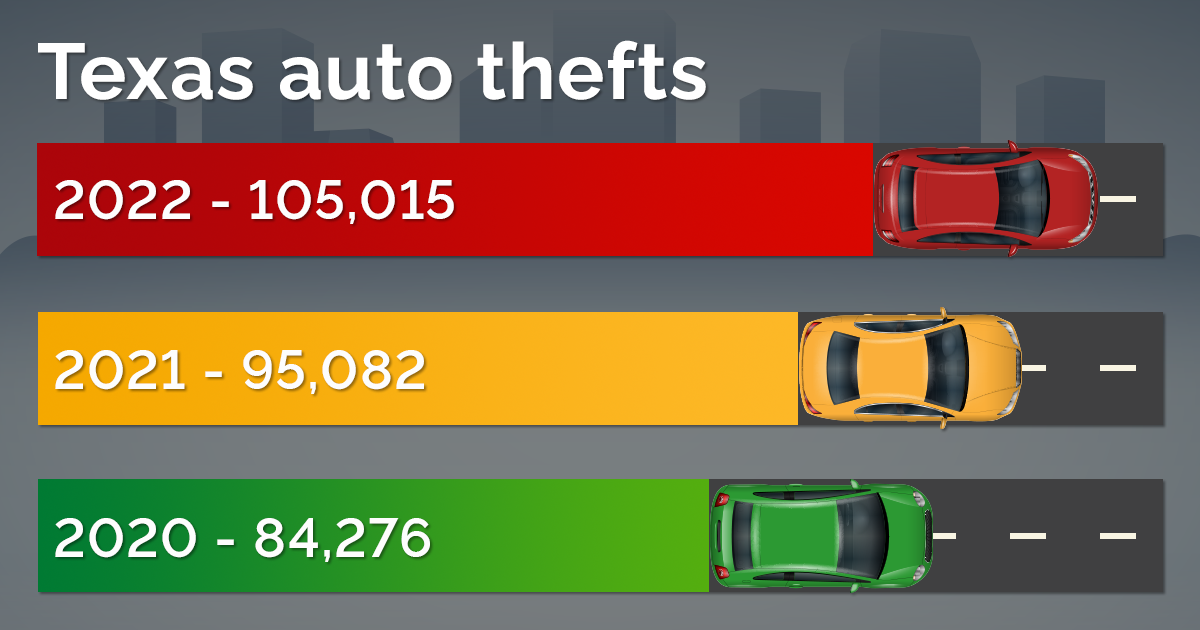
Locking up your car or truck might seem a little thing. But always locking up protects you and your property.
Here’s why to lock up:
- Theft happens a lot. In the U.S., a car is stolen once every 32 seconds. And car theft went up 7% in 2022, according to the National Insurance Crime Bureau.
- Theft costs money. The average loss per Texas motor vehicle theft topped $12,000 in 2020.
- Leave your keys, risk your ride. Driver error, such as keys left in a vehicle or leaving it unlocked, is a factor in about half of all auto thefts. In Texas in 2017 through 2019, more than 17,000 stolen vehicles involved keys left in the car or truck.
- Burglaries happen fast. A criminal can grab valuables in seconds. The crime that police call “sliding” targets unlocked cars briefly parked at stores such as gas stations. A thief sneaks up one side of the vehicle, opens a door, slides in, takes items, and slips away.
- Lock up as soon as you’re in your car. Car or truck doors may automatically lock once you’re driving. But locking up as soon as you get in the driver’s seat better protects you from surprise break-ins.
Learn more
Auto theft and insurance: How to protect your ride
Car burglaries and break ins are increasing. Here's how to protect your car (podcast)
November 2, 2023
Shopping tips for health insurance

Are you ready to pick a new health insurance plan? Here are shopping tips to help you make the right decision:
- When you find a plan you like, make sure it offers the care and treatment benefits you need.
- Review all costs including your monthly premium, deductible, and copayments.
- Check if your current doctors are in-network with the plan.
- Make sure the plan covers your prescription medicines.
- If a plan looks too good to be true, it probably is. Keep shopping. Shopping on a trusted website like Healthcare.gov will help you see all your options and avoid scams.
- Be wary of anyone pressuring you to commit to a plan right away. Remember, there are no one-day sales in health insurance. Take your time. Buy when you're ready. The open enrollment period starts Nov. 1 and ends Jan. 15.
Hear more on shopping smart for health coverage in the latest This Is TDI podcast.
Learn more
- Before you buy a health plan (video)
- Find the health plan that fits your needs (video)
- Health plan shopping checklist
- Need health insurance? How to find a new health plan now.
- Don't get scammed shopping for a health plan
October 12, 2023
Prevent cooking fires, protect your home
Cooking fires are the No. 1 cause of home fires.
So do right in your kitchen and protect your home.
Cooking safety tips:
- Once you start cooking, keep your eyes on the sizzle. Inattention can lead to flames you don’t want.
- Try not to leave the kitchen while cooking — and never ditch a hot stovetop. If you stray from your oven, set a timer so you’re back before dinner chars.
- If children are afoot, keep them 3 feet away from your cooking zone, indoors or out. Enforce the zone for your pets too.
Get more tips in our cooking safety podcast featuring Kelly Ransdell of the National Fire Protection Association. The association marks National Fire Prevention Week each October.
Learn more
- How to prevent kitchen fires with our cooking safety tips
- Is your kitchen too hot to handle? (video)
- How to make a home fire escape plan (video)
September 7, 2023
How to shop for home insurance

Are you wanting to lower your home insurance costs?
Consider shopping for a new policy. Plan ahead by starting a month or more before your current policy expires.
Shopping tips:
- Ask your agent if a premium increase or other changes in your policy are in the works. This helps you make comparisons.
- Consider a higher deductible, which could reduce your premium.
You can hear more on shopping for home insurance in the Texas Insurance Podcast.
Learn more
- How much home insurance do you need? (video)
- Ways to save money on home insurance
- Lower your home insurance cost by asking for discounts
- How to shop smart for home insurance
- FAQ: Homeowners insurance, claims, saving money, and more
August 3, 2023
Coastal Texans can turn to TWIA for hail, windstorm coverage
In August 1970, Hurricane Celia slammed ashore at Corpus Christi, killing and injuring residents and leaving previously unheard-of hundreds of millions of dollars in damage.
In response to insurance companies increasing rates or no longer selling wind and hail coverage along the Gulf Coast, state lawmakers in 1971 launched the Texas Windstorm Insurance Association (TWIA).
TWIA continues to serve as the wind and hail insurer of last resort for property owners in Texas’ 14 coastal counties and parts of Harris County. TWIA currently backs more than 237,000 policies.
If you live in a coastal community, read your homeowners policy to see if it covers hail and wind damage. If not, contact your insurance agent to see what options you have for coverage.
Eric Casas, TWIA ombudsman at the Texas Department of Insurance, cautions against assuming you can go without wind or hail coverage just because your home hasn’t been hit by a terrible storm. And if you have a mortgage, your lender will likely require you to have windstorm coverage.
Hear more tips about protecting your home from hail and wind damage in this episode of the Texas Insurance Podcast.
Learn more
- What is windstorm insurance?
- Texas Windstorm Insurance Association
- Homeowners, flood, and wind and hail policies: Know how they work
- What you need to know about windstorm inspections
July 6, 2023
Have an insurance complaint? Tips to understand the complaint process
Have a problem with your insurance company, agent, or adjuster?
You might want to file a complaint with the Texas Department of Insurance (TDI).
Before you consider a complaint, talk to your insurance agent or company about the problem you’re having. Sometimes conversations clear the air, delivering satisfaction.
You can file a complaint with TDI about insurance companies, agents, and adjusters. We can help you get started.
After you file a complaint, our experts will reach out to the insurance company to get more information. Last year, we returned $56 million to consumers in refunds and claim payments.
Before you file a complaint, understand that there are some things we can’t do:
- We can’t make a company pay a claim unless the failure to pay violates a law or the terms of your policy.
- We can’t help with complaints against another person’s insurance company. For instance, we probably won’t be able to help you if you’re in an accident and the other driver’s insurance company won’t accept liability.
- We can’t decide who was at fault in an accident.
Questions? Call our Help Line at 800-252-3439 to understand your rights. For more on filing a complaint, watch this Texas Insurance podcast.
View podcast Q&A: How to get help with an insurance complaint
Learn more
- Can TDI help with my complaint? (video)
- What if my insurance isn't paying enough?
- Not sure who to call with your question or complaint? We can help.
May 2, 2023
Plan to be safe before a hurricane hits Texas
The Texas Division of Emergency Management (TDEM) regularly leads the state’s response to natural disasters including summer storms and hurricanes.
It also wants Texans to plan ahead to stay safe.
For instance, it’s a good idea to keep emergency “go kits”— basic disaster supplies including food, water, medicine, clothes, and other vital items — in your home, office, and car.
Also wise: Settle with family members ahead of time where you’re going to go if a bad storm hits. And if you think you might need flood insurance, shop before you hear a scary weather forecast. It takes 30 days for a flood policy to take effect.
View podcast Q&A: How to prepare for hurricane season
Learn more
- Hurricane season: How to prepare your home and property
- Flood insurance: Why you need a policy
- Before the storm
- Texas Ready disaster supply checklist
April 25, 2023
Dog burned in fire now helps state investigate fires

Harley was destined to be a K-9 arson investigator with the State Fire Marshal’s Office. When she was just 3 weeks old, a heat lamp burst in her kennel and started a fire. Harley's mother barked for help until the owners came to rescue her puppies.
The owners didn’t notice that Harley was stuck between a kennel and a fence until the fire was out. She was the only puppy hurt in the fire.
While Harley was getting treatment for her burns, the owners reached out to Tommy, a lieutenant with the Fire Marshal’s Office, about adopting the German shepherd as a family pet. His daughter and the owner’s daughter were friends.
Tommy said Harley was a handful as a puppy.
“She was like: Here, throw this toy; here, throw it again. She was always wanting to play,“ Tommy said. “She was always wanting to work.”
Harley joined Tommy’s other dog, Clear, on the family’s 165-acre ranch in Central Texas. Clear was Tommy’s K-9 partner, helping him investigate fires with the Fire Marshal’s Office. Clear’s job was to sniff out accelerants to learn what caused a fire.
As Tommy got to know Harley, he realized she had some qualities that would make her a good K-9 partner.
“When you can leave a toy in the pasture for a week, and she can go search for 15 minutes and find it, you think: Dog, you might have something here,” Tommy said.
When Harley was 2 years old, and Clear was 11 and ready to retire, Tommy proposed the idea to his captain. After a lengthy process, Harley was approved to start training in 2021. Tommy and Harley were certified as an accelerant detection K-9 team three months later.
K-9 handlers across the state have been impressed with Harley’s “nose on source” indications.
“She puts her nose on a source and lays down as flat as she can and holds still, waiting for a command to come get her toy,” said Tommy. “She really gets into her work.”
As for the kennel fire, Harley fully recovered from her burns and probably doesn’t remember it.
“She’s done with that,“ said Tommy. “She has other things to do.”
April 6, 2023
Prepare your home and family for spring Texas storms
A spring hurricane is unlikely. The latest one, Hurricane Alma, fizzled out near Cuba in May 1970.
Still, spring rains, hail, wind and even tornadoes can threaten homes, cars, and lives.
Some storm preparation tips:
- Paul Yura of the National Weather Service suggests you keep three days of food, water and other supplies, including pet food, on hand.
- Also, Yura says, decide well ahead of time where your family will go if dangerous weather approaches.
- Count on weather alerts on your cell phone. But, Yura says, also keep a weather radio handy, with fresh batteries. Sometimes the phone runs out of juice.
View podcast Q&A: How to prepare for spring storms
Learn more
- Texas summer storm safety
- 5 tips for driving in windy conditions
- Are you ready for a disaster?
- Tips to avoid a tornado: Follow weather reports
March 3, 2023
Insurance fraud could happen to you
Do you think insurance fraud rarely happens or mostly on TV dramas?
Think again.
Last year, the Fraud Unit at the Texas Department of Insurance (TDI) got more than 16,000 reports of possible fraud. The unit, which has officers around the state, worked on nearly 400 criminal investigations. It currently has more than 170 ongoing investigations in 40 Texas counties.
Tips to protect yourself from fraud:
- When shopping for insurance, check that the agent you’re working with has a state license. You can call the TDI Help Line at 800-252-3439 or look up the agent on TDI’s website, www.tdi.texas.gov/agent/agent-lookup.html.
- Be wary of buying a policy from anyone who only accepts cash or who wants to meet you only at your home or in a parking lot.
- If someone tells you that you must act today or you'll lose the offer, that's usually a bad sign. Legitimate insurance plans won’t have purchase deadlines. Don't be rushed when shopping for insurance.
- After you buy a policy, call the insurance company to confirm that the policy is in your name.
- If you’re asked to cash in an annuity or some other life insurance policy to buy a different annuity or policy, don't take the bait. Annuities and life insurance products are generally worth more the longer you hold onto them.
Listen to more on stopping insurance fraud in Texas in The Texas Insurance Podcast, featuring Chris Davis of TDI’s Fraud Unit.
View podcast Q&A: What’s insurance fraud?
Learn more
- Fraud investigators: How TDI solves insurance crimes (video)
- Types of fraud
- Insurance fraud guide
- Report fraud
January 5, 2023
Texans, especially older adults, should beware of phone, online scams
Your phone rings, you answer, and someone with a friendly voice asks for your bank account or Social Security number.
Hang up. It’s probably a scam.
Fraudsters tend to target older people, who are often more trusting and vulnerable. Older people are also more likely to talk to someone they don’t know.
In 2021, more than 6,700 Texans over age 60 reported losing more than $159 million to fraud.
Common scams:
- A caller offers to fix a non-existent computer problem or to renew a fraudulent software or security subscription. The caller might even transfer you to fake “customer service” staff.
- A caller pretending to be a grandchild calling from another country and needing hundreds of dollars fast. Once money gets sent outside the United States, it’s very hard to recover.
- A call or email that says you’ve won a sweepstakes or lottery. The catch: You need to pay thousands of dollars to get the bigger prize.
- Someone on the phone or sending an email adopts a fake identity to gain affection and confidence. The scammer builds a relationship with the victim to steal their money.
Learn more
- 5 ways to stop insurance agent fraud (video)
- How to avoid scams aimed at older adults
- How a radio show host defrauded investors of millions (video)