
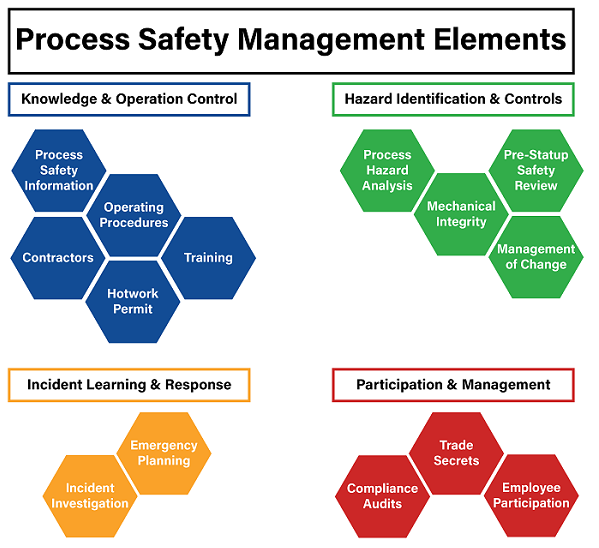
Process Safety Management (PSM) is a system that helps companies handle dangerous chemicals safely. It’s designed to prevent serious accidents like explosions, fires, and toxic releases by making sure the equipment is working right, and workers know what to do.
But today, the risk of these accidents is growing. According to a recent industry report, 49% of companies say that losing experienced workers is increasing the danger. Plus, many chemical plants and factories are getting old, making problems more likely. It’s not just about having good intentions — 66% of companies say there’s a big gap between their safety goals and what’s really happening.
What PSM does
PSM helps identify risks before something bad happens. It focuses on:
- Preventing accidents by fixing problems early.
- Training workers the right way.
- Planning for emergencies.
- Keeping good records to track safety.
OSHA’s role in PSM
The Occupational Safety and Health Administration (OSHA) created the PSM standard to protect workers in industries that deal with dangerous chemicals. If your company works with large amounts of certain hazardous substances, you must follow these safety rules. PSM requirements only apply to employers that use specific chemicals in quantities that meet or exceed established thresholds. OSHA provides a list of these chemicals and their threshold quantities in its regulations. (See 29 CFR 1910.119, Appendix A).
Here are the key steps involved in PSM — made simple:
1 Make a list of all hazardous chemicals.
Start by knowing what chemicals are on site and how much of each you have. This list helps determine the risks and whether OSHA’s PSM rule applies to your business.
2 Do a Process Hazard Analysis (PHA).
This is a deep look at what might go wrong — such as equipment failures or mistakes — and how to prevent them. Include employees with different roles and experience in this process.
3 Write clear operating procedures.
Create step-by-step guides for safely running equipment and handling chemicals. These procedures should cover regular operations, emergency shutdowns, and special tasks like maintenance. If work involves heat or sparks — such as welding or cutting — use a Hot Work Permit system to control fire hazards and keep everyone safe. Update procedures whenever changes are made.
4 Train employees and contractors regularly.
Teach your team – including any contractors on site -- how to do their jobs safely. As of now, 41% of companies say employee competency is a major challenge — which means ongoing training is more important than ever. Ensure contractors are properly trained and held to the same safety standards as your full-time staff.
5 Maintain equipment and perform pre-startup safety reviews.
Regular checks help prevent failures. Even though most companies try to stay on top of this, only 23% complete all safety-critical maintenance on time, showing there’s lots of room for improvement. Always perform a pre-startup safety review to ensure safety standards are met, procedures are in place, and workers are trained for the change.
6 Manage changes carefully.
Before making any changes to equipment, chemicals, or processes, analyze the risks. This is called Management of Change (MOC) and it prevents new hazards from sneaking in.
7 Plan for emergencies.
Have a response plan in case something goes wrong. Train your staff to respond quickly and safely, and practice drills often.
8 Investigate every incident.
Even near misses can teach important lessons. Learn what happened, why it happened, and how to prevent it in the future.
9 Keep accurate records.
Track all safety activities, such as training, inspections, and equipment fixes. Good documentation proves you’re doing the right things and helps you spot areas for improvement.
10 Audit your program regularly.
Every few years, take a fresh look at your whole PSM system. Get feedback, review reports, and make changes as needed. Only 9% of companies feel fully confident that they’re aware of all major risks — regular audits can help raise that number.
Today’s challenges — from older plants to fewer experienced workers — make PSM more important than ever. And the benefits go beyond safety. Improving your PSM program can also boost production uptime, cut costs, and keep your company competitive.
For more information on workplace safety or upcoming training classes, visit www.txsafetyatwork@tdi.texas.gov, email us at safetytraining@tdi.texas.gov, or call 800-252-7031, option 2.