

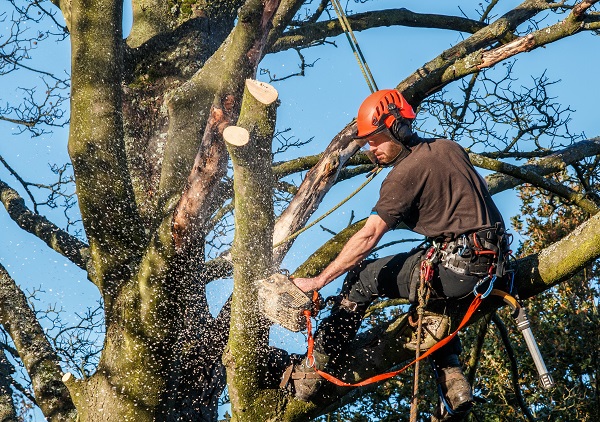
Tree trimming and removal ranks among the most hazardous jobs in construction and landscaping. Arborists and tree crews often work at heights, on slippery or uneven ground, and around heavy limbs, power lines, and powerful cutting tools — sometimes in bad weather or emergency situations. These hazards increase the risk of falls, electrical contact, struck‑by incidents, and chainsaw injuries.
With proper planning, training, and equipment, employers and crews can control many of these hazards and reduce fatal and life‑changing injuries. These tips can help tree service employers and workers create safer job sites and send workers home safely at the end of the day.
1 Conduct a job briefing and site survey before any work.
Walk the site as a team and identify overhead power lines, dead or cracked limbs, tree lean, nearby structures or traffic, and unstable or wet ground. Check the tree’s health and structure to determine if it can support climbing, rigging, or cutting loads. Call in a qualified arborist or line-clearance tree trimmer for complex, storm-damaged, or power-line-adjacent trees. Review the work plan, felling direction, drop zones, and communication signals so the crew understands their roles and the hazards.
2 Stay at least 10 feet from power lines and treat them as energized.
Always assume overhead lines carry current. Keep people, ladders, tools, and branches at least 10 feet away, increasing the distance for higher-voltage lines. Contact the utility company to de-energize any ground lines or install insulating covers before working nearby. Only qualified line-clearance tree workers should perform tasks within the minimum approach distance. Train workers to carry ladders horizontally, watch for hidden conductors in branches, and avoid standing near grounding points or conductive equipment.
3 Use proper fall protection and safe climbing or lifting techniques.
Choose the safest way to access the work area — whether that means climbing, using an aerial lift, or another type of equipment. When climbing, make sure workers use saddles, harnesses, and climbing lines according to manufacturer instructions and industry standards. Keep at least one secure tie-in point at all times and avoid disconnecting while repositioning. Select strong, healthy limbs that can support both climbing and rigging forces. When using an aerial lift, tie off to the designated anchor point, keep both feet on the platform, and never stand on the rails or use ladders or planks to gain extra height.
4 Set up and enforce drop zones on the ground.
Mark a drop zone that extends at least twice the expected height of the tree or limb. Keep non-essential workers and bystanders out of the area while workers cut or lower branches. Assign a spotter or ground leader to watch the work area, keep in contact with climbers or lift operators, and control access — especially near streets or sidewalks. Use clear voice commands, hand signals, or radios so ground workers know when cutting starts, when limbs will fall, and when it is safe to return to the area.
5 Plan felling direction and retreat paths before making the first cut.
Check the tree’s lean, crown weight, wind, and nearby obstacles before you start cutting. Use this information to choose a safe direction for the fall. Do not fell trees toward other trees, structures, or traffic. Clear at least one escape path that angles back and away from the fall line. This path gives the sawyer and helpers a safe way to move once the tree begins to fall. Train chainsaw operators in proper notching, hinge wood, and back-cut techniques. Keep ground workers well beyond the height of the tree.
6 Inspect and maintain chainsaws, chippers, and other equipment.
Inspect saws, ropes, saddles, carabiners, and lift equipment before each use. Remove damaged or worn items from service according to manufacturer instructions. Keep chains sharp and maintain proper chain tension. Follow safe starting and cutting practices. Maintain firm footing and a two-handed grip on the chainsaw while cutting. Use guards and emergency stops on wood chippers and stump grinders, and follow safe feeding techniques. Train workers to stay clear of the equipment’s in-feed chute and never push material with hands or feet.
7 Provide and use task-specific personal protective equipment (PPE) on every job.
Provide workers with the PPE they need for each task. This may include hard hats, eye and face protection, hearing protection, cut-resistant leg protection, gloves, and high-visibility clothing. Require climbers and aerial lift operators to use approved fall-protection systems. Make sure boots have slip-resistant soles and good ankle support for uneven or wet ground. Train workers to fit, inspect, clean, and replace PPE properly. Include PPE requirements in the company’s written safety and health program.
8 Train for emergencies and changing weather or traffic conditions.
Create written procedures for tree or aerial lift rescues, electrical contact, severe bleeding, and equipment entanglements. Practice mock drills so workers can respond quickly in an emergency. Watch weather conditions and stop tree work during high winds, lightning, or storms. These conditions can cause branches or entire trees to fall without warning. For roadside or municipal work, use cones, signs, and flaggers when needed. Train workers to recognize heat-related illness. Adjust work-rest schedules and encourage workers to drink water during extreme heat.
For more tips on preventing tree trimming and removal injuries, download DWC’s Tree Trimming and Removal Safety Fact Sheet (English/Spanish), or review OSHA’s tree trimming guidelines at Tree Care Industry Hazards and Solutions. For more information on workplace safety and health training, visit www.txsafetyatwork.com or email SafetyTraining@tdi.texas.gov.